

by Jess Hoffman
Pippin is a musical theater classic, and it’s hard to explain why. Don’t get me wrong, I love it–I find the score irresistible, the main character lovable, and the entire concept quite charming–but it’s hard to say exactly why. The plot is nonsensical and the titular character is a disaster of a man. And yet Pippin continues to be staged, watched, and loved over and over again. Currently, it is being staged at the Schenectady Light Opera Company, with a dynamic cast, a live orchestra, and a (woefully uncredited) cameo from very cute little dog.
For those unfamiliar, Pippin is a strange and metatheatrical play within a play, where a vaudevillian performance troupe tells the story of the eldest son of Charlemagne. The fourth wall is broken, the layers of story become blurred, and the inciting incident of Act 1 is undone in the beginning of Act 2 so the play can go in an entirely different direction. As I said, it is a nonsensical plot. But as I struggled to understand the allure of Pippin, I came up with three reasons why I think audiences are so enraptured with the odd musical. The first is the spectacle of it: the portrayal of a traveling theater troupe, however it is staged, demands bright, vivacious costumes and splashy choreography for its many upbeat musical numbers. Which brings me to the second reason: Pippin’s music is so lively and catchy, and as long as it is performed by sufficiently talented musicians, it is easy to get swept away by Stephen Schwartz’s score. And finally, there is the raw energy of Pippin; it is a play about a naively optimistic dreamer that is, again, performed by a vaudevillian troupe of performers who, from start to finish, promise a magical story to be performed by a multi-talented troupe. It’s easy to get swept away in the lively theatrics of Pippin so much so that you don’t much worry about it making sense, as long as it is performed by people who understand how to stage it well. SLOC’s production is a mixed bag, but its high points outweigh the missteps and the result is an imperfect but thoroughly enjoyable show.
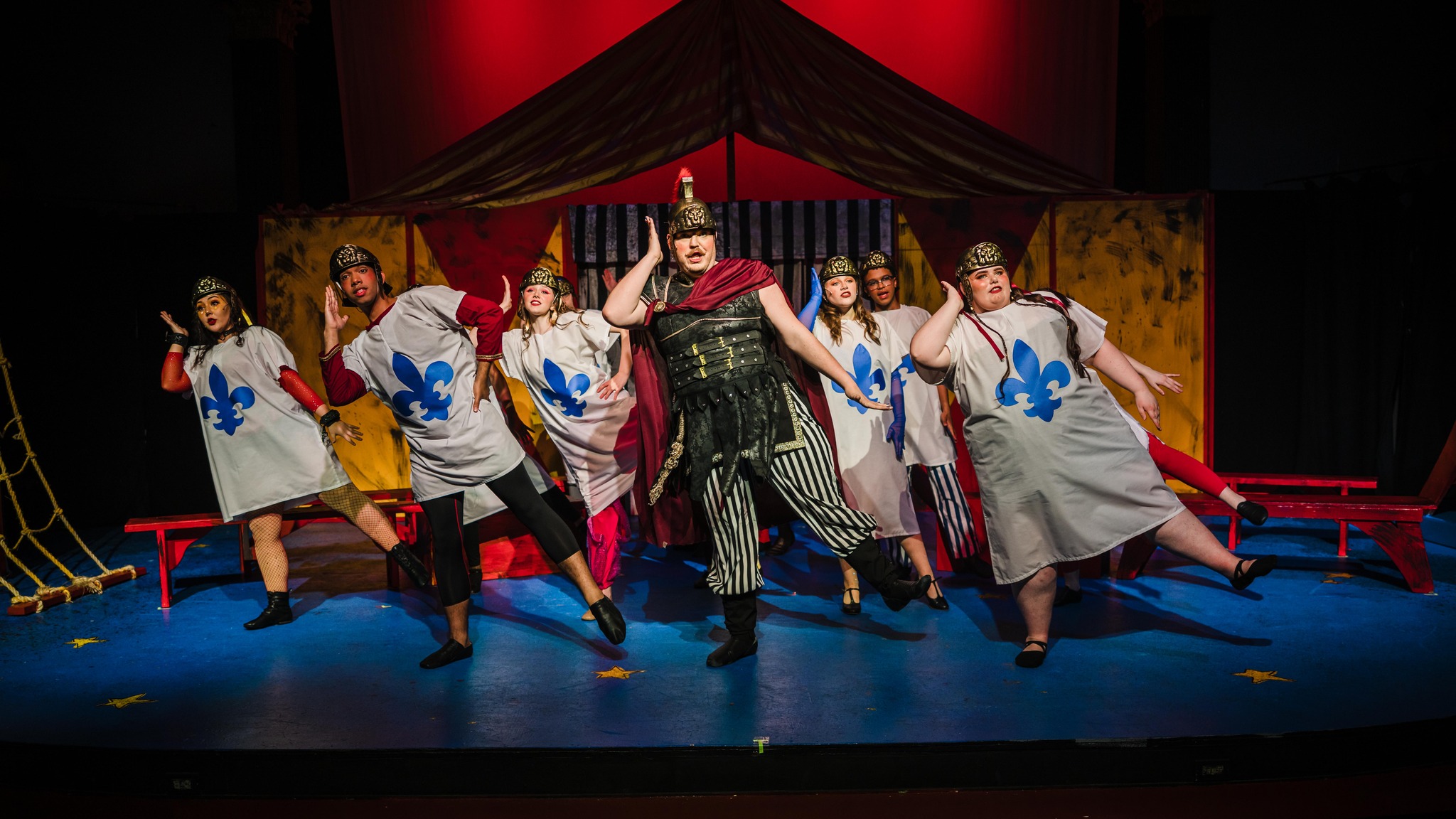
Some members of SLOC’s cast and crew certainly understand what makes Pippin an enjoyable play, first and foremost among them are choreographer Mahogany Akita and dance captain Mani Velvet McCalmon. Akita and McCalmon have done an excellent job of creating perfectly unified dance numbers out of a company of very diverse ages and body types. Costume designers Sean T. Baldwin and Cheryl Zatt add to the spectacle with some striking but somewhat slapdash costumes. None of the costumes look bad individually, but whereas the choreography creates a unified aesthetic of the company as a whole, the costumes seem to be trying to do the opposite. Perhaps this is by design, but the costumes don’t really contrast enough to create a contrasting aesthetic either. It looks more like Baldwin and Zatt found all the best vaudevillian costume pieces in SLOC’s costume room and started handing them out at random.
The cast of SLOC’s production has an excellent handle on Schwartz’s music, and it is performed beautifully by all. The stand-out singers by far are McCalmon as the Lead Player and Alex Walley as Pippin. Walley’s wide range as both a singer and an actor are apparent in this production: he is overzealous as a would-be soldier, sensual in his romantic dalliances, and thoroughly despondent in his adolescent despair. McCalmon leads the show with impressive stage presence and a bit of the sultriness associated with many vaudevillian acts, but their acting range isn’t quite what one might expect from a leading player. McCalmon is certainly engaging as they address the audience directly and move the show forward, but in a show with war, rebellion, romance, and intrigue, McCalmon is a one-trick pony. Luckily that one trick is thoroughly enjoyable.

Photo by Best Frame Forward. 
Photo by Best Frame Forward. 
Photo by Best Frame Forward. 
Photo by Best Frame Forward. 
Photo by Best Frame Forward. 
Photo by Best Frame Forward. 
Photo by Best Frame Forward. 
Photo by Best Frame Forward. 
Photo by Best Frame Forward. 
Photo by Best Frame Forward. 
Photo by Best Frame Forward. 
Photo by Best Frame Forward. 
Photo by Best Frame Forward. 
Photo by Best Frame Forward. 
Photo by Best Frame Forward. 
Photo by Best Frame Forward. 
Photo by Best Frame Forward. 
Photo by Best Frame Forward. 
Photo by Best Frame Forward. 
Photo by Best Frame Forward. 
Photo by Best Frame Forward. 
Photo by Best Frame Forward. 
Photo by Best Frame Forward. 
Photo by Best Frame Forward. 
Photo by Best Frame Forward. 
Photo by Best Frame Forward. 
Photo by Best Frame Forward. 
Photo by Best Frame Forward. 
Also thoroughly enjoyable are most of the supporting actors. Jerry Gretzinger is regal and commanding as the no-nonsense King Charles; it is largely thanks to him and the way he plays foil to Walley’s over-exuberant Pippin that “War is a Science” is a stand-out number in this production. The other stand-out number is “Spread a Little Sunshine,” carried by the outrageous and charismatic Regan Zlotnick as Fastrada. And there is no shortage of comic relief from Cody Logan’s portrayal of Pippin’s brutish half-brother.
For all the talent among the cast, it still feels like something is lacking from this production. As I said before, there is a raw energy to the musical that makes it charming, but it requires that the cast is fully invested and ready to sweep the audience away on a fantastical adventure. In short, Pippin is a play which demands that even its background actors perform with unabashed theatricality. While this show has its high points, it seems as though many of the players in the ensemble–not all, but many–are holding back their swagger. This is a real shame.
Nevertheless, SLOC has put on a charming and entertaining production of Pippin. Whether you are a long time fan of Pippin, or a newcomer to this particular show, you will find something to enjoy in SLOC’s production.
Schenectady Light Opera Company presents Pippin by Roger O. Hirson and Stephen Schwartz, directed by Sammy Wilson, runs from May 9-18, 2025, at SLOC Musical Theater, 427 Franklin Street Schenectady, NY 12305. Music Director: Peter Mostert. Choreography by Mahogany Akita. Produced by Sara Fredericks & Michaela Torres. Stage Manager: Julian C. Kovacs. Cast: Mani Velvet McCalmon as Leading Player, Regan Zlotnick as Fastrada, Melissa Putterman Hoffmann as Berthe, Cody Logan a Lewis, Jerry Gretzinger as Charles, Alex Walley as Pippin, Gabrielle Gellys as Catherine, Sebastian Hogan as Theo, and Gillian Austin, Claudia Bertasso, Danni Brody, Gabrielle Gellys, Claudia Hetzer, Julian Hugo-Perez, Annaleigh Lester, Cody Logan, Anthony Mucci, Justin Nadal, Natalia Palmer, Stephanie Saint Germain, Peyton VanDerheyden, Kay Whelan, Thomas Wilding, Tyler Wills, and Ellya Winchester as The Players. Dance Captain: Mani Velvet McCalmon. Set design by Jacob Bell. Master carpenter: Jacob Bell. Lighting Design by Dimitri Vasilakos. Sound design by Katie Fitzmorris. Costume design by Sean T. Baldwin & Cheryl Zatt. Hair by Olivia Sabatini. Make-up by Rheonna Koss. Property design by Sara Fredericks & Sammy Wilson.
Performance dates are Friday-Sunday May 9-11 and Thursday-Sunday May 15-18.Tickets run from $27-$32. Runs approximately 2 hours and 20 minutes with one intermission. Tickets are available online, by phone, or at the door for any performance. Visit http://sloctheater.org/, call 518-730-7370, or e-mail info@sloctheater.org for more information. Contains sexually suggestive scenes. Recommended for ages 12+.