

by Sierra Pasquale
“Taming of the Shrew is a hard one”, my companion for the evening noted as we were leaving the
theater and, especially in 2025, I agree. Few works in Shakespeare’s canon provoke as much heated
conversation as this battle-of-the-sexes comedy, whose closing monologue can seem like a ringing
endorsement of female subjugation. In an era deeply attuned to gender politics and equity,
productions of Shrew walk a precarious tightrope: lean too far into tradition, and the play risks
appearing tone-deaf; tip too heavily into irony, and it can dissolve into a hollow parody.
Shakespeare & Company’s latest staging tried to strike balance but, I must admit, took me a lot of
mental gymnastics to get there.
Director Nicole Riccardi uses a modern day scenario to frame the work, in which, a seemingly drunk
“crypto-bro” audience member (Ryan Winkles) requests they end the production of Waiting for
Godot that has just begun and do something else. They settle on Taming of the Shrew and begin
anew. That trope was enjoyable as a moment of levity before the play begins, but I’m not sure it
works throughout.


For those unfamiliar with the canon (or haven’t seen the millennial staple film, 10 Things I Hate
About You), Shakespeare’s The Taming of the Shrew is a raucous comedy centered on the courtship
of Katherina Minola (MaConnia Chesser), the sharp-tongued elder daughter of a wealthy merchant,
Baptista (Sheila Bandyopadhyay). While her younger sister Bianca (Rory Hammond) attracts
multiple suitors, Baptista declares that Bianca cannot marry until Katherina does. Enter Petruchio
(Jamal James), a bold gentleman determined to wed for wealth and status, who takes on the
challenge of marrying Katherina. Their relationship becomes a battle of wills, culminating in
Petruchio’s controversial “taming” methods, which involve denying her food, sleep, and clothing
until she bends to his will. The play ends with Katherina delivering a speech on wifely obedience –
one that strikes a particular cord these days. The work is both slapstick comedy and social commentary, raising enduring questions about gender roles, performance, and power.
From the moment the play opens, the staging acknowledges its own artifice. The set opens on
Waiting for Godot. After a few lines, the actors are interrupted by an audience member proclaiming
how boring it is and ruining the ending of Godot (spoiler, he never comes). This metatheatrical
concept reminds us that we are watching a performance of a performance. The notorious “taming”
thus becomes a question: who is directing whom? And what does it cost to play along?
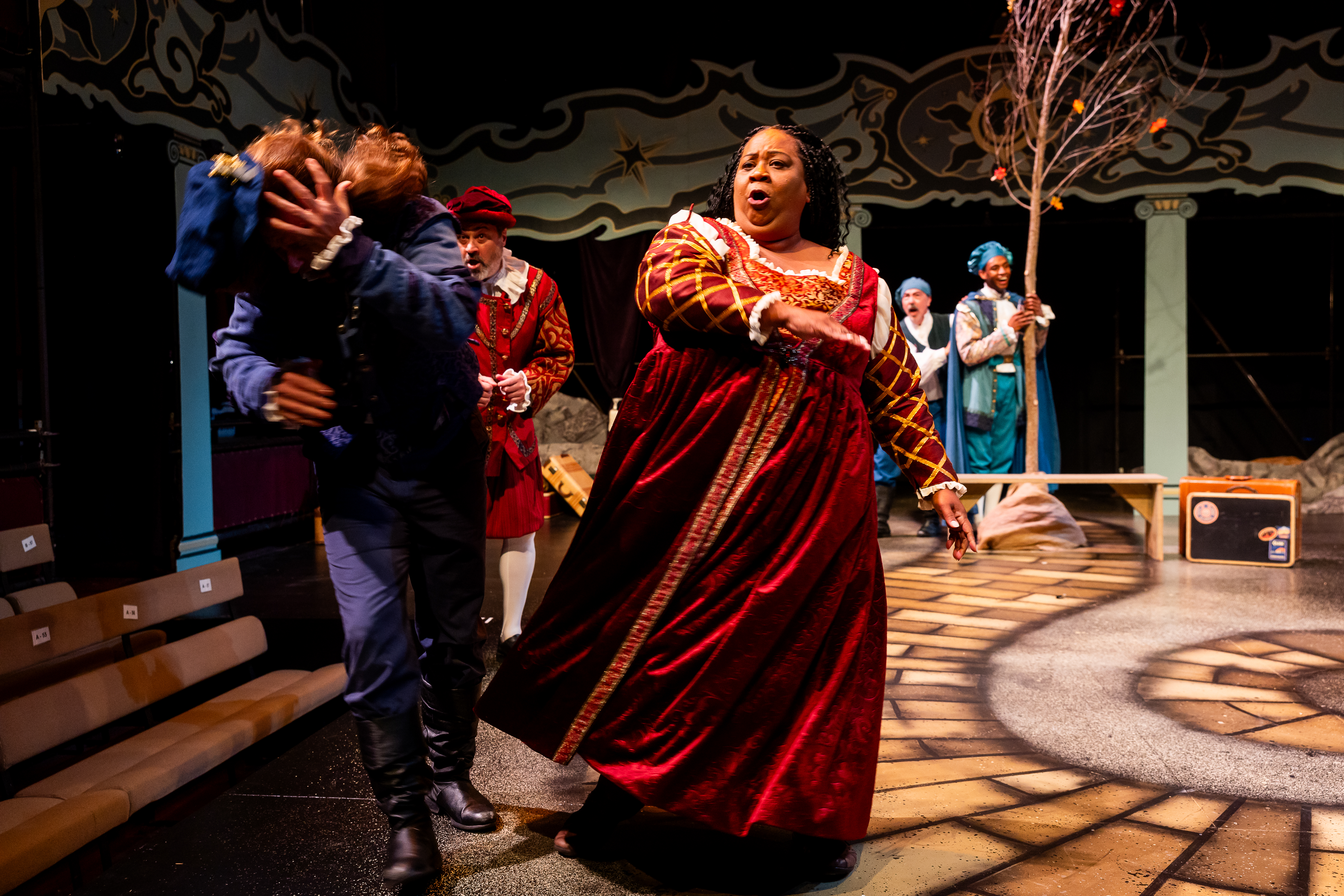
At the center of the production is a blazing performance by MaConnia Chesser as Katherina. Too
often reduced to a caricature, Katherina is sharp, wounded, and deeply human. She hurls her insults
with ferocious wit, but beneath the barbs is a woman keenly aware of her marginalization in a
patriarchal society. When she finally delivers her climactic speech on wifely obedience, Chesser
delivers it not as capitulation, but as a sly act of reclamation. Her measured tone and piercing gaze
suggest a woman who has chosen, for her own survival, to master the rules of the game rather than
be destroyed by them.
Opposite her, Jamal James as Petruchio exudes charisma tinged with menace. His Petruchio is not
merely a swaggering bully but a man equally ensnared in societal expectations of masculinity. He
“tames” Katherina with tactics that are disturbing to witness, but his occasional faltering reveals his
awareness of the cruelty of his role. Their scenes crackle with tension, and while the power
imbalance is undeniable, the chemistry between the two hints at a mutual recognition that they are
both actors trapped in a script they did not write.
The supporting cast adds vitality and levity. J. Austyn Williamson’s Lucentio is full of impish charm,
while Ryan Winkles as Hortensio leans into a surfer-bro bravado that satirizes masculine vanity.
Bianca, Baptista, and the various suitors all contribute to the larger commentary: patriarchal
control is not confined to Petruchio alone but woven into the fabric of every male character on
stage.
What makes this production resonate most, however, is its willingness to let ambiguity linger.
Rather than resolving the play into a neat message (whether pro- or anti-feminist) the production
highlights the contradictions, inviting the audience into the discomfort. The final scene marks the
final return of the interrupting audience member from the beginning; this time we writes a check to
them for a large amount for succumbing to his whims. The silence that follows is deafening, as if
the director has handed the question back to the audience: who tames who? The production makes
clear that Shakespeare’s comedy, though problematic, can still serve as a mirror forcing us to
confront enduring questions about power, gender, and identity. The modern day framing was
clever; it just took me hours to get it.
The design elements deepen these themes. Costumes move fluidly between Elizabethan and
contemporary dress, reminding us that the structures of gender performance are not relics of the
past. Music underscores the play’s shifts in tone, alternating between jaunty comedic motifs and
darker, more discordant strains. Even the choreography of physical comedy feels double-edged: the
pratfalls are funny, but they also expose the violence underlying supposedly lighthearted banter.
Ultimately, this staging of The Taming of the Shrew does not “solve” Shakespeare’s (arguably) most
troubling comedy. Instead, it embraces the play’s contradictions, presenting them with honesty,
intelligence, and theatrical daring. By foregrounding performance, role-playing, and survival, the
company has crafted a Shrew that is both entertaining and deeply unsettling, reminding us why this
play continues to provoke debate more than four centuries after it was written.
The Taming of the Shrew at Shakespeare & Company, directed by Nicole Ricciardi and assistant
direction by directing fellow Bobbin Ramsey. CAST: Juan Luis Acevedo as Tranio, Shelia
Bandyopadhyay as Grumia/Baptisa, MaConnia Chesser as Katarina, Rory Hammond as Biana, Jamal
James as Petruchio, Dennis Trainor, Jr. as Gremio, J. Austyn Williamson as Lucentio, and Ryan
Winkles as Sly/Hortensio. Understudies: Christopher Brophy, Aiden Chalfonte, Ellie Bartz, Luke
Haskell, and Joslyn Eaddy Meléndez. Scenic design by Will Sexton, costume design by Govane
Lohbauer, lighting and production design by James W. Bilnoski, sound design by Brendan F. Doyle,
intimacy direction by Corinna May, fight choreography by John Leggett, stage management by Hope Rose Kelly, assistant stage management by Kathleen H. Soltan, Ryan Winkles and Dennis Ebert, Jr.. .
Running August 14–24, 2025 at the Tina Packer Playhouse.