
by Dan Mayer
Back in the 1990s, playwright Suzan-Lori Parks had made a joking comment that she would write a riff on Nathaniel Hawthorne’s The Scarlet Letter, and title it Fucking A. That one comment ultimately led her to write two different plays, which came to be known as Parks’ “Red Letter Plays”. The second of those plays was actually titled Fucking A, but the first became In The Blood. Twenty-five years later, Harbinger Theatre‘s production demonstrates that In The Blood is still disturbingly relevant today.
Hester (Nicole DamaPoleto) is illiterate, unemployed, unmarried, and living on the streets while raising five children. She doesn’t wear a literal scarlet letter, but she carries a reputation for having borne five children from five different fathers. As events unfold, it’s not hard to see how she ended up in these circumstances. She’s a kind and overly trusting person, constantly giving of herself to others (especially her children) while asking little or nothing for herself, and everyone she encounters takes advantage of her. We meet at least half a dozen people who bear some shared responsibility for her circumstances and those of her children, yet she’s the only one forced to take responsibility. It’s obvious from the start that things are likely to end badly for her, but just how dark things get is still shocking.
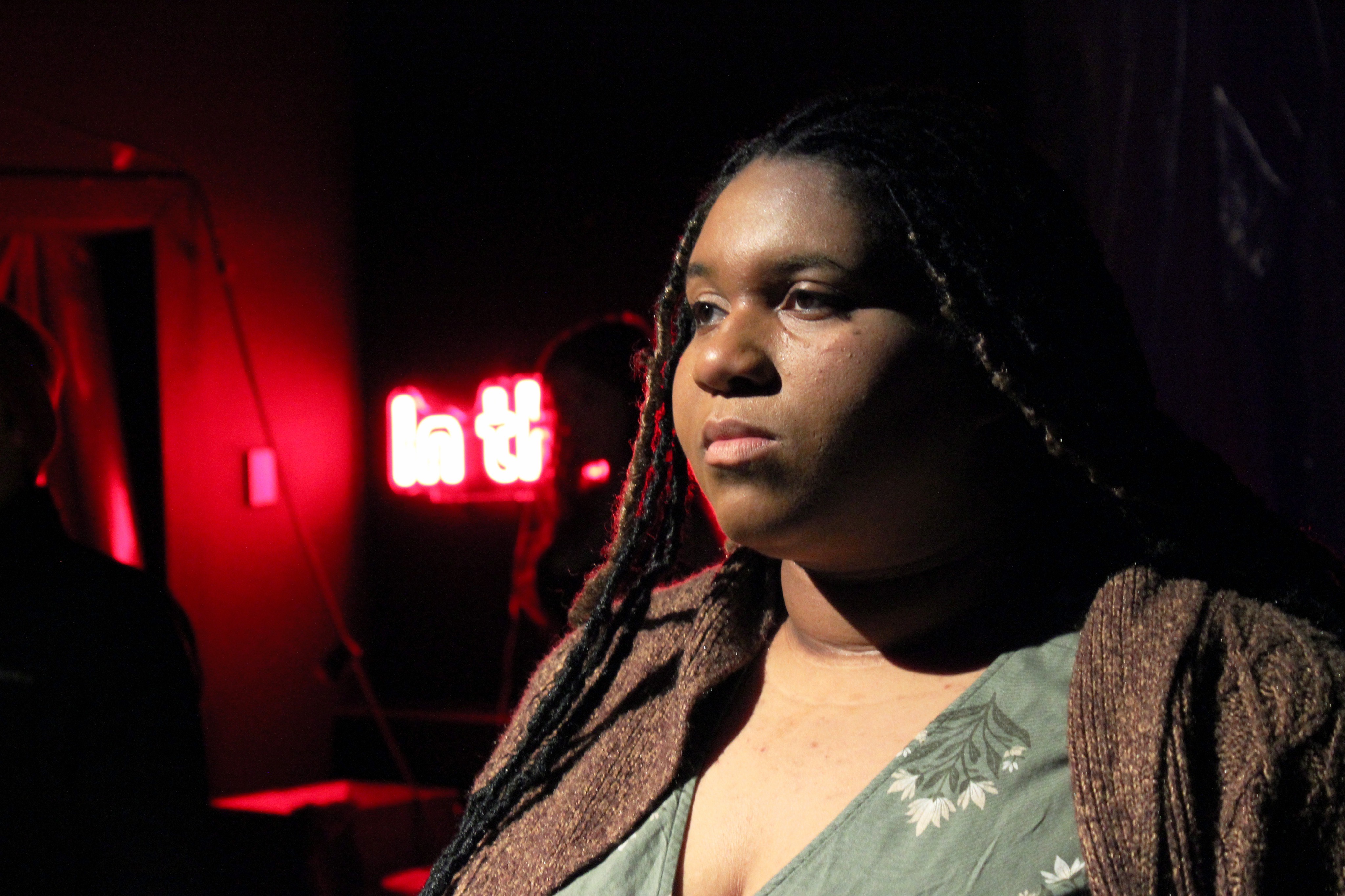
The set, designed by director T.J. Collins-Gutierrez and constructed by Bob Dawes, calls to mind an abandoned construction site in a rough part of town. Semi-transparent sheets of plastic serve as makeshift curtains. An old traffic cone and trash bags lie strewn about. Rough panels that look like concrete walls bear graffiti. To one side, the bold words “GOD SAVES” accompany the vague shape of a cross. In the center, “SLUT” is scrawled in tall red letters. A small neon sign glowing on the back wall stage right announces the show’s title: “In The Blood.”
The audience is gradually immersed further in the moments before the show begins. Distant street noise slowly grows louder leading up to the start (courtesy of sound designer Andrew Deitch). A few members of the cast quietly linger around the audience and improvise a few wordless interactions, stopping just short of direct audience involvement. It’s simple but remarkably transportive. As actor Tyler Cardona sits quietly wrapped in a blanket staring out at us, I wonder how many people uncomfortably averted their eyes out of habit.
Most of the cast are playing dual roles, portraying one of Hester’s kids and one of the people in her life that have taken advantage of her. Everyone is fairly convincing as adult actors portraying children, aided by some excellent costumes. Their adult character counterparts are a little more hit-and-miss, and their interactions sometimes have an inconsistency of tone to them.

Monet Thompson-Young in Harbinger Theatre’s production of “In The Blood” by Suzan-Lori Parks, directed by T.J. Collins-Gutierrez, at the St. Rose Theatre. Photo by David Quiñones Jr. 
Zach Kaiser, Monet Thompson-Young, Dalton Russell, Nicole DamaPoleto, Aaliyah Al-Fuhaid, and Tyler Cardona in Harbinger Theatre’s production of “In The Blood” by Suzan-Lori Parks, directed by T.J. Collins-Gutierrez, at the St. Rose Theatre. Photo by David Quiñones Jr. 
Zach Kaiser in Harbinger Theatre’s production of “In The Blood” by Suzan-Lori Parks, directed by T.J. Collins-Gutierrez, at the St. Rose Theatre. Photo by David Quiñones Jr. 
Nicole DamaPoleto and cast in Harbinger Theatre’s production of “In The Blood” by Suzan-Lori Parks, directed by T.J. Collins-Gutierrez, at the St. Rose Theatre. Photo by David Quiñones Jr. 
Dalton Russell, Nicole DamaPoleto and Aaliyah Al-Fuhaid in Harbinger Theatre’s production of “In The Blood” by Suzan-Lori Parks, directed by T.J. Collins-Gutierrez, at the St. Rose Theatre. Photo by David Quiñones Jr. 
Nicole DamaPoleto in Harbinger Theatre’s production of “In The Blood” by Suzan-Lori Parks, directed by T.J. Collins-Gutierrez, at the St. Rose Theatre. Photo by David Quiñones Jr. 
Monet Thompson-Young & Dalton Russell in Harbinger Theatre’s production of “In The Blood” by Suzan-Lori Parks, directed by T.J. Collins-Gutierrez, at the St. Rose Theatre. Photo by David Quiñones Jr. 
Poster artwork by Marc Christopher for Harbinger Theatre’s production of “In The Blood” by Suzan-Lori Parks, directed by T.J. Collins-Gutierrez, at the St. Rose Theatre. Photo by David Quiñones Jr.
The few scattered laughs throughout the show seem intentionally awkward, but offer some brief reprieve from the heavy subject matter. The cast have some fun with the material when they can; Aaliyah Al-Fuhaid in particular. She plays Amiga, a prostitute with whom Hester has a complicated relationship. Al-Fuhaid’s performance as Amiga is especially over the top with a lot of playful posing and suggestive vocal affect, reigning it in during the heavier dramatic moments.
Those heavy dramatic beats tend to be where the script and the cast are at their best. Each of the actors in dual roles gets one main monologue as their adult character, giving us the context of how they and Hester are connected, and each one hits like a punch in the stomach. Russell is deeply unsettling in that moment. Al-Fuhaid as Amiga and Monet Thompson-Young as Welfare elicit disgust and shock, perhaps more so since they had been embodying their characters with a kind of playfulness up to that point. They began feeling like Cinderella’s wicked step-sisters, but ended up so much worse.
DamaPoleto portrays Hester in a somewhat more subdued manner, standing in contrast to the big characters around her. She’s effectively overshadowed by them at times, which feels perfect for the character. When she’s with her children, she’s the center of attention, radiating warmth. When she’s with other adults, she seems small and timid, pushed out of the spotlight (sometimes literally), and bending to whatever whims they have. Even so, there’s a fear and frustration that creeps into her performance over time. Meanwhile, I’m staring at that policeman’s baton that Trouble stole, that she notably carries on her hip through the rest of the show, and my sense of dread just keeps rising.
Tyler Cardona as Reverend D may have drawn the most audible gasps from the audience, with a few particularly chilling line deliveries. Zach Kaiser has the monumental task of giving us two of the play’s most heartbreaking moments as Chilli and Jabber. He excels as Hester’s two-faced first love, but he sells both characters well. His final moments as Jabber are particularly haunting.
The one shocking moment of violence at the climax is not directly acted out, but the impact is palpable. There’s a deft bit of restraint in how Collins-Gutierrez presents the violence. The audience doesn’t have to see the act to feel the horror of it.
Her last few lines are where DamaPoleto impresses the most. Her presence has been fairly restrained and generally soft up until this last scene, and that lends even more impact to the desperation, rage, and despair she portrays in these final moments.
The story closes as it began, with society coldly judging her.
I’ve struggled to process and write about this story. It’s a tragedy in all senses of the word, and what stings the most about it is that it ultimately feels true to life. Regardless of how it happened, things end with Hester in prison, her children most likely languishing in the foster care system if they’re lucky, and society’s cruel judgment has not changed. It closely echoes the stories of real people living in similar circumstances, some of them a few city blocks away from where this performance is held. It makes me uncomfortable, but I guess that’s the point. Society doesn’t change when people are too comfortable.
Harbinger Theatre presents In The Blood by Suzan-Lori Parks, directed by T.J. Collins-Gutierrez, runs from March 15-24, 2024, at St. Rose Theatre, 1000 Madison Ave in Albany, NY. Cast: Nicole DamaPoleto as Hester/La Negrita, Aaliyah Al-Fuhaid as Beauty/Amiga Gringa, Zach Kaiser as Jabber/Chilli, Monet Thompson-Young as Bully/Welfare, Tyler Cardona as Baby/Reverend D, and Dalton Russel as Trouble/Doctor. Set design by T.J. Collins-Gutierrez. Set Construction by Bob Dawes. Lighting design by David Caso. Sound design by Andrew Deitch. Poster artwork by Marc Christopher. Photography by David Quiñones Jr. Light board operator: John Schnurr. Lighting assistant: Cheryl Hussey. Stage Manager: Lauren D’Annibale.
Performance dates are Friday–Sunday, March 15-17 and March 22-24. Friday and Saturday curtains are at 7:30 pm, and Sundays are matinees only at 2:00 pm. Friday performances include talkback sessions after the show. Tickets are $16. Runs approximately 90 minutes with no intermission. Note: the production uses strobe effects and herbal cigarettes. Recommended for ages 18+. Tickets are available online. Visit https://www.actingclasswithpatrickwhite.net/ for more information.