

by Barbara Waldinger
Since the Covid pandemic, theatres have been struggling financially to make up for the huge losses they suffered when they were forced to shut down. Many Berkshire theatres have chosen to produce one or two-person plays to cut expenses. The challenge for new playwrights is to find a way to create the world of a play with so few performers. A case in point is Jim Frangione’s FLIGHT OF THE MONARCH, a Regional Premiere now playing at Shakespeare & Company, in association with Great Barrington Public Theater, where Frangione serves as Artistic Director.
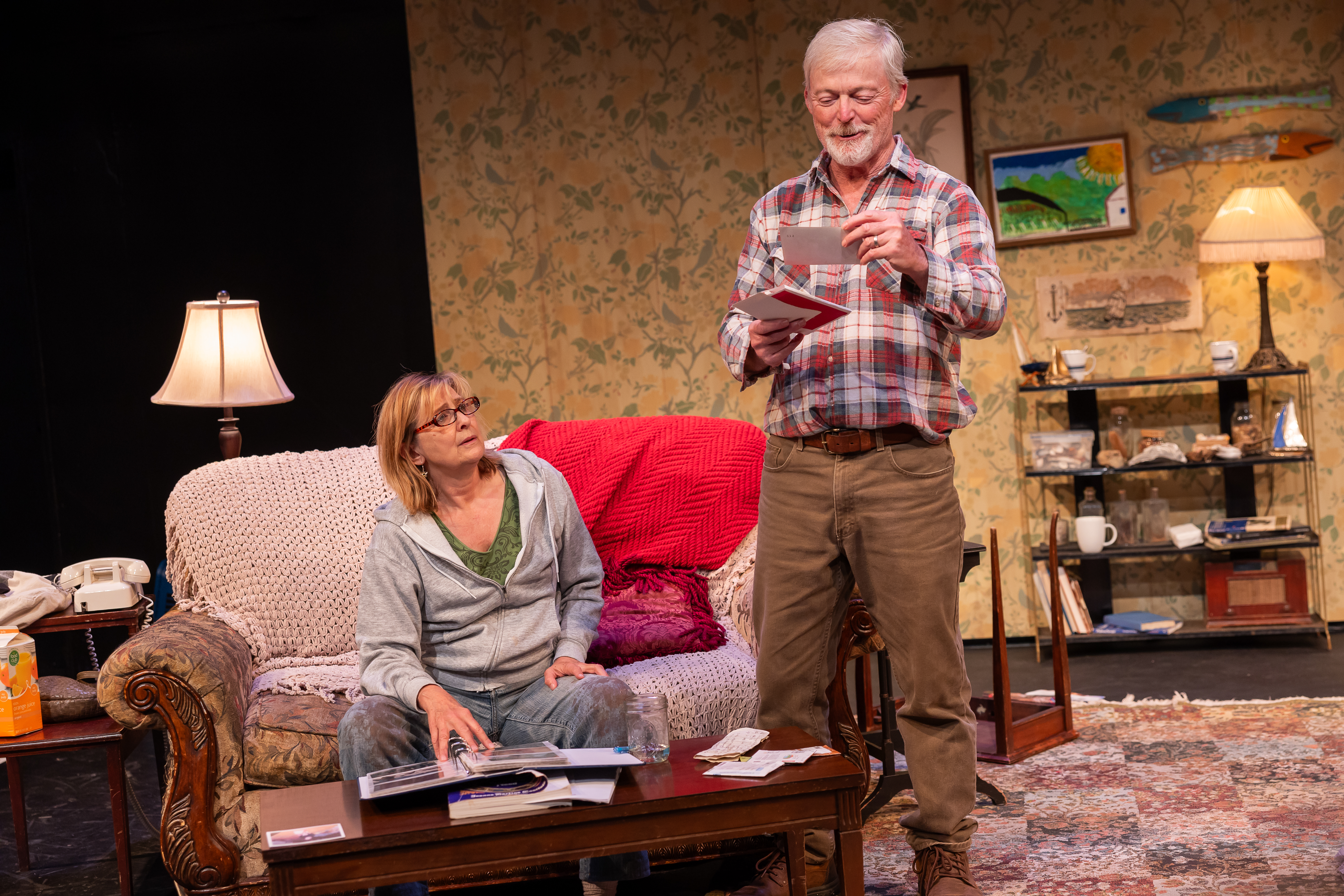
In this play, directed by Great Barrington Public Theater’s Associate Artistic Director Judy Braha, Frangione attempts a variety of approaches aimed at bringing to life what Braha describes as the “working-class Cape Cod community he grew up in.” Actors Allyn Burrows, Artistic Director of Shakespeare & Company (formerly Artistic Director of the Boston-based Actors’ Shakespeare Project) and Corinna May (a much-admired, long-time actor at Shakespeare & Company) seem to enjoy their working class accents and costumes (designed by Christina Beam, which would easily feel at home in one of Ben Affleck’s Boston-based films or in The Perfect Storm). We instantly identify where we are and might even recognize people we know who look and sound like these two characters.
But these are accoutrements. The question is how to tell the story of Thomas and Sheila Callaghan, their dysfunctional family members, friends and neighbors, up to the point where we meet the two middle-aged siblings in the room of a mental hospital soon after the play begins. Frangione chooses to introduce all of these other characters through phone calls and monologues, which is a clever way to bring in exposition. We learn that there is another sibling—Lacey–but an absent father; that their mother Deirdre was a drunkard who never cared for her children; and that neither Thomas nor Sheila has a loving partner (though Sheila has an adult daughter). We hear in great, colorful detail about fishermen friends of Thomas, Sheila’s garden (about the need to get it ready for the arrival of the soon-to-be extinct monarch butterflies, whose journey takes four generations), about therapists, dreams, and otherworldly influences like psychics and astrological charts. Though Frangione has a wonderful ear for dialogue, much of the first act of FLIGHT OF THE MONARCH features the two actors listening to (and commenting on) each other’s stories and memories. Not until the second act do we feel the full extent of the characters’ anger, pain, vulnerability, fear of aging, of neediness and their deep love for one another. It is in this act that the playwright gives these capable performers a chance to respond, to let go, to be free. And then they come alive.


Corinna May uses a deep, bass voice for Sheila, a tough, hardened, bitter woman. As the elder of the siblings, it was Sheila who mothered Thomas and helped him get through their nightmarish youth. The play’s dark humor comes out of the suffering and disappointments in the characters’ lives. Both May and Burrows mine the comedy: it’s not often that we see these actors, both classically trained, stomping around, slouching, throwing things and behaving the way their characters probably did as kids. Yet there are moments, especially early on, when it seems that they are reaching for Thomas and Sheila, but could probably use more time to live with them in order to get to their core, which is much easier for a playwright who was himself a denizen of that world.
Director Judy Braha apparently spent several months collaborating with Frangione on revisions of FLIGHT OF THE MONARCH, his first play. Having served for many years as the head of the MFA Directing Program at Boston University’s School of Theater, Braha was able to shepherd the development of the script, suggesting how to clarify what was unclear, to cut what was superfluous, to move the plot forward and to keep the momentum going. Frangione, a gifted actor and director, was a willing participant in this process, even agreeing to cut some of the lines he loved the most, as he explained in an interview with Ann Berman at Shakespeare & Company. Is the play finished? Exposure to an audience is the next layer of this process. Further attention to the ending might still be useful.
It must have been a relief for Braha to finally put the play on its feet, after working on it for so long. She is a model of creativity in her staging, the development of the characters, and her collaborative approach with all of the artists involved. Set Designer Patrick Brennan built two distinct rooms: the hospital and the working-class living room of Sheila’s house. In each case he supplies what is needed but always leaves room for the actors to move, an important part of Braha’s physical concept. Rachel Harrison, the Sound Designer, delivers both vocal and instrumental music before and after the play and between scenes; adding sounds of the ocean, seagulls, the engine of a boat and cicadas, all of which help with the feeling of place (though it is a bit strange to hear sound cues during the recounting of past memories, rather than to highlight the present). Light Designer James Bilnoski’s scene transitions are smooth, ushering us from one segment to another without drawing undue attention to the lights.
There is much to recommend about FLIGHT OF THE MONARCH, including the richness of the language, the professionalism of every artist, and the association of two of the Berkshire’s finest theatre organizations.
FLIGHT OF THE MONARCH runs from August 3-25 at Shakespeare & Company’s Bernstein Theatre, 70 Kemble Street, Lenox, MA. For tickets call 413-637-3353 or online at shakespeare.org.
Shakespeare & Company, in association with Great Barrington Public Theater, presents FLIGHT OF THE MONARCH by Jim Frangione. Director: Judy Braha. Cast: Allyn Burrows (Thomas Callaghan) and Corinna May (Sheila Callaghan). Set Designer: Patrick Brennan; Light Designer: James Bilnoski; Costume Designer: Christina Beam; Sound Designer: Rachel Harrison. Production Stage Manager: Rachel Harrison.
The performance runs one hour and thirty minutes plus intermission.