

by Macey Levin
In 1879 the Connecticut Legislature enacted a law, promulgated by P.T. Barnum, a member of that body, outlawing the use of any type of contraceptive device by anyone, male or female. In 1954 Estelle Griswold became the executive director of the Planned Parenthood of Connecticut that only talked about contraception but couldn’t supply devices. Griswold was hired primarily as a fundraiser. Her story, and her fight to give women the right to own their bodies is the basis of the compelling drama Griswold by Angela J. Davis which is receiving a compelling production at Bridge Street Theatre in Catskill, New York.
Griswold’s (Margo Whitcomb) story is about a determined, feisty woman who refuses to bend to the prevailing sexual roles and rules of her era. As a younger woman she lived and worked in Paris, assisted refugees during World War Two, and led an organization that fought for civil rights. In 1954, having experienced several careers, a neighbor invites her to interview for Planned Parenthood. Griswold takes
the job but ventures beyond the original description of being a fundraiser and mounts a campaign to challenge the Connecticut law. Though she lacks the support of the organization’s board, she continues to fight for the cause. At first focusing on the use of diaphragms she contends that it is a woman’s right to do as she wishes and not to adhere to male-instituted laws. She creates the Planned Parenthood Clinic in 1961 in Hartford with Dr. Buxton, Chief of Obstetrics and Gynecology at the Yale Medical School as chief medical officer.
They are sued by the state. A citizen, James Morris, appears at the court arguing for morality while ignoring people’s rights. Later he equates birth control and prostitution. Planned Parenthood loses the case.
Ultimately, the case of Griswold and C. Lee Buxton v. Connecticut goes to the Supreme Court in March of 1965. A decision is rendered in June 1965 that strikes down the Connecticut law on the grounds that it “…denied disadvantaged citizens… access to medical assistance and up-to-date information in respect to proper methods of birth control” and violated the “right to marital privacy.” The decision was written
by Justice William O. Douglas who went on in the decision to affirm the sanctity of marriage.
A sub-plot details Estelle’s relationship with her husband Richard into their older years and the stress of his illnesses upon her and her battles. There is an epilogue that takes the play to the present day that dramatizes the importance of the Court’s decision all those years ago on young lives.
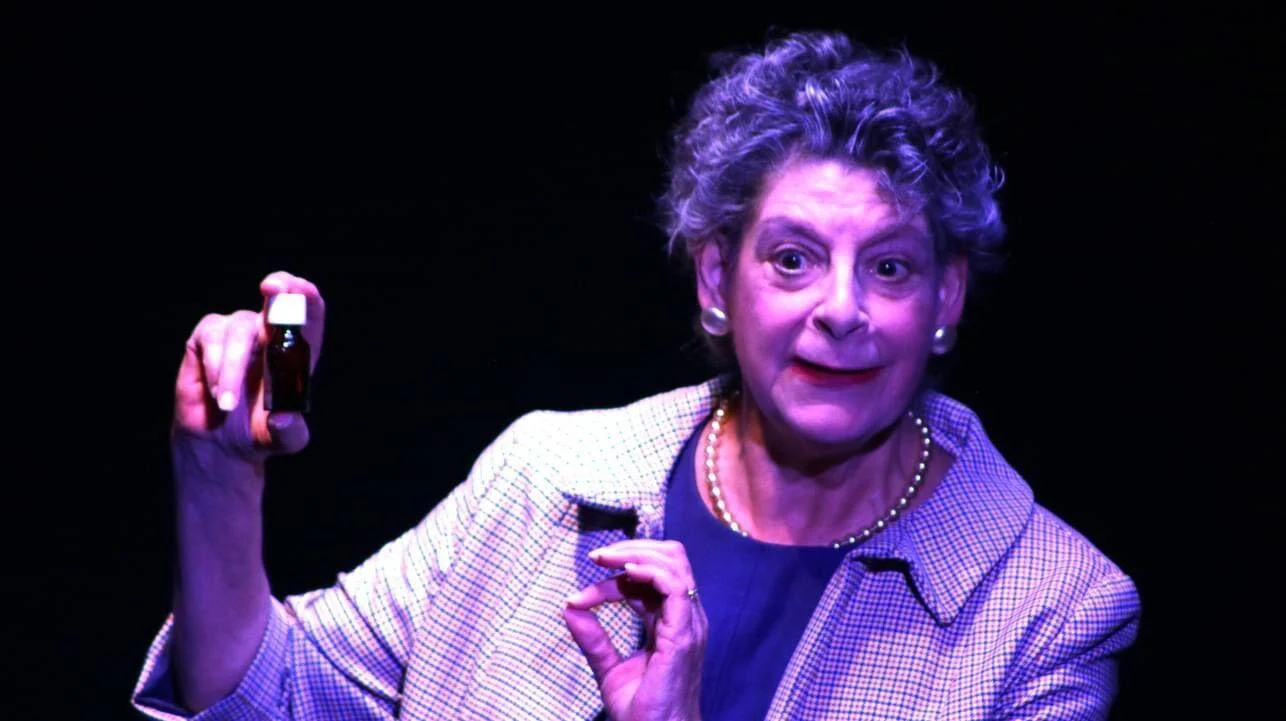
Ms. Whitcomb delivers a dynamic performance. Onstage for the entire hour and forty minutes of the play she is a commanding personality mining laughs and touching sensitivities. It is difficult not to be entranced by her Griswold. In addition to Whitcomb’s thrilling performance, two other actors …Leyla Modirzadeh and Andre G. Brown portray twenty-three various characters. Ms. Modirzadeh has a nice stage presence ranging from a nerdy woman to a bold advocate for women’s rights, but her throat seems tight making some of her lines at times difficult to hear. Mr. Brown is a joy to watch. His characters range from P.T. Barnum to Dr. Buxton to Tyrone, a young man arrested in Texas in the 1990’s, among others. He gives all of them a vital life.

Leyla Modirzadeh and Andre G. Brown in the Bridge Street Theatre production of Angela J. Davis’ GRISWOLD directed by M. Burke Walker. Photo by Carmen Borgia 
Leyla Modirzadeh in the Bridge Street Theatre production of Angela J. Davis’ GRISWOLD directed by M. Burke Walker. Photo by Carmen Borgia 
Andre G. Brown, Margo Whitcomb, and Leyla Modirzadeh in the Bridge Street Theatre production of Angela J. Davis’ GRISWOLD directed by M. Burke Walker. Photo by Carmen Borgia 
Margo Whitcomb in the Bridge Street Theatre production of Angela J. Davis’ GRISWOLD directed by M. Burke Walker. Photo by Carmen Borgia 
Leyla Modirzadeh, Andre G. Brown, and Margo Whitcomb in the Bridge Street Theatre production of Angela J. Davis’ GRISWOLD directed by M. Burke Walker. Photo by Carmen Borgia 
The production directed by M. Burke Walker is beautifully staged. With minimal movement the story unfolds gripping our attention. The minor characters’ entrances are fluid as they embellish the electric pace of the production. There are no sluggish moments in the development of the story. The stage pictures are simple yet definitive. Bridge Street’s production values are of the highest order. On a set designed by John Sowle, myriad locations on the bare stage are created by a table and three chairs.
Costumes and props are stored on a visible clothing rack and shelf. Michelle Rogers’ costumes are colorful for those characters who need it to identify themselves, i.e. Barnum in a bright red jacket. Others wear clothes that represent their place in society.
Sowle’s lighting, often using shadows and dimmed areas, adds character to the various locations. Carmen Borgia’s sound design enhances appropriate accompaniment to each scene.
Bridge Street Theatre’s Griswold is a must-see!
Griswold by Angela J. Davis; Director: M. Burke Walker; Cast: Margo Whitcomb (Estelle Griswold) Leyla Modirazeh (Actor One) Andre G. Brown (Actor Two) Set and Light Design: John Sowle; Costume Design: Michelle Rogers; Sound Design: Carmen Borgia; Production Stage Manager: Hannarose Manning; Running time: 1 hour, 40 minutes, no intermission; August 8 – August 18, 2024; Bridge Street Theatre, 45 Bridge
Street, Catskill, NY. For information and tickets go to their website at www.bridgestreettheatre.org