
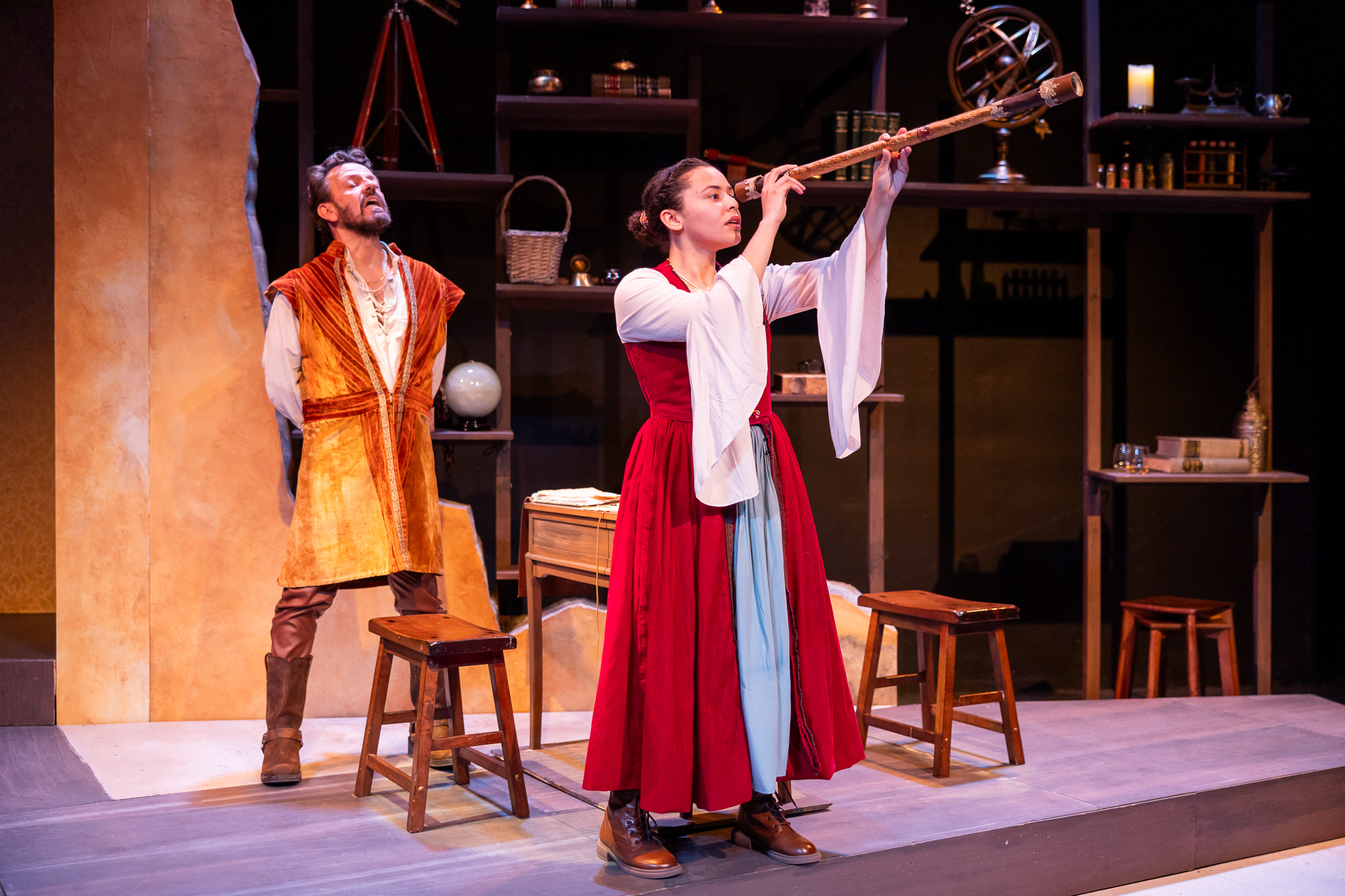

by Barbara Waldinger
GALILEO’S DAUGHTER by Jessica Dickey, produced by WAM Theatre at Shakespeare & Company’s Bernstein Theatre, is the physical, intellectual and emotional journey of a New York City playwright in the midst of a painful relationship crisis. As narrator of the play, she explains to the audience her oft-repeated reason for traveling:
“I have come to Italy
To Research the letters
Of Galileo’s Daughter.”
In a fast-paced production that takes place in both the twenty-first and the seventeenth centuries, often simultaneously, Dickey tries to theatricalize this quest. With the help of a clever and creative director, Reena Dutt, wonderful actors, crackerjack designers and a good deal of “smoke and mirrors,” we are left breathless but unfulfilled.
It turns out that this unnamed young playwright [aka “the writer”] (Caroline Kinsolving), facing an uncertain future, is searching for a “Rock Star Nun”: Sister Maria Celeste (Sandra Seoane-Seri), named for her father’s groundbreaking astronomical studies. Because Sister Maria is an illegitimate daughter of Galileo Galilei (Diago Arciniegas) she cannot marry, nor can she remain an assistant to her father because of the danger of his heretical heliocentric thinking. Her only option is to go into a convent, where she will spend the rest of her life enclosed within its walls. Making the best of her situation, she is able to teach astronomy, become an apothecary, transcribe her father’s manuscripts—hundreds of pages—by hand, and write letters not only to her father but to the church authorities she lobbies to pardon him. Ultimately, she serves as an inspiration to the writer and to the actual playwright: Dickey herself, who learned about Sister Maria Celeste when she read Dava Sobel’s book: GALILEO’S DAUGHTER: a historical memoir of science, faith and love, in which she translated 124 letters into
English.
In an interview with Talya Kingston, Associate Artistic Director of WAM and Production Dramaturg, Dickey claims that she tried not to make the play autobiographical but it happened in spite of her efforts to avoid it. An actress and award-winning playwright, Dickey received a Sloan Grant to write it and then admitted that, like the writer in her play, her “life blew up,” she traveled to Italy, and the resulting play chronicles that journey. Dickey, who is close with her sister, a pastor, believes that playwriting and
theatre itself are spiritual callings, a kind of healing waiting to happen: the kindling of a fire that ultimately warms the creators and the audience.
In order to weave together the two stories contained within the play (the writer’s personal struggle and the life of Sister Maria Celeste), director Dutt has chosen to stage many of the scenes using physical actions. Early in the play, the writer and the Sister (who sometimes plays a contemporary character in 17th century garb) are literally running around the circumference of the set as they speak. The set (designed by Qingan Zhang), is a master class in representing several locations on the small stage of the theatre: contemporary Florence (the Museo Galileo, the Library, the Archives, a Hotel), the San Matteo convent, and Tuscany in the early 17th century, using symbols to represent Galileo’s work (e.g. his telescope). In contemporary Florence, the writer runs back and forth from the Library to the Archives to locate the letters, battling every possible obstacle along the way (she never seems to have the correct cards, passes, materials that she needs). She is even present in different areas of the set during scenes between Galileo and his daughter. Arciniegas not only plays Galileo but also every male character. He is amazingly skilled in changing his character, voice, accent, and his physical self, as he races to add or remove a costume piece, sometimes in seconds. His magical transformations must certainly have challenged the capable Costume Designer: Malorie R. Grillo. Sound Designer Masatora Goya supplies music as varied as contemporary rock music, church choir music, crowd noise, xylophone sounds along with synonymous lighting cues (designed by Andrea Sofia Sala) to emphasize what was seen through the telescope and other critical moments. Why are speed and spectacle so important to this production? Perhaps because a play about doing research can be static and unable to sustain itself without these outer trimmings. But no matter how skillful they may be, do they really add to our overall appreciation of
the forgotten daughter of Galileo?


This is an enormously challenging piece for the actors: Kingsolving does a wonderful job of guiding us directly into the action from the opening announcement of the play to the final narration. The lines are often written in verse form though they are contemporary prose, even in the seventeenth century. With her ponytail and backpack, tights and running shoes, the actress leads us into each building she visits, painting a word picture of her surroundings. We watch her character overcome the emotional turmoil she suffers, as she finds common ground with the brave and exceptional nun who accomplished all that she set out to do, despite her circumstances.
Seoane-Seri is also put through her paces as she spans the two centuries, in addition to playing Galileo’s daughter. It is lovely to see her as Sister Maria Celeste finding her calling in that terrible convent and describing her joyous relationship with another nun. She is convincing in her scenes with Galileo, loving him, frightened for him, desperate to share his work as her character matures and develops her own reputation.
But much of the play rests on the capable shoulders of Diago Arciniegas, whose Galileo encompasses a variety of conflicting emotions: the excitement of a scientist given the opportunity to see what no one else has seen; the sacrifice that entails: “The price of being allowed to See is the responsibility to Tell,” as he knowingly puts his life in danger; the guilt he feels about pursuing his own goals rather than visiting his daughter regularly, though he has such tender love for her and trusts her absolutely. His other fine characterizations include the brilliant, sympathetic scientist who meets the writer towards the end of the play as they share their personal stories, and the evil Friar who suspects Sister Maria Celeste’s complicity in disseminating her father’s heliocentric theory.
WAM is donating a portion of box office sales to funding The Girls Science After School Programs run by Flying Cloud Institute in Berkshire County. Since this is a co- production with Central Square Theater in Cambridge, MA, this play will transfer there after the run at Shakespeare & Company.
GALILEO’S DAUGHTER runs from October 18—November 3 at Shakespeare & Company’s Bernstein Theatre, 70 Kemble Street, Lenox, MA. For tickets call 413-637-3353 or online at shakespeare.org.
WAM Theatre presents GALILEO’S DAUGHTER by Jessica Dickey. Director: Reena Dutt. Cast: Caroline Kinsolving (the writer), Diago Arciniegas (Galileo et al.), Sandra Seoane-Seri (Maria Celeste). Scenic Design: Qingan Zhang; Costume Design: Malorie R. Grillo; Sound Design: Masatora Goya; Lighting Design: Andrea Sofia Sala; Intimacy Director: Kim Stauffer. Production Stage Manager: Hope Rose Kelly. The performance runs 80 minutes with no intermission.