

by Paula Kaplan-Reiss
Admittedly, I knew nothing about the Civil Wars in Liberia. In fact, I know nothing about Liberia in West Africa. Eclipsed by Danai Gurira, performed by the Black Theatre Troupe of Upstate NY and housed at theRep introduces us to the war-stricken lives of Liberian women captured and held at a Lurd Rebel Army Camp in 2003.
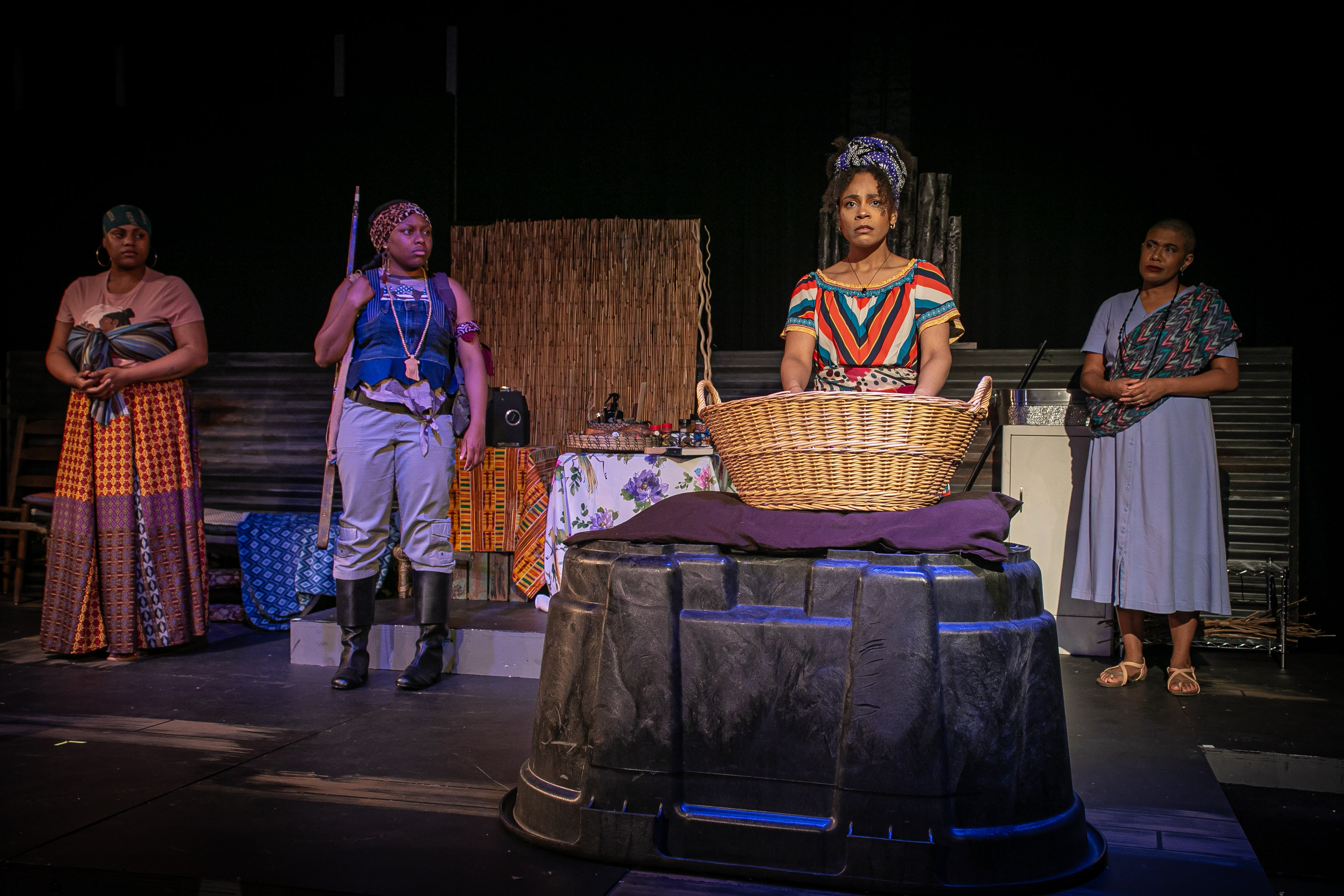
In the Lauren and Harold Iselin Studio on the second floor of theRep, the stage is a platform, shallow in depth, depicting the crowded conditions of a makeshift home made of corrugated sheet metal and bamboo, and well-designed by D. Colin. Wife #1 and Wife #3 are hiding a recently captured teenage girl to prevent her from becoming Wife #4. Their attempts, however, are in vain.
With numerical names, these women have already been stripped of their identities. They exist to sexually serve the needs of their C.O. (commanding officer). Wife #3 is miserably pregnant with his baby. Tired of constantly hiding under an oversize basket anytime the C.O is near, the teenage girl sneaks out at night and unwillingly becomes Wife #4 after being raped.
Wife #2 arrives later in Act 1. She has left the home of the wives and is armed with a rifle, wearing fatigues, taking up the fight against ‘The Monkey Charles Taylor’ for a free Liberia. Wife #1 despises her and Wife #4 sees her as a way out of being repeatedly raped.
Jean-Remy Monnay directs a solid ensemble of women with each character fully developed by playwright, Guria. Angelique Powell, Wife #1, aptly plays a mature matriarch who runs the household and cooks for everyone, despite limited provisions. She demonstrates her pragmatism in her painful life, while mourning the loss of her baby to the war and her fertility to the C.O. She can barely remember her life before the war. When visited by a Woman of Peace (Monet Thompson-Young), someone who is trying to negotiate with the C.O.s, and encouraging the wives to remember and use their real names, #1 proclaims, “I don’t know who I is out of war!” She has given up on forging a new identity, but she desperately longs to read and write. Powell’s performance is powerful. We empathize with #1.
Alanna Aleece as #3 tries to be fun-loving and feminine in an impossible situation. She longs for nice clothes and hair extensions. She detests being pregnant and imagines she will have no use for her baby and will pass her on to #1. Her carefree, almost immature style is infectious and evokes laughter.
Deasia Clarke, the youngest Wife #4, desperately misses her mother and is the only wife who can read and write. When the wives are gifted a used and tattered book about President Bill Clinton, she reads it to the other wives who respond to it like a telenovela, eager to hear each chapter. Clarke demonstrates the greatest growth in her role. Forced to have sex with the C.O., she becomes quieter and more depressed. Determined to not be stuck in this role, she is attracted to the militant life of Wife #2.

The Black Theatre Troupe of Upstate NY presents “Eclipsed” by Danai Gurira, directed by Jean-Remy Monnay, at Capital Repertory Theatre. Photo Willie David Short. 
The Black Theatre Troupe of Upstate NY presents “Eclipsed” by Danai Gurira, directed by Jean-Remy Monnay, at Capital Repertory Theatre. Photo Willie David Short. 
The Black Theatre Troupe of Upstate NY presents “Eclipsed” by Danai Gurira, directed by Jean-Remy Monnay, at Capital Repertory Theatre. Photo Willie David Short. 
The Black Theatre Troupe of Upstate NY presents “Eclipsed” by Danai Gurira, directed by Jean-Remy Monnay, at Capital Repertory Theatre. Photo Willie David Short. 
The Black Theatre Troupe of Upstate NY presents “Eclipsed” by Danai Gurira, directed by Jean-Remy Monnay, at Capital Repertory Theatre. Photo Willie David Short. 
The Black Theatre Troupe of Upstate NY presents “Eclipsed” by Danai Gurira, directed by Jean-Remy Monnay, at Capital Repertory Theatre. Photo Willie David Short. 
The Black Theatre Troupe of Upstate NY presents “Eclipsed” by Danai Gurira, directed by Jean-Remy Monnay, at Capital Repertory Theatre. Photo Willie David Short. 
The Black Theatre Troupe of Upstate NY presents “Eclipsed” by Danai Gurira, directed by Jean-Remy Monnay, at Capital Repertory Theatre. Photo Willie David Short. 
The Black Theatre Troupe of Upstate NY presents “Eclipsed” by Danai Gurira, directed by Jean-Remy Monnay, at Capital Repertory Theatre. Photo Willie David Short. 
The Black Theatre Troupe of Upstate NY presents “Eclipsed” by Danai Gurira, directed by Jean-Remy Monnay, at Capital Repertory Theatre. Photo Willie David Short. 
The Black Theatre Troupe of Upstate NY presents “Eclipsed” by Danai Gurira, directed by Jean-Remy Monnay, at Capital Repertory Theatre. Photo Willie David Short. 
The Black Theatre Troupe of Upstate NY presents “Eclipsed” by Danai Gurira, directed by Jean-Remy Monnay, at Capital Repertory Theatre. Photo Willie David Short. 
The Black Theatre Troupe of Upstate NY presents “Eclipsed” by Danai Gurira, directed by Jean-Remy Monnay, at Capital Repertory Theatre. Photo Willie David Short. 
The Black Theatre Troupe of Upstate NY presents “Eclipsed” by Danai Gurira, directed by Jean-Remy Monnay, at Capital Repertory Theatre. Photo Willie David Short. 
The Black Theatre Troupe of Upstate NY presents “Eclipsed” by Danai Gurira, directed by Jean-Remy Monnay, at Capital Repertory Theatre. Photo Willie David Short. 
Zilpa Oduor as Wife #2 is an amazing performer from East Africa in her first play. She is strong, tough and demanding. Telling #4 what to do, she teaches her to shoot and tolerates no weakness or empathy. Forcing her to find unwilling women for the C.O.s, #2 reminds her it is better for other women to suffer than her. What an impossible position for this teenage girl.
As the Woman of Peace, Rita, Thompson-Young plays a sophisticated, well-dressed peace negotiator. However, her personal life has been marred by war and her real reason for entering this role is revealed. Determined to help these women become more self-actualized, she struggles to convince these women to hope for more. Thompson-Young effectively plays the outsider who has more in common with these women than she would like.
A terrific sound design by Jacqui Anscombe-Waring subjects us to African beats and music during less somber moments and soulful melodies between scenes. At the same time, drumbeats call each wife to attention when being summoned by the unseen C.O. The effect is chilling.
Costumes and hair by Sheilah London Miller clad the various wives in bright African prints and head coverings, and decidedly militaristic clothing for #2 and eventually #4. Hair is either natural or braided and authentic to each character.
Lighting Designer, Laura Darling, draws our attention to the outside, stage right during the gunfights while ably lighting the inside, and dimming the lights between scenes.
Monnay, a man, magnificently directs a cast full of woman in a painful play written by a female playwright. As endless wars endure throughout our world, most visibly in Ukraine and Israel, we cannot always see the personal female stories which continue long after wars end. Men abuse power and women and children suffer. Eclipsed serves as a powerful reminder of the tragedies about which we never hear.