

by Barbara Waldinger
Who hasn’t heard of THE MOUSETRAP? Reputed to be “the world’s longest running play,” Agatha Christie’s masterpiece, offered to director Gerry McIntyre by the Berkshire Theatre Group, was met with skepticism. In the program notes he asks: “what could I possibly bring to the show to keep it fresh and interesting?” It turns out, quite a lot!
Premiering as a play in 1952 in London’s West End, Christie’s first treatment of this material, which was inspired by true events, was a short radio play broadcast in 1947 under the title “THREE BLIND MICE.” Following that was a short story never published in the UK, as per Christie’s request, because her full-length play is still being performed there to this day (with a temporary pause during the Covid pandemic).
St. Martin’s Theatre, the current location of THE MOUSETRAP, advertises it as “THE genre-defining murder mystery.” Indeed, that is what finally convinced McIntyre of its universal appeal: “deception, intricate plotting, suspense and unexpected twists.” The combination of a well-made script and this exhilarating production should assure theatregoers that they are in for a thrilling ride.
Justifiable suspicion is attributed to every one of the characters: two young recently married innkeepers who have inherited Monkswell Manor, with very little knowledge of how to run the remote guesthouse, five guests, and a policeman, all stranded in the middle of a snowstorm, cut off from communication from the outside world. One murder has been committed in the vicinity and the fear is that the murderer, who may be among them, will commit additional violence.
McIntyre has assembled a strong, professional, diverse cast. Keshav Moodliar, hailing from India, plays the innkeeper Giles Ralston, married to Mollie Ralston (Gillian Saker, a British-American actor with extensive theatre and television credits in the UK and U.S.) Moodliar and Saker play unlikely hosts, figuring out how to deal with difficult guests and with each other, as they try to meet challenges they have never had to face. Saker is more at home with expressing her feelings as each new situation arises, while Moodliar comes into his own in the second act, when his insecurities begin to crack his confident exterior.
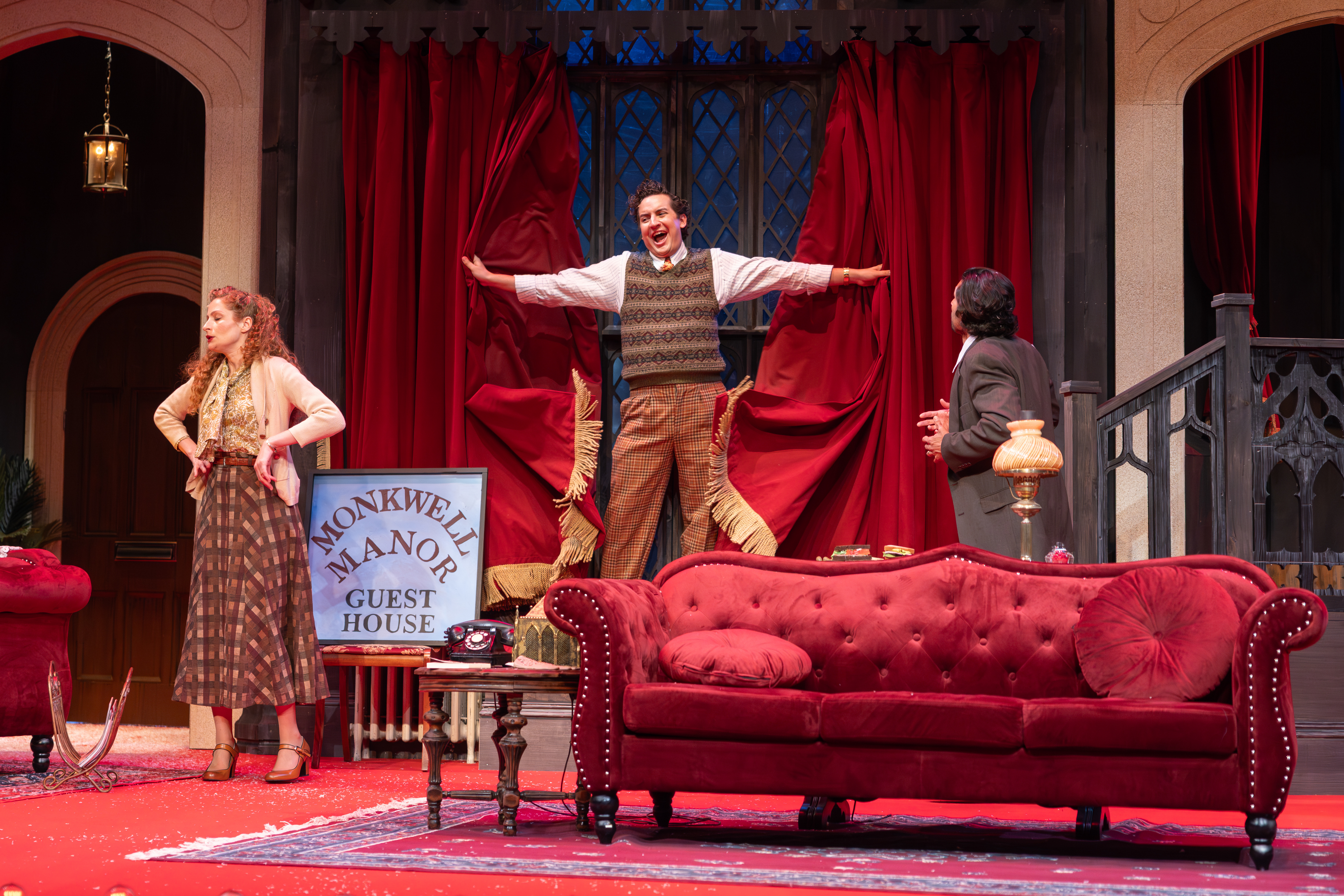
Greg Cuellar, a Mexican-American/Lipan Apache actor based in Los Angeles, plays Christopher Wren (an obviously assumed name). He gives a virtuoso performance that bridges the divide between over-the top melodrama and truthful emotion, tongue-in-cheek humor and genuine fear, low self-esteem and his need to entertain those around him. His stellar work in this play exemplifies the challenge to actors and directors who take on a melodrama and attempt to make it relevant and meaningful for contemporary audiences, who tend to ridicule the genre. Melodrama originated in France after the Revolution, when plays began to depict ordinary people caught in difficult circumstances. It became highly successful in the late nineteenth/early twentieth centuries in the U.S, because of its stock character formula, appealing to immigrant audiences who did not speak English but could identify with the characters. Hissing the villain, which helped to alleviate tension, cheering the hero who saved the heroine, and laughing with the comic sidekick were all part of the fun. Though melodrama eventually found its niche in films, this production shows us that it can still grip an audience in the theatre.

Gillian Saker and Keshav Moodliar In the Berkshire Theatre Group’s production of Agatha Christie’s “The Mousetrap”, directed by Gerry McIntyre. Photo: Caelan Carlough. 
Thursday Farrar and Keshav Moodliar In the Berkshire Theatre Group’s production of Agatha Christie’s “The Mousetrap”, directed by Gerry McIntyre. Photo: Caelan Carlough. 
Gillian Saker, Matt Sullivan, and Keshav Moodliar In the Berkshire Theatre Group’s production of Agatha Christie’s “The Mousetrap”, directed by Gerry McIntyre. Photo: Caelan Carlough. 
Thursday Farrar and Michael Kostroff In the Berkshire Theatre Group’s production of Agatha Christie’s “The Mousetrap”, directed by Gerry McIntyre. Photo: Caelan Carlough. 
Michael Kostroff, Bernadette Sefic, Gillian Saker, and Greg Cuellar In the Berkshire Theatre Group’s production of Agatha Christie’s “The Mousetrap”, directed by Gerry McIntyre. Photo: Caelan Carlough. 
Gillian Saker and Greg Cuellar In the Berkshire Theatre Group’s production of Agatha Christie’s “The Mousetrap”, directed by Gerry McIntyre. Photo: Tucker Bair. 
Gillian Saker, Greg Cuellar, and Keshav Moodliar n the Berkshire Theatre Group’s production of Agatha Christie’s “The Mousetrap”, directed by Gerry McIntyre. Photo: Tucker Bair. 
Bernadette Sefic In the Berkshire Theatre Group’s production of Agatha Christie’s “The Mousetrap”, directed by Gerry McIntyre. Photo: Tucker Bair. 
Allen Tedder, Gillian Saker and Keshav Moodliar In the Berkshire Theatre Group’s production of Agatha Christie’s “The Mousetrap”, directed by Gerry McIntyre. Photo: Tucker Bair. 
The cast of the Berkshire Theatre Group’s production of Agatha Christie’s “The Mousetrap”, directed by Gerry McIntyre. Photo: Tucker Bair. 
Michael Kostroff (Major Metcalf) and Allen Tedder (Sergeant Trotter) create characters who are instantly recognizable. Kostroff, playing a former soldier, is the perfect older English gentleman, offering help to anyone in need, while Tedder is the absolute embodiment of a Scotland Yard policeman. Notebook in hand, he is fast-talking, efficient, knows how to gather together the guests and innkeepers for questioning, and can bully and threaten them into giving him the information he needs to solve the case.
Matt Sullivan as Mr. Paravicini, the mystery guest who appears at the door without a reservation, amuses himself by scaring the group as he creates suspicion about his identity; Thursday Farrar plays Mrs. Boyle, who makes it instantly clear to anyone who listens that she thinks this guesthouse is subpar, run poorly by incompetents; and Bernadette Sefic plays Miss Casewell, dressed in manly garb, sporting a short red hairstyle, always seen with a cigarette and a drink, and keeping a low profile for much of the play.
McIntyre has chosen a top-notch design team. The set (designed by Bryce Cutler) is spectacular, hidden behind The Colonial’s luxurious red velvet curtain until the play begins. Much of the heavy Victorian furniture is deep red; there are various entrances and exits: a full-length window upstage with doors that allow actors to climb through, and doorways, arches, and a staircase with easy access in and out. Lighting cues (Sam Rushen designed the lighting) must be precise, especially when a dramatic blackout is called for. Realistic touches include lighting fixtures and an old-fashioned radio, which give the appearance of being controlled by the characters, and a fireplace with a screen and wood to replenish it as heating pipes freeze during the terrible snowstorm. And that snow! Throughout the play we can see heavy snow projected (again, Bryce Cutler) behind the upstage window, and whenever someone enters, snowflakes enter with them on their clothing, hair, and swirl around. Many of the beautiful, period costumes (designed by Dustin Cross) are in shades of purple, the men wearing double-breasted suits in plaids, stripes, checks, with colorful vests, ties, scarves, and the women in lovely dresses (except for Miss Casewell). The characters change all or parts of their costumes at different times. Sound designer Joanna Lynne Staub provides only one musical selection when the audience arrives until the play begins, which grinds on with a lugubrious, repetitive beat. But once the first act ends, the music changes to lively jazz pieces, mostly vocal.
It has always been a tradition in this play to warn the audience at the end not to reveal the identity of the murderer, and this production is no exception. But at intermission, Kate Maguire, the Artistic Director and CEO of Berkshire Theatre Group, delivers a recorded invitation to the audience to fill out a paper in the lobby indicating who they think the murderer is. The winner receives two free tickets to THE MOUSETRAP. Whether this is original or not, it surely adds a good deal of excitement to the intermission.
McIntyre strikes just the right balance in the tone of this production, maintaining a pace that builds tension throughout, and projects this old chestnut of a play forward to keep us involved, entertained, and guessing “whodunit.”
THE MOUSETRAP runs from July 24—August 17 at The Colonial Theatre, 111 South St., Pittsfield. For tickets call 413-997-4444 or online at www.BerkshireTheatreGroup.org
Berkshire Theatre Group presents THE MOUSETRAP by Agatha Christie.
Director: Gerry McIntyre. Cast: Greg Cuellar (Christopher Wren); Thursday Farrar (Mrs. Boyle); Michael Kostroff (Major Metcalf); Keshav Moodliar (Giles Ralston); Gillian Saker (Mollie Ralston); Bernadette Sefic (Miss Casewell); Matt Sullivan (Mr. Paravicini); Allen Tedder (Sergeant Trotter). Scenic Designer: Bryce Cutler; Costume Designer: Dustin Cross; Lighting Designer: Sam Rushen; Sound Designer: Joanna Lynne Staub; Projection Designer: Bryce Cutler; Dialect Coach: Jennifer Scapetis. Production Stage Manager: Jason Hindelang.
The performance runs two hours plus intermission.