

by Barbara Waldinger
Paula Vogel, multiple award-winning playwright and beloved teacher, explained in a 2024 interview in American Theatre that she has always tried to “write something that’s impossible to stage.” That was the year in which her MOTHER PLAY: a Play in Five Evictions, received its first Broadway production (directed by Tina Landau and starring Jessica Lange) and garnered several Tony nominations, including Best Play. The director of Shakespeare & Company’s current New England Premiere, Ariel Bock, rises to the challenge, describing her approach to the Berkshire Eagle: “The structure is loose enough that you can imagine almost anything and see how it works.” And that is exactly what Bock does.
Vogel is opposed to what she calls the “Tyrannosaurus Rex” theory of playwriting, espoused by Edward Albee (also Samuel Beckett), who insisted that no actor or director could change a word, not even a comma, in his scripts. Vogel believes that plays are meant to be interpreted by their collaborators. Bored by the business of theatre, Vogel prefers the rehearsal process, where her advice to the director and cast, according to Landau, is: “Take what you will, leave what you will, make your own, add, subtract.” In this way, claims Vogel, the three characters in MOTHER PLAY “are being created by the process, not by me as a writer.”
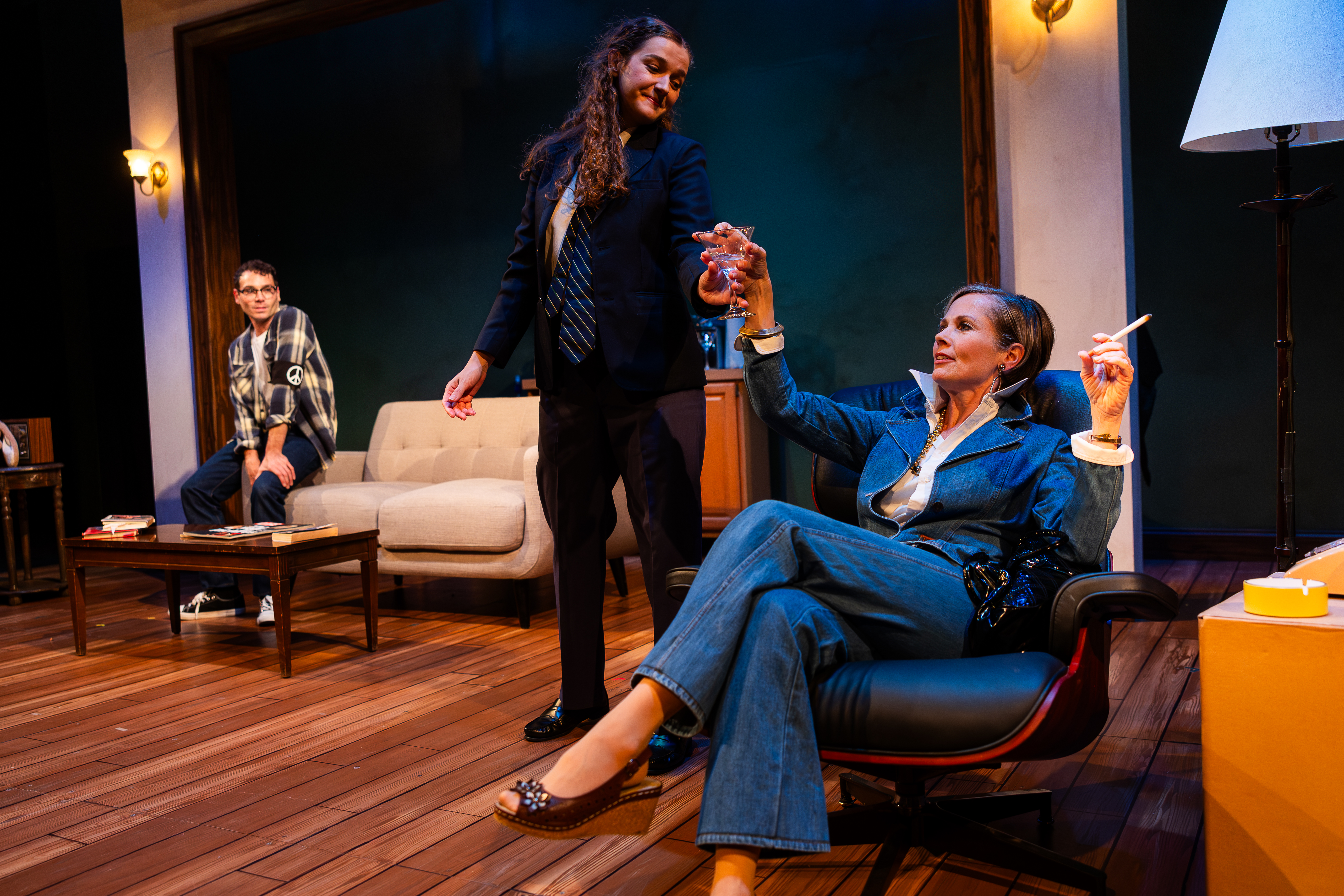
Considering that Vogel’s play is largely autobiographical, and no one but the playwright knew and felt deeply about these characters, it must have been difficult for her to let go, but that’s what makes Vogel so unique. MOTHER PLAY is a non-realistic, non-linear memory play, in which Martha Herman, the daughter (Zoya Martin), a stand-in for Vogel, remembers pieces of her past, which are then staged, describing her life with her adored brother, Carl Herman (Eddie Shields), and their outrageous and often appalling mother, Phyllis Herman (Tamara Hickey). It has been compared to THE GLASS MENAGERIE, but written from a female point of view. Vogel wrote an earlier darkly comic fantasy about Carl, The Baltimore Waltz, in which brother and sister travel throughout Europe during the AIDS crisis, and has completed a memoir called Travels Without Carl. The play begins in 1964 and spans about forty years, as the poverty-stricken family (the father abandoned them long ago) moves into a series of cockroach-infested basement apartments, each slightly better and higher than the one before, as the mother’s salary as a typist increases. Every scene brings us into a different historical and cultural time shift, brought to life by the design team. The play is both comedic and very painful, as the children grow and change, under the domination of a mother determined to control their choices.
What makes this play impossible to stage? Consider a few of the playwright’s limited stage directions: “Make a story when the roaches dance in transitions,” (she suggests a courtship, marriage, and babies); a magical purse for the mother that “can hold infinity;” and “Please sprinkle some magic throughout these basement apartments.”
With the help of Bock’s set designer, Omid Akbari, somehow these different apartments with their cardboard boxes containing all sorts of odd things (e.g. a stuffed rabbit), a couch, one comfortable chair and a coffee table, manage to look a bit different, especially as the children rearrange the furniture during transitions. An all-purpose chest or hutch upstage gives rise to almost every conceivable prop, seeming to appear and disappear as needed– food, unlimited alcohol (mother is an alcoholic), dishes and table settings, while hooks behind a constructed proscenium hold costume pieces. The set is simple, unencumbered, and easy to maneuver. Costumes (Arthur Wilson) that represent every decade are wild, since the mother is a clothes horse who buys fabulous outfits at thrift shops, and we must not forget the get-ups for the dancing cockroaches (choreography thanks to Susan Dibble; cockroach creation by Brendan F. Doyle, projections; and cockroach art by Jim Youngerman. Madeleine Hebert lights the stage, including a spinning disco ball for the 70s; and there is an assortment of “music and muzak” requested by Vogel and played throughout, provided by Bryn Scharenberg, sound designer.
Zoya Martin’s Martha controls the narrative: her memories tell the story. From a teenager to a caretaker of both her brother and eventually her mother, we witness her struggles to lead her own life, to maintain her relationship with her brother despite their mother’s homophobia, and to pay for and manage her mother’s care in a facility. Yet, in spite of the cruel, critical, at times unbearable behavior of her mother, Martha keeps returning to her side, always trying for the approval she never seems to obtain. This is a family, after all, and the bond of love they share is unbreakable. From beginning to end, Martin has captured our sympathy and we root for her. Like the never-ending supply of cockroaches, Martha is a survivor.
Eddie Shields’ Carl, mother’s favorite, a bookish intellectual accepted into Johns Hopkins, is nonetheless subject to Phyllis’s wrath, because he dresses like a member of SDS (a “hippie”) and worse, he’s gay (she calls him “filth”). He is more vulnerable than Martha, who would do anything to protect him from being hurt by his mother. Shields wear his heart on his sleeve—we always know how he feels, from the joy of sharing his youth with Martha, to the sorrow at his mother’s rejection.
Vogel offers many reasons to explain why Hickey’s Phyllis is such an angry, unrelenting parent– a force of nature steamrolling everyone in her path: she became pregnant while unmarried, never wanted to be a mother, was abandoned by her strict, right-wing parents, which left her no choice but to marry a man who turned out to be unfaithful and abusive, and had to bring up both children alone after he left. Ironically, this fierce woman still calls her parents every day, trying to get their approval (just as her own children kept trying for hers), which she never receives (a just dessert?). She would not dare, because she knew she would be blamed, tell them about her gay children.
About two-thirds through the play, after she is all alone in her apartment after evicting her children, the mother engages in what Vogel describes as a “Phyllis Ballet”– a long, extended non-speaking section, where she performs a series of mundane tasks. But it doesn’t hold the audience, who became visibly restless on opening night. It could have been because the silence lasted too long, or, more likely, we don’t feel sorry for Hickey’s Phyllis, because the actress projects the cruelty of the character but not the vulnerability that caused it.
Vogel claims to have written this play as a “ritual of forgiveness,” but is there really forgiveness at the end of this production? Can love exist without forgiveness?
MOTHER PLAY: A Play in Five Evictions runs from August 29—October 5 at the Elayne P. Bernstein Theatre, 70 Kemble St., Lenox. For tickets call 413-637-3353 or online at shakespeare.org.
Shakespeare & Company presents MOTHER PLAY by Paula Vogel. Director: Ariel Bock. Cast: Tamara Hickey (Phyllis Herman), Zoya Martin (Martha Herman), Eddie Shields (Carl Herman). Set Designer: Omid Akbari; Light Designer: Madeleine Hebert; Costume Designer: Arthur Wilson; Sound Designer: Bryn Scharenberg; Movement: Susan Dibble; Projections Designer: Brendan F. Doyle; Cockroach Art: Jim Youngerman. Production Stage Manager: Alex Magallanes.
The production runs one hour 35 minutes with no intermission.