

by Jeannie Marlin Woods
The Bennington Theater is a performing arts center formed in 2022 in the charming theatre space that was formerly the home of the Oldcastle Theatre Company. Offering a range of entertainment from standup and improv, to live music, to readings of new works, the group also has a community theatre “reimagined.” This year the community theatre is offering an attractive slate that is sure to entertain. The season opened with Lucas Hnath’s “A Doll’s House, Part 2.” The summer shows will be Shakespeare’s “Much Ado About Nothing” and Steve Martin’s “Picasso at the Lapin Agile.” The season will end in December with the “Nunsense” Christmas musical, “Nuncrackers.” What’s not to like?
“A Doll’s House, Part 2” is a diverting choice and quite a daring choice. It is not well known or typical light summer fare. It is, however, extremely well done and terrific theatre. David Dubov-Flinn is Co-Artistic Director as well as the Director for this work. He has pulled together an accomplished cast of actors and staged the play with a sure hand. The sparkling repartee and the solid ensemble work of the cast was a joy to behold.
To understand this play, we need to reflect on the theatre history that engendered it. It is, of course a sequel of sorts to Henrik Ibsen’s play, “A Doll’s House.” When Ibsen’s play premiered in Copenhagen, it sparked a huge outcry, that not only rattled society but also helped transform theatre—as it dealt with social mores on marriage and women’s place in the world. Ibsen’s play presents a seemingly happy, 19th century marriage between Nora and her husband, Torvald. Or so it seems. But Torvald treats his wife as a little doll, never really seeing who she is or perceiving what she needs or wants—to be taken seriously. When a crisis arises and he doesn’t stand by her side, Nora realizes she cannot sustain the relationship. At the end of the play, Nora abandons her husband and children and walks out the door to an unknown future.

Stephanie Phelan and Shawn Paper in “A Doll’s House, Part 2” by Lucas Hnath, directed by David Dubov-Flinn, at the Bennington Theater. 
Shawn Paper and Hope Jasper in “A Doll’s House, Part 2” by Lucas Hnath, directed by David Dubov-Flinn, at the Bennington Theater. 
Stephanie Phelan and Shawn Paper in “A Doll’s House, Part 2” by Lucas Hnath, directed by David Dubov-Flinn, at the Bennington Theater. 
Stephanie Phelan and Shawn Paper in “A Doll’s House, Part 2” by Lucas Hnath, directed by David Dubov-Flinn, at the Bennington Theater. 
Stephanie Phelan and Hope Jasper in “A Doll’s House, Part 2” by Lucas Hnath, directed by David Dubov-Flinn, at the Bennington Theater. 
Stephanie Phelan, Shawn Paper, Hope Jasper, and Tess McHugh in “A Doll’s House, Part 2” by Lucas Hnath, directed by David Dubov-Flinn, at the Bennington Theater. 
Stephanie Phelan and Shawn Paper in “A Doll’s House, Part 2” by Lucas Hnath, directed by David Dubov-Flinn, at the Bennington Theater. 
Hope Jasper in “A Doll’s House, Part 2” by Lucas Hnath, directed by David Dubov-Flinn, at the Bennington Theater. 
Shawn Paper and Tess McHugh in “A Doll’s House, Part 2” by Lucas Hnath, directed by David Dubov-Flinn, at the Bennington Theater. 
Stephanie Phelan in “A Doll’s House, Part 2” by Lucas Hnath, directed by David Dubov-Flinn, at the Bennington Theater. 
Stephanie Phelan and Tess McHugh in “A Doll’s House, Part 2” by Lucas Hnath, directed by David Dubov-Flinn, at the Bennington Theater. 
Shawn Paper in “A Doll’s House, Part 2” by Lucas Hnath, directed by David Dubov-Flinn, at the Bennington Theater. 
Stephanie Phelan and Shawn Paper in “A Doll’s House, Part 2” by Lucas Hnath, directed by David Dubov-Flinn, at the Bennington Theater. 
Stephanie Phelan and Shawn Paper in “A Doll’s House, Part 2” by Lucas Hnath, directed by David Dubov-Flinn, at the Bennington Theater. 
Shawn Paper and Hope Jasper in “A Doll’s House, Part 2” by Lucas Hnath, directed by David Dubov-Flinn, at the Bennington Theater. Photo: Danny Zaffarano, Vermont News and Media correspondent. 
Stephanie Phelan and Shawn Paper in “A Doll’s House, Part 2” by Lucas Hnath, directed by David Dubov-Flinn, at the Bennington Theater. Photo: Danny Zaffarano, Vermont News and Media correspondent. 
Hope Jasper and Stephanie Phelan in “A Doll’s House, Part 2” by Lucas Hnath, directed by David Dubov-Flinn, at the Bennington Theater. Photo: Danny Zaffarano, Vermont News and Media correspondent. 
Stephanie Phelan and Shawn Paper in “A Doll’s House, Part 2” by Lucas Hnath, directed by David Dubov-Flinn, at the Bennington Theater. 
Stephanie Phelan and Shawn Paper in “A Doll’s House, Part 2” by Lucas Hnath, directed by David Dubov-Flinn, at the Bennington Theater. 
Hope Jasper and Stephanie Phelan in “A Doll’s House, Part 2” by Lucas Hnath, directed by David Dubov-Flinn, at the Bennington Theater. 

In this new play by Lucas Hnath, Nora returns after 15 years of absence. What will she discover about the repercussions of her departure when she once again sees her husband, the housekeeper who raised her children, and her only daughter? This writer won’t tell you what happens because that is a great deal of the pleasure of the story. What I can tell you is that this script is not your grandmother’s Ibsen! Hnath has decided to keep the play in its original era and location in Norway, but to dispense with the formal, stilted language that we connect with Ibsen (although that is mostly a result of translation.) Instead, the text is liberally sprinkled with the F-bomb and other crass terms out of place with a story set 150 years ago. This is a bit jarring and disagreeable, but it does push the text into an interesting context. Ibsen and Chekhov were contemporaries and Chekhov’s work (because of how it was staged at the Moscow Art Theatre) tended to have the same grave and formal ambience as Ibsen’s. This was the modern drama, played in realistic style – a total disruption of the western theatre that had preceded it. However, Chekhov always claimed his plays were human comedies that should have revealed the irony and absurdity that imbues our lives. And that is what Hnath’s approach accomplishes. It reminded me of more recent productions of Chekhov where the characters are entangled in the folly of making sense of it all and it is funny, sad, and morose. This “Doll’s House” is entertaining and captivating through what amounts to a very long argument.
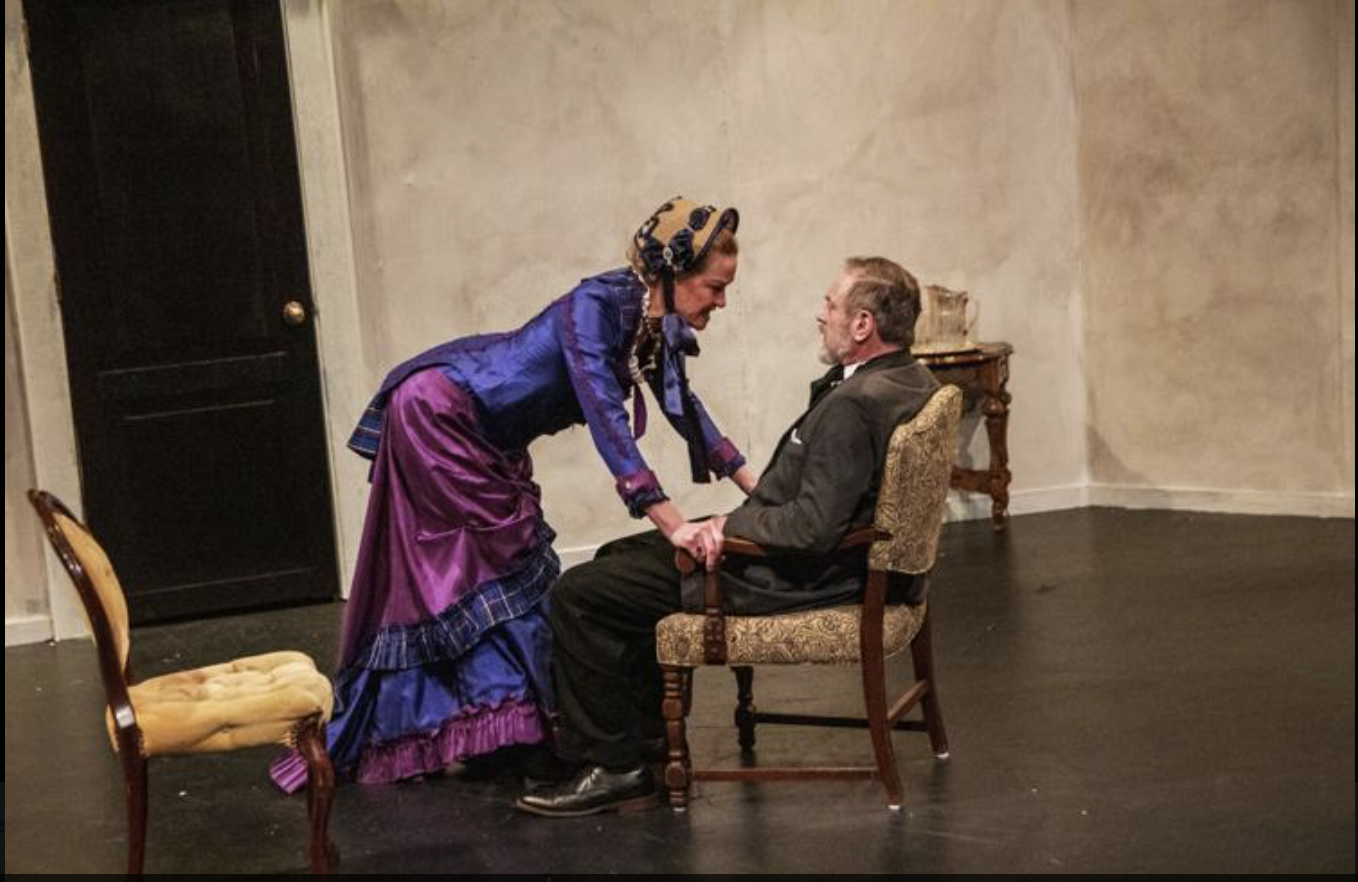
The key figure of the story is Nora, played with great perceptiveness and esprit by the marvelous Stephanie Phelan. While her voice was a tad shrill at the outset, as she settled into the performance and tapped into her lower register, she effectively portrayed a woman who had evolved into her authentic self. Shawn Paper was an excellent complement in the role of Torvald, her abandoned husband. From the outset he looked every inch the 19th century banker—stodgy and petulant. His final entrance showed us a deeper side and Paper found the pathos in the somber man who struggled to understand a modern woman. Hope Jasper and Tess McHugh filled out the cast. As the housekeeper, Anne Marie, Jasper was at her best in her comic moments. As Emmy (Nora’s teenage daughter), McHugh turned in a fine performance, effectively embracing the young girl but also finding the irony and intelligence in her character. Each actor contributed to the extremely fine ensemble performance – cues were tight and diction and projection were excellent – and they played off one another’s energy, sustaining the momentum from beginning to end.
On the technical side, costumer Janet Groom provided attractive clothing suitable to the period, although one or two pieces looked more like costumes than clothing. As for the setting for the play, it was a challenge in several ways. We learn that when Nora slammed that door, Torvald got rid of everything that was her or reminded him of her. As such, we have a large empty room and three doors (looking like a setting for a farce, which in a way it is.) With only two chairs, a small table at the back for drinks, an umbrella stand and a coatrack, the characters are almost lost in the open space. The light-colored walls and floor were far from the heavy “brown furniture” of Ibsen’s day and supported the idea that this was to be more of a comedy than a tragedy. Moreover, the bright, general lighting is stark and unchanging. No lighting designer is listed in the program, but the production would have benefitted from both area light and changes within scenes. One suggestion for the set – another small table next to the coat tree for the ladies’ hats would be most efficacious. Fortunately, the excellent performances made it all work. In fact, that creamy white space becomes a metaphor for the aftermath of Nora’s radical act—the room seems to be waiting for some force to change it.
As noted, “A Doll’s House, Part 2” was a brave start to the community theatre’s new season. It was also an extremely fine evening of theatre and all those involved should be proud of their accomplishment. It bodes well for the Bennington Theater season of 2026.
Credits
Playwright: Lucas Hnath
Director: David Dubov-Flinn
Costumer: Janet Groom
Set Construction: Todd Clark
Cast:
Hope Jasper as Anne Marie
Stephanie Phelan as Nora
Shawn Paper as Torvald
Tess McHugh as Emmy
Information
A DOLL’S HOUSE, PART 2 runs March 27-29 and April 3-5. Performances on Friday and Saturday at 7 p.m. and on Sunday at 2 p.m. For tickets, phone: (802) 500-5500.
Running time: 2 hours including one intermission
Bennington Theater, 331 Main Street, Bennington, VT 05201
Closing date: April 3
Website: www.benningtontheater.org