

by Barbara Waldinger
Anna Ziegler’s Photograph 51 is not only significant because of its account of Dr. Rosalind Franklin, a Jewish female scientist whose essential contributions to her field continue to be overlooked sixty-five years after her death, but also as a psychological study revealing how Franklin’s all-consuming approach to her work deprived her of her humanity as well as the recognition she deserved. In David Auburn’s simply-staged, beautifully-acted and directed production, complex questions arise about male-female relationships, the male-dominated world of science, and the intersection of scientific discovery and fame/fortune.
Auburn, Associate Artistic Director at Berkshire Theatre Group, directed last year’s Dracula, as well as many previous productions at BTG. He is also a successful playwright whose play Proof won the 2001 Pulitzer Prize, Tony Award, and New York Drama Critics Circle Award. Photograph 51,written in 2010, received its first major production in London’s West End starring Nicole Kidman, who won the Evening Standard Award for Best Actress. The following year the play won the 2016 WhatsOnStage award for Best New Play in London and has been widely produced and honored in the U.S. and globally. In 2020, Mandy Greenfield, then Artistic Director of the Williamstown Theatre Festival, was determined to produce the play but was thwarted by the closing of the theatre due to the pandemic. She decided to produce the whole season on Audible Theater’s series for Audiobooks. Directed by Susan Stroman, Photograph 51 was recorded by actors who spoke their lines remotely from their homes.
The play takes place between 1951-1953, when Franklin (Rebecca Brooksher) is offered a fellowship at King’s College London, luring her away from the position she enjoyed at the Laboratoire Centrale in Paris. What she doesn’t realize until she arrives in London is that instead of working on what interested her (proteins), she would be deciphering the structure of DNA, and instead of doing her own research, she would be an assistant to another scientist, Dr. Maurice Wilkins (David Adkins). Wilkins, seeing her disappointment, offers a partnership. He explains that once the shape of the DNA molecule is determined, scientists will be able to figure out how the molecule replicates itself, passing genetic information from parent to child, basically “the secret of life.” But Franklin is angry, insulted, insisting that she work alone on her own time table. As scientist Dr. James Watson (Allen Tedder) observes: “She was meant to be Wilkins’ assistant, and therein lies the problem. She misunderstood the terms. And after that, the rest was inevitable. The race lost right there. In a single moment.”
This narration illustrates two things: the fascinating structure of the play and the intransigence of Franklin. Each of the five male actors serves as both character and narrator. In this way, Ziegler is able to convey scientific information to a general audience and allows the action to move back and forth in time and place without confusion. Many scientists, including Dr. Linus Pauling, were working on the structure of DNA—they were going in the right direction but made mistakes (Pauling thought there were three strands of DNA instead of a double helix.) The race to get it right provides much of the tension in the play. Eventually Watson, his partner Dr. Francis Crick (Christian Coulson), and Wilkins win the Nobel Prize, thanks in large part to the uncredited title photograph taken by Franklin, an expert in X-ray crystallography.

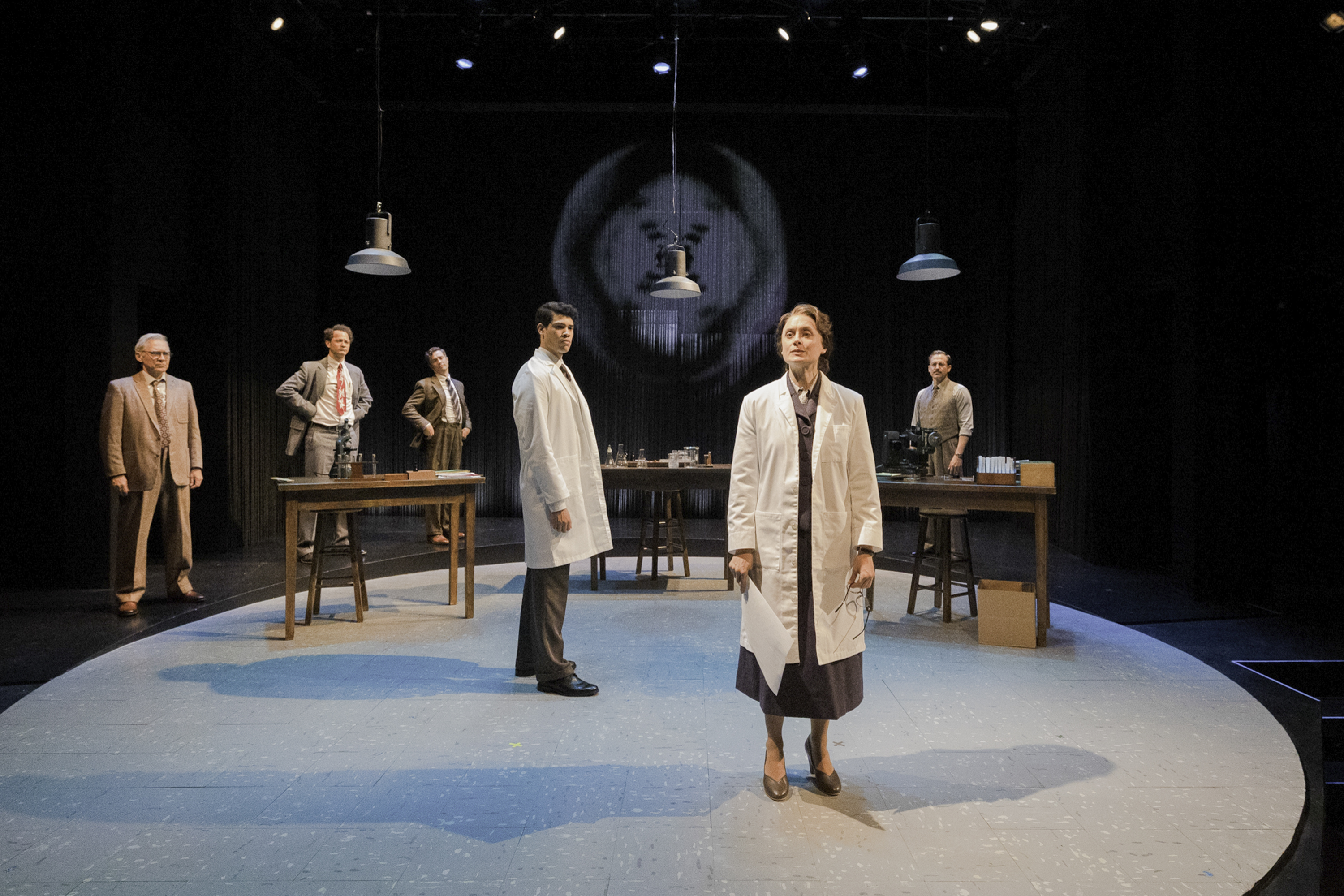
The cast of Photograph 51, 2023. Photo by Emma K. Rothenberg-Ware. 
David Adkins, Brandon Dial and Rebecca Brooksher in Photograph 51, 2023. Photo by Emma K. Rothenberg-Ware. 
Brandon Dial and Rebecca Brooksher in Photograph 51, 2023. Photo by Emma K. Rothenberg-Ware. 
Allen Tedder, Christian Coulson and David Adkins in Photograph 51, 2023. Photo by Emma K. Rothenberg-Ware. 
Poster art for Photograph 51 at the Berkshire Theatre Group 2023.
Rebecca Brooksher is in top form both as she fights for her rights (e.g. to be called Dr. Franklin rather than Rosalind or Rosy, and be permitted to dine in the senior common room [for men only]), and as she reveals her vulnerabilities. At the University of Cambridge, when she insisted on majoring in science though her father had advised against it, he warned: “Rosalind, if you insist on going forward with this life… you must never be wrong. In one instance, you could lose all you’ve achieved.” Franklin shares her personal reaction with the audience: “But it was in that moment that, without realizing it, a kind of fear set in, a dread around the edges of my convictions. . .” Perhaps that explains her refusal to share her findings, her workaholic hours at the lab, her inability to proclaim her discovery, to be acknowledged, to win the race.
Though the subject matter of Photograph 51 is serious, flashes of humor permeate the play, delivered by Allen Tedder’s Watson—a loud-mouthed, win-at-all-costs American scientist with bad hair; and Brandon Dial’s Ray Gosling, Franklin’s doctoral assistant, who often finds himself in the position of mediator between Wilkins and Franklin.
David Atkins’ Wilkins, with his stiff, bumbling attempts at a relationship with Franklin, has no clue how to deal with an intelligent and capable female scientist. He would be pitiable if it weren’t for his burning ambition, which leads him to collaborate with Watson and Crick (his friend from Cambridge) at the expense of Franklin. Shaun Anthony’s Don Caspar, an American Jewish scientist who recognizes Franklin’s brilliance and is eager to work with her, forges the only real (though short-lived) emotional connection between Franklin and any of the males in the play.
The spare set is composed of a large, blue-tinged oval where the action takes place, behind which is a black raised area where the narrators tell the story. Scenic designer Bill Clarke has provided three desks, lamps and stools with microscopes and other paraphernalia used by the scientists in the oval that can easily be carried on and off stage. In a Berkshire Eagle interview, Auburn talks of the cinematic nature of the script, which he has successfully transformed using the trappings of theatre with the help of Clarke, Scott Killian’s music/soundscape and the lighting and projections of Daniel J. Kotlowitz.
The combination of Ziegler’s multi-layered, poetic script, with its symbolic references to Shakespeare’s The Winter’s Tale, the quality and depth of the performances and direction, coupled with the contributions of the understated but no less valuable design team, results in a compelling production that remains in the mind of the viewer long after the lights go dark.
PHOTOGRAPH 51 runs from June 15-July 1 at Berkshire Theatre Group’s Unicorn Theatre, The Larry Vaber Stage, 6 East Street, Stockbridge, MA. For tickets call 413-997-4444 or online at BerkshireTheatreGroup.org.
Berkshire Theatre Group presents PHOTOGRAPH 51 by Anna Ziegler. Director: David Auburn. Cast: David Adkins (Maurice Wilkins), Shaun Anthony (Don Caspar), Rebecca Brooksher (Rosalind Franklin), Christian Coulson (Francis Crick), Brandon Dial (Ray Gosling), Allen Tedder (James Watson). Scenic Designer: Bill Clarke; Costume Designer: Elivia Bovenzi Blitz; Lighting & Projections Designer: Daniel J. Kotlowitz; Resident Composer/Sound Designer: Scott Killian; Wig Designer: Mary Schilling-Martin; Resident Dialect Coach: Jennifer Scapetis-Tycer. Production Stage Manager: Jason Weixelman.
The production runs one hour 45 minutes. There is no intermission.