

by Jess Hoffman
If you are looking for a world premier of an award-winning modern playwright without having to travel to New York City, you may be in luck! Three Mothers by Ajene D. Washington won the Next Act! New Play Summit in 2022 and it is now being produced on Capital Repertory Theatre’s main stage. Three Mothers certainly has an intriguing description: “June 21, 1964. Three young men were tortured and murdered by the Ku Klux Klan in Neshoba County, Mississippi. Their crime: registering Black Americans to vote and being born Black or Jewish. Taking inspiration from the 1964 photo of their bereft mothers leaving the final funeral together, Three Mothers is the imagined moment afterward.”
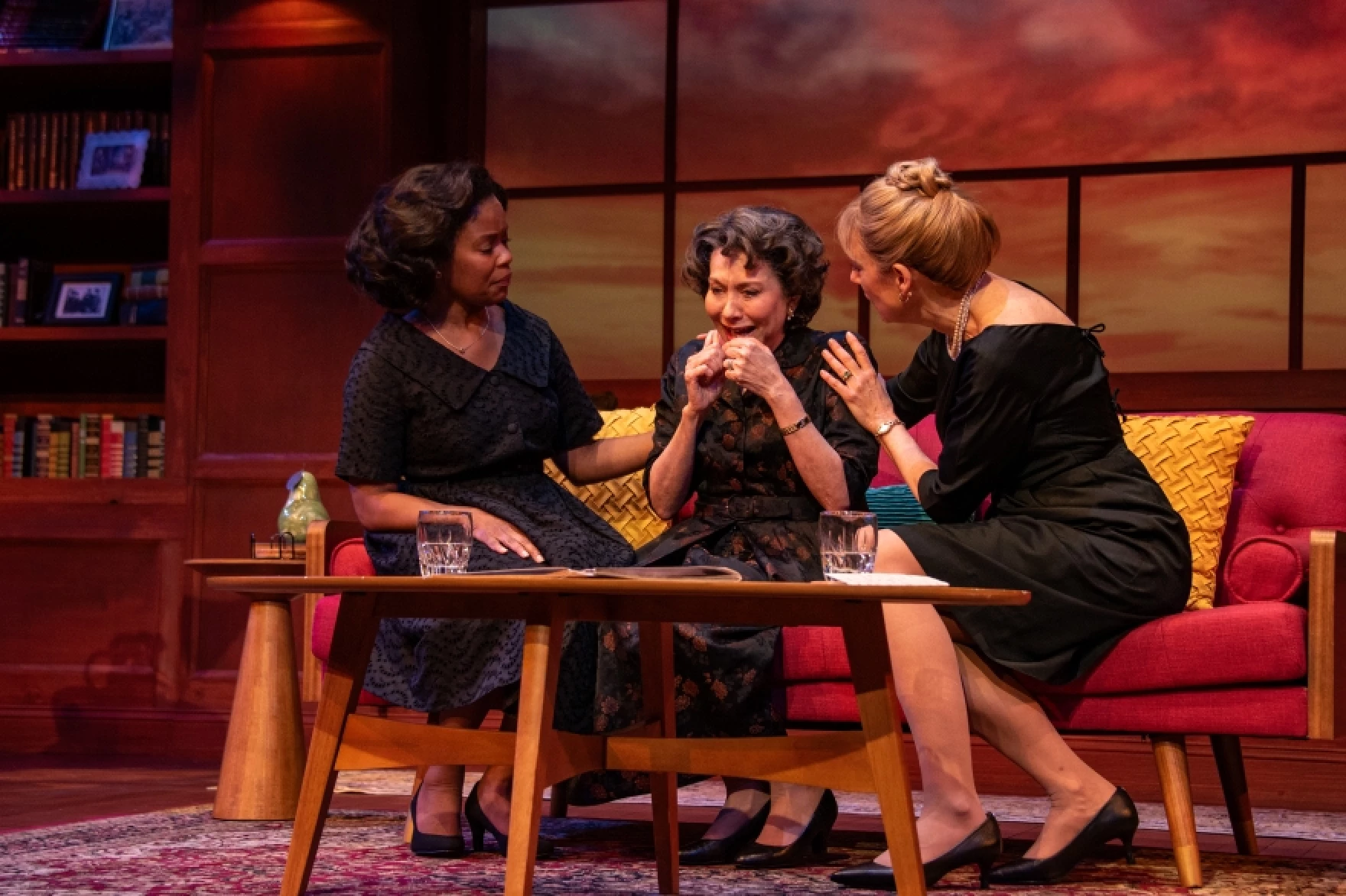
This historical crime and the larger historical moment of 1960s America offer a plethora of emotions, tensions, and struggles for playwright and actors alike to work with. The three actresses in this show seem to understand that and do an excellent job showing the different ways that three very different women cope with loss. Judith Lightfoot Clarke plays the coolly stoic activist Carolyn Goodman with a practiced detachment that betrays a depth of emotion that she cannot express. Cheryl Stern plays the fretful Jewish schoolteacher Anne Schwerner with a lovable intensity that will likely remind audience members of at least one overbearing but well-meaning woman in their lives. Most impressive of all is Trisha Jeffrey’s portrayal of Fanny Lee Chaney, the African American Mississippi native whose son suffered the most brutality of the three. From the moment she steps on set, we immediately see that Fanny is out of her element, but her stalwart nature also shines through. As the other women insistently try to “help” Fanny by finding her and her family a place to live in New York, Fanny continues to argue that her place is in Mississippi, finishing the work that her son started. Even as she does this, she seems to be at war with herself, for she knows that Mississippi is a dangerous place for herself and her younger son.
The three women look their parts as very different women of the 1960s. All three wear different styles of black dresses, expertly chosen by costume designer Elivia Bovenzi Blitz to suit each character’s age, status, and overall personality. Special props must also be given to Tommy Kurzman’s wig styling for the three women’s sixties dos.


The set, designed by Baron E. Pugh, appears to be a lavish penthouse apartment. The stage is open and spacious, but not sparse; a desk stands in one corner while a plush couch takes center stage. Bookshelves line the back wall where a small menorah and understated Star of David give a clue to the cultural background of the beautiful penthouse’s owner. The three grieving mothers standing amidst such a large background in a grand room reminds the audience what a small part these women play in the larger forces shaping American politics.
Unfortunately, the writing in Three Mothers never reaches its full potential, and because of that its talented cast members lack the opportunity to move the audience as they might have been able to do with a more nuanced script. In his haste to explore the different cultural moments at play, Washington attempts to do far too much in too short a time. His play rapidly shifts focus between the mothers’ grief and different historical movements and issues in a way that ensures none of these themes ever receive the depth of exploration they deserve. In addition to (or, perhaps because of) the rapidly shifting focus, Three Mothers lacks a satisfactorily unified plotline; the closest this play ever gets to reaching a climactic or pivotal point is with the reveal of the involvement of both the Mississippi State Sovereignty Commission and the Ku Klux Klan in the murders, which isn’t much of a reveal at all. It is a shame, because this play touches on a lot of very important and timely topics–hate, violence, political protest, social justice, and the way that tragedy can galvanize change–but fails to ever explore any of these topics in a meaningful way. This play is, in fact, so timely that it reminds me of the unforgivably shallow conversations around deeply important topics that I currently see on the 24-hour news cycle or on social media. This shallowness does not do for a play about the grieving mothers of hate-crime victims.
Despite its lackluster script, the excellent stagecraft and immensely talented cast of Three Mothers redeem it somewhat. Those theatergoers expecting a complex and timely meditation on social justice, or those who hope to see a deeply emotional play about loss, grief, and coping are not going to find what they had hoped for. But for those who are happy enough to see some excellent stagecraft, Three Mothers will be worth the time.
Capital Repertory Theatre presents the world premier of Three Mothers by Ajene D. Washington, directed by Petronia Paley, runs from April 26 – May 12, 2024, at the REP, 251 North Pearl St., Albany, NY 12207. Cast: Trisha Jeffrey as Fanny Lee Chaney, Cheryl Stern as Anne Schwerner, and Judith Lightfoot Clarke as Carolyn Goodman. Casting Director: Stephanie Klapper, csa. Production Stage Manager: Shayne David Cameris. Assistant Stage Manager: Michaela Savoie. Set design by Baron E. Pugh. Lighting design by Devorah Kengmana. Costume design by Elivia Bovenzi Blitz. Sound design by Nathan Leigh. Projection design by Kylee Loera. Wig design by Tommy Kurzman.
Performance dates are Tuesday–Sunday (April 26-May 12). Wednesday and Thursday performances are at 7:30pm, with one weekday matinee on Wednesday May 8 at 2pm, Friday performances are at 8pm, Saturday performances are at 3pm and 8pm, and Sunday performances are at 2pm. Tickets range from $20 to $52. Runs approximately 90 minutes with no intermission. Contains discussions of murder, torture, and hate crimes, and cultural prejudice. Recommended for ages 13+. Tickets are available at the door, by phone at (518) 346-6204, or online at https://capitalrep.org/.