

by Paula Kaplan-Reiss
“Who’s crazy, the husband or wife…the one who can’t cope, or maybe the one who’ll still hope?” sings Dan in Next to Normal at Barrington Stage Company (in a co-production with Round House Theatre) about his struggling wife, Diana, and his suffering family. A Tony Award and Pulitzer Prize winning musical, Next to Normal was originally performed on Broadway in 2009.
As a psychologist, I can’t help but notice the mental health issues characters possess in the theatre I’ve seen here in the Berkshires. Having just seen a wonderful production of The Islanders at Shakespeare & Company, where bipolar disorder is on full display, psychopathology and the havoc it wreaks on friends and family make dramatic grist for the playwrights’ mill. The powerful voices and performances of the cast of Next to Normal draw us into the painful world of everyone affected.
‘Just Another Day’ is the song that introduces us to the family: Dad Dan (Alan H. Green), Mom Diana (Natalie Joy Johnson), daughter Natalie (Madison McBride), and son Gabe (Adante Carter). We immediately see how everyone struggles to be a “perfect loving family,” but, on the inside, Diana tries to keep it together while her family dreams of running away.
Suffering from treatment resistant bipolar disorder triggered by the tragic loss of her infant son 18 years before, Diana is married to her devoted husband, Dan. Dan sticks by Diana, sometimes delighted by her sexy vivacious behavior, and other times alarmed, brings her to the doctor to have her medicine regulated when she is out of control. Teenage daughter, Natalie, a pianist, tries to be the good girl, and longs to be seen by her mother, while being on high alert for changes in her mother’s unpredictable mood and actions.
We soon learn that Gabe, played as a high school teen, can only be seen by Diana. In fact, his loss and his presence keep Diana in her delusional world and is the biggest symbol of her mental illness. Natalie, constantly frustrated that the brother she never knew is the only child her mother ‘sees,’ feels ignored and neglected.
Her world changes when stoner, Henry (Ben Clark) shows interest in her as she practices piano, and introduces her to the world of pot and clubbing. Having watched her mother take endless meds, Natalie allows herself to escape into a world of drugs, while resisting letting Henry meet her dysfunctional family. They sing ‘Perfect for You,’ believing, “…even if everything else turns to dirt, we’ll be the one thing in this world that won’t hurt.”


Diana visits endless doctors, all played by Joseph Morales. Bipolar disorder left untreated can result in aggressive, impulsive behaviors or severe depression, with risk of suicide. Often finding the right medication or the right dosage can be difficult, as Diana experiences. We watch her see her psychiatrist week after week, experiencing numerous side effects from her pharmaceutical cocktail, including diarrhea, numbness, constipation, and anxiety. Only when she no longer feels like herself and feels nothing does her doctor proclaim her stable. Yet, Diana cannot tolerate this ‘stability.’
‘I Miss the Mountains’ is the song that depicts the clearest reason why Diana decides to go off her meds. “I miss the mountains, I miss the highs and lows, all the climbing, all the falling, all while the wild wind blows…”
Playing Diana requires Johnson to display every emotion a woman endures being crippled by bipolar disorder, as a mother, wife, patient, and a survivor of loss of the greatest magnitude. She more than succeeds. Her voice soars, belts, and whispers. We feel her desperation and hopelessness. We see her hallucinated relationship with Gabe and wish with her that he was alive. She commands the stage and everyone around her.
Green, as Dan, tries to be everyone that Diana cannot be for the family. His patience is endless. Green sings powerfully and beautifully. He gently tries to show Diana the truth about Gabe, yet fears setting off her delusions when memory loss from ECT (electroconvulsive therapy) is significantly impaired. He is in a thankless, helpless position. Green plays this role perfectly. As Diana and Dan sing to each other and to themselves, ‘Why Stay?’ we see a couple who loves each other, but miss when life was easier and wonder if their future will improve.
McBride, as Natalie, experiences adolescent angst on steroids. Superboy and the Invisible Girl aptly displays her competition with her deceased brother. Wanting intimacy and attention, fearing closeness, experimenting with drugs and acting out, we watch Natalie mirror her mother’s behavior and relationship, playing opposite Henry, her accepting boyfriend. McBride, too, enables us to feel her every frustration, especially with her magnificent voice. Clark, as Henry, is nothing but eager and comforting, harmonizing beautifully with McBride.
Carter as Gabe is a standout. Given that his mother is constantly drawn to his presence, Gabe needs to draw in the entire audience. Carter, singing I’m Alive, has no difficulty attracting, seducing, singing and enticing all of us to believe in him.
Morales portraying every hopeful psychiatrist, must alternate between playing a rockstar in Diana’s imagination and the patient physician who offers medication, hypnosis, therapy, ECT and hospitalization.
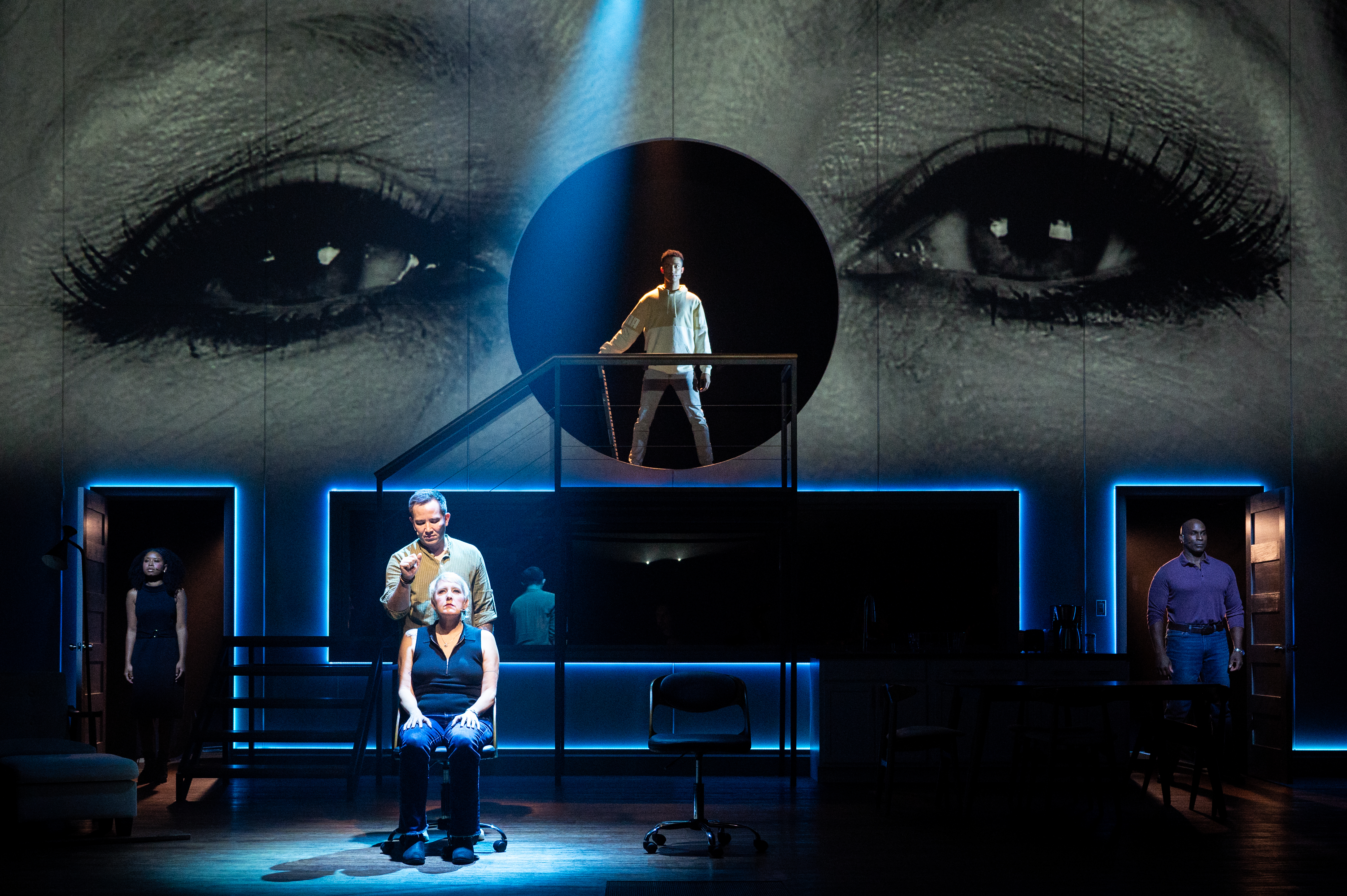
Director, Alan Paul, Scenic Designer, Wilson Chin, Projection Designer, Nicholas Hussong and Lighting Designer, Cory Pattak work together masterfully to create an atmosphere bringing us up close to a chaotic world. We see a single eye projected in black and white on a grey backdrop as we enter the theatre. Whose eye is this? What does it see? What does it mean? On a mostly bare stage with a chair and ottoman stage right and a kitchen set stage left, we see a set of metal stairs, upstage, rise to a second level, with a huge cutout circle where characters appear and disappear. Creating intensity, we often see the same characters on stage in a huge mirrored projection behind them. This technique is clever, unique and powerful in magnifying every character’s feelings. The only minor distraction is the taped microphone on each actor’s face seen jumbo size in the projections.
The rock band, conducted by Jacob Carli and directed by Angela Steiner, requires a good sound system designed by Ken Travis to hear the musicians and the actors. The score is wonderful and together the cast often sings different melodies and lyrics which we need to hear and remarkably we do.
Next to Normal’s book, characters and music are hard to forget and linger long after the performance is over. Rarely does the story of mental illness have a happy ending. Families chronically struggle, but go on, searching for the light, hoping to get close to normal. As the doctor sadly sings, “You’ve struggled for years, but you’ve only begun.” Kudos to this cast of Next to Normal and Alan Paul for effectively presenting the suffering of too many people in this world, while enabling us all to feel empathy.
Barrington Stage Company, (in a co-production with Round House Theatre) , presents Next to Normal, music by Tom Kitt, book & lyrics by Brian Yorkey, directed by Alan Paul, running from August 14-September 8, 2024, on the Boyd-Quinson Mainstage at 30 Union Street in Pittsfield, MA. CAST: Natalie Joy Johnson as Diana, Alan H. Green as Dan, Madison McBride as Natalie, Adante Carter as Gabe, Ben Clark as Henry, Joseph Morales as Dr. Madden. CREATIVE TEAM: Choreography by Eamon John Foley, scenic design by Wilson Chin, costume design by Helen Huang, lighting design by Cory Pattak, sound design by Ken Travis, projections design by Nick Hussong, and musical direction by Angela Steiner. Production Stage Manager is Jason Brouillard. Casting by McCorkle Casting Ltd.
Performances Tuesday and Wednesday at 7:30 p.m., Thursday through Saturday at 8:00 p.m., Matinees Wednesday and Saturday at 2:00 p.m., and Sunday at 3:00 p.m. Boyd-Quinson Stage (30 Union Street). Tickets: $25 – $89. 413-236-8888, barringtonstageco.org.