

by Barbara Waldinger
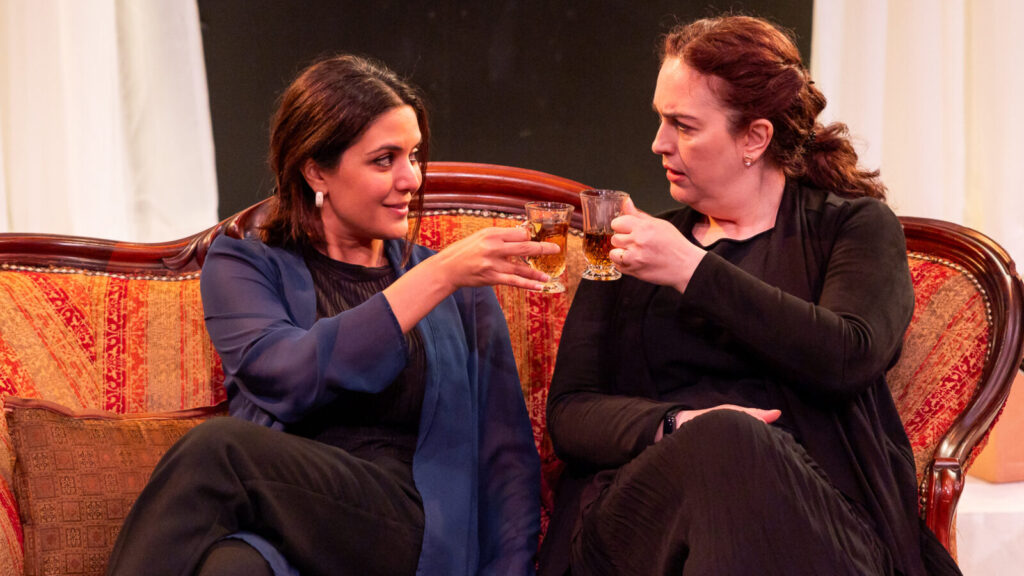
Shakespeare & Company’s fall play, THREE TALL PERSIAN WOMEN, a world premiere by Awni Abdi-Bahri (who also plays Golnar, the youngest of the women), is about many things: a gathering (the “mehmooni”) of three generations of Iranian women and their friends to pay homage to Golnar’s father one year after his funeral; the cultural importance of mourning and expressing grief long after that funeral; the migration of an Iranian family who left their home in Iran and fled to the U.S. after a revolution that deposed the Shah and threatened their freedom; the culture clash between Iranian and American traditions and values; women’s roles; intergenerational conflict; the impact of the past on the present. If all of this sounds intense, the play is also a sitcom about the scheme of Golnar’s mother, Nasrin, and grandmother, Mamani, who intend to marry her off to a traditional Iranian man from a good family.
When a playwright introduces such a variety of issues and genres in one script, it becomes like a soup stuffed with so many ingredients that it loses track of what it was supposed to be in the first place. In a discussion with Kate Abbott in “btw Berkshires,” cast members and Abdi-Bahri express their delight at being able to portray their characters through humor and joy, something they don’t often get to do because of the traumas these displaced women have faced. Not only do the performers get to enjoy being in a comedy, but it helps their audiences to laugh with them, to see them as individuals, rather than stereotypes; every culture can identify with wanting to see their children settled and happy with a caring, like-minded spouse. The audience seems to love the broad comedy with its punch lines and zingers, especially those delivered by Lanna Joffrey (Mamani). But if that’s what Abdi-Bahri wanted to write, why bring in all of these other issues? There is no time to develop them before each one leads to a joke. For example, Golnar, trying to help her family get rid of their past possessions (literally in boxes obstructing their every movement since Mamani moved in), begins to sell them secretly on e-bay to earn enough money to afford a west coast apartment. Each sale sends the audience into gales of laughter. Then why raise the complex subject of letting go of the past? And why have Mamani glorify the days when the Shah ruled Iran and her life was good, just to face the groans of the other women when she keeps repeating it? Maybe the audience might like to know what conditions were like for her before and after the Shah. For the most part the dialogue is comedic but when each woman has the opportunity to speak her mind in a monologue away from the others, then we get to the heart of who they really are. Abdi-Bahri needs to decide what message she wants to convey.


Edward Albee wrote a Pulitzer-prize-winning play called THREE TALL WOMEN, his most personal work, about his difficult relationship with his mother. In the first act the play features an old woman nearing death, her middle-aged female caretaker, and even younger lawyer. In the second act we learn that all three women represent three stages in the life of the same woman (presumably his mother). What was Abdi-Bahri implying when she named her play? In an interview with the Eagle, she explained that the idea for the play was suggested by her moving back from New York to Southern California during the pandemic to be with her mother and grandmother, who lived next door. Could it be that she wants us to see the three generations of women as one, not only at different stages, but coming from a different culture and tradition—that Golnar could have been her mother or grandmother had she lived in Iran?
Abdi-Bahri plays Golnar as an anxious, high-strung young writer, living in New York, who is so uncomfortable being in her mother’s house for the mehmooni that she’s ready to flee at nearly every word her mother speaks, painfully sensitive to what she feels is her mother’s disapproval and judgmental attitude towards her. There is a palpable awkwardness between Nasrin (Niousha Noor) and Golnar, well played by both actors, unfortunately broken by Noor’s too obvious attempt to speak words that she heard from a therapist or that she read in some self-help book. Despite their difficulty communicating, we feel the love between these women, but the cultural gap may be too great to bridge. Joffrey’s Mamani is actually more open-minded than her daughter: she’s closer to her granddaughter in her thinking and her actions. She doesn’t believe in accepting her lot in life and she makes that very clear. Afsheen Misaghi plays Shayan, the sole male, the guy Nasrin and Mamani want Golnar to marry. It turns out that the young people have known each other for years as neighbors. Though Iranian-American, like Golnar he does not share the repressive beliefs of the current regime in Iran. With a good job and a home, he’s modern, likable, and when Golnar realizes they’ve been set up and proceeds to insult him cruelly, he knows very well how to respond in kind.
Set designer Omid Akbari has cleverly arranged the small stage of the Bernstein Theatre to represent the different rooms in the California home all at the same time, including an upstage platform with full-length chiffon-like curtains that offers a separate playing area. Sound Designer Bryn Scharenberg’s music selections add immeasurably during the scene transitions in furthering the story of the two cultures. Director Dalia Ashurina (longtime friend of the playwright) keeps the action going at a fast clip, despite the clutter of Mamani’s boxes, a small bed and a piano onstage.
Speaking of the double challenge of writing and performing in her own play, Abdi-Bahri expresses her appreciation to the cast and director for their collaboration as she revised the script while rehearsing it. Hopefully the process will continue beyond this production so that she can keep what’s best and rework the rest.
THREE TALL PERSIAN WOMEN runs from August 30-October 13 at Shakespeare & Company’s Bernstein Theatre, 70 Kemble Street, Lenox, MA. For tickets call 413-637-3353 or online at shakespeare.org.
Shakespeare & Company presents THREE TALL PERSIAN WOMEN by Awni Abdi-Bahri. Director: Dalia Ashurina. Cast: Awni Abdi-Bahri (Golnar), Lanna Joffrey (Mamani), Afsheen Misaghi (Shayan), Niousha Noor (Nasrin). Set Designer: Omid Akbari; Light Designer: Erika Johnson; Costume Designer: Andrea Herrera; Sound Designer: Bryn Scharenberg; Intimacy Director: Atalanta Siegel. Production Stage Managers: Anthony Feola, Amelia Heastings.
The performance runs two and hours ten minutes, including intermission.