

by Gail M. Burns
You will not enjoy this production if you are…
1. a Gilbertian purist
2. a Scotsperson who is rabid and humorless about their ethnic heritage
3. a Gilbert & Sullivan hater
Everyone else will have a wonderful time and should buy a ticket forthwith!
I know way too much (and simultaneously not enough) about Gilbert & Sullivan, which makes me both the best and the worst critic to be writing this review. It is too easy for me to start this piece from the “knowing too much” side of things, so let’s start at the beginning.
Sir William Schwenk Gilbert (1836-1911) and Sir Arthur Seymour Sullivan (1842-1900) were an internationally famous British lyricist/composer team who cranked out 13 comic operettas that are still widely performed. That being said, their style is very British and very Victorian and not to everyone’s taste, but there’s no doubt that American musical comedy is a direct descendant of Gilbert & Sullivan.
Coming smack in the middle of their oeuvre, their 1885 operetta “The Mikado” is considered Sullivan’s musical masterwork in this genre (Sullivan was also a serious classical and ecceslesiastical composer); and while Gilbert’s libretto has a remarkably weak second act, there’s no question that the intricate and erudite lyrics are some of his best. Both Stephen Sondheim and Lin-Manuel Miranda were greatly influenced by Gilbert.
Japan was “opened” to “the west” in 1853, so by the time “The Mikado” was written there was a popular craze for “all things Japanese” and “The Mikado” is set in Japan. Well, not really. All of Gilbert’s plays and operettas are set in what was called “cloud cuckooland” in the Victorian vernacular. Gilbert was making fun of Great Britain and its politics. He knew and cared little about real Japanese people and culture, but the show is traditionally presented in yellow-face which is very problematic today.
How to present Sullivan’s greatest and most beloved musical score without cultural appropriation or being just plain offensive?
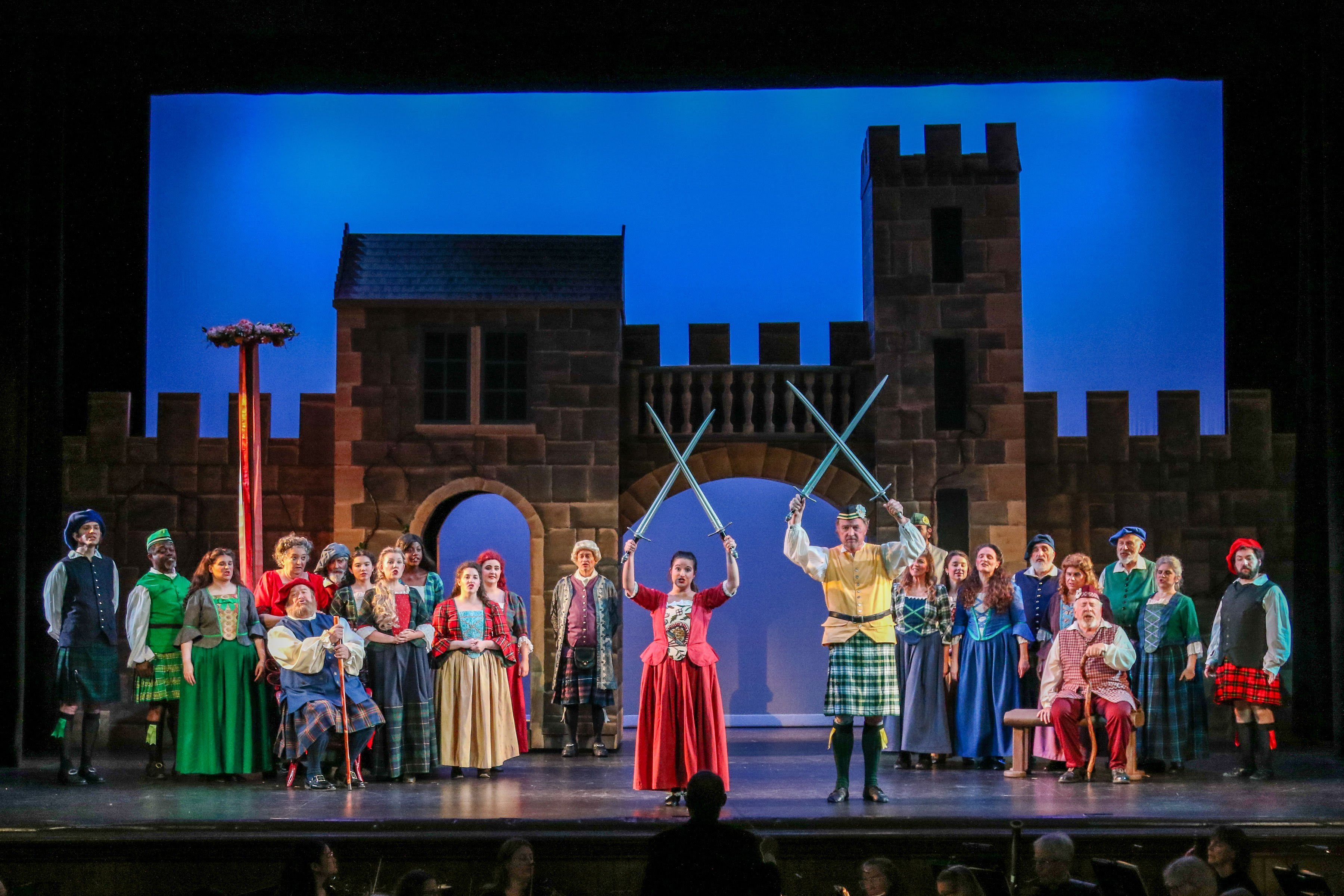
The answer according to Michael Meigs and Jeffrey Jones-Ragona of Gilbert & Sullivan Austin (TX), the solution is to set the action in Scotland and call the whole thing “The McAdo” which is what the Valley Light Opera (VLO) is presenting at the Academy of Music Theatre in Northampton in a cheerfully silly production directed by Jacqueline Haney.
Is it less politically correct to poke fun at the Scots? Logic tells me no, but applying Gilbertian logic that answer is happily yes. I, Mrs. Robert Burns, sat through an entire afternoon of bad Scots accents and wasn’t offended once. The accents would undoubtedly make the ears of true highland lads and lassies bleed, but they were consistent and therefore very funny.

Rory Mason as Wee Jo, Elaine Crane as Wynn Somme, and Katelyn Geary as Pretty Jean in the Valley Light Opera’s production of “The McAdo” directed by Jacqueline Haney. Photo credit: Paige Fowler Photography, 
Elaine Crane as Wynn Somme and Brad Amidon as Nanky-Doug in the Valley Light Opera’s production of “The McAdo” directed by Jacqueline Haney. Photo credit: Paige Fowler Photography, 
David Leslie as Pubagh, Thom Griffin as Coco, and Jeff Erb as Pischtusch in the Valley Light Opera’s production of “The McAdo” directed by Jacqueline Haney. Photo credit: Paige Fowler Photography, 
Kathy Blaisdell as Katishaugh and David Belew as The McAdo in the Valley Light Opera’s production of “The McAdo” directed by Jacqueline Haney. Photo credit: Paige Fowler Photography, 


“The McAdo” retains the entire plot and score of “The Mikado,” but the character names, while pronounced much the same, are spelled in mock Gaelic fashion. In this plot synopsis I will use both Gilbert’s original mock Japanese names and their Gaelic versions to help accustom folks used to the former. Nanky-Doug (pronounced Nanky-dooog aka Nanki-Poo) the son of the McAdo disguised as a wandering minstrel, arrives in Ballydew (aka Titipu) in search of his love Wynn Somme (aka Yum-Yum) who he met a year earlier. He has heard that her engagement to Coco (aka Ko-Ko) a cheap tailor, has been broken off and she is free to marry. But alas, Coco is alive and well and has been raised to the exalted rank of Lord High Executioner! He and Wynn Somme are to be married that afternoon.
I have opened reviews of “The Mikado” with the sentence: “Ah, ‘The Mikado’! That happy family musical about suicide, decapitation, and hitobashira (the practice of being buried alive).” And that’s pretty much it for the rest of the show. Someone has to die to satisfy the McAdo’s decree and it takes two acts, a full orchestra, and a lot of kilts and sporrans to decide how to resolve that dilemma.
Spoiler Alert: Everyone lives happily ever after, even Katishaugh (pronounced Katie-shaw, aka Katiisha, which is properly pronounced Kat-ih-shuh) the middle-aged woman with her sights set on marrying Nanky-Doug and becoming the daughter-in-law of The McAdo.
Pubagh (aka Pooh-Bah) and Pischtusch (aka Pish-Tush) are members of Coco’s “administration,” and Pretty Jean (aka Pitti-Sing) and Wee Jo (Peep Bo) are Wynn Somme’s schoolmates. Pubagh and Pretty Jean get quite involved in the “who’s going to be beheaded?” plot, but the other two roles are just to add extra voices to Sullivan’s beautiful madrigals and harmonies.
The VLO is an amateur, community group, which is a wonderful thing. Nothing is more fun or more inclusive of community than a good Gilbert & Sullivan production, which is what this is. But the VLO is not a professional company. The orchestra, conducted by Aldo Fabrizi, and the singers are great, and many of them have top-notch training and experience, but they are volunteers and this production should not be held to professional standards.
In the Gilbert & Sullivan cannon, the “character man” is always the star. Here that role is Coco, and I was sorely disappointed in Thom Griffin’s low-key and humorless portrayal. His singing was fine, but he did nothing to embody the role and bring Coco to life.
But like a black hole, where the center is dark, the action around the perimeter shines that much more brightly. David Leslie is a delightfully pompous and craven Pubagh and Katelyn Geary is an adorable and sassy Pretty Jean, with serious singing chops. I enjoyed Jeff Erb’s Pischtusch, a thankless role if ever there was one, more and more as the performance progressed.
But the award for thankless roles goes to Wee Jo, poor girl. She gets to sing a few notes and then makes an inexplicable exit in Act II, never to reappear until the finale. The talented and charming Rory Mason did a nice enough job that people noticed she’d disappeared, which is al you can really do with the role.
Nanky-Doug is a very silly role, and Brad Amidon made me smile frequently as he passed through life posing as a second fiddle. Elaine Crane has been singing G&S ingenue roles for as long as I can remember, and the passage of years has done nothing to dim her beauty or her voice. Wynn Somme is an entitled little snot, which Crane made sweetly obvious in her Act II solo.
The strongest singers in the cast are Crane, David Belew as The McAdo, and Kathy Blaisdell as Katishaugh. It is delightful when the latter two team up in Act II. W. S. Gilbert was a notorious misogynist with no time at all for women over 40. Most of the contralto roles in the Savoy operas are depicted as being frustrated in love and life. Katishaugh, we are told, is “a most unattractive old thing with a caricature of a face” but I love her bald-faced lust for love and power in the form of the McAdo’s heir apparent. Blaisdell did a fine job with Katishaugh’s two laments, personal musical asides aching with longing and despair, before morphing into blood-thirsty glee when Coco is in her grasp.
Despite being pioneers of international copyright laws, Gilbert & Sullivan left no heirs and so their work passed into the public domain in the late 20th century. That means you can legally produce the operettas without paying royalties, and you can rewrite Gilbert’s lines and lyrics six ways to Sunday. Many of Gilbert’s bad Japanese jokes translated well into bad Scots jokes – the lack of pocket handkerchiefs really caught me by surprise – and lyrics were tweaked to make them either timely or less offensive (the N-word appears twice in the original libretto).
Coco’s “little list” song is routinely updated because, well, it’s just not 1885 anymore and we laugh at different things, but I’ve heard wittier attempts than this one. If I were writing topical lyrics to this song at this exact point in history, for a production set to run the weekends before and after the Presidential election, I would have avoided the topic of politics altogether. The VLO has opted to mention politicians but not to identify specific individuals – as Gilbert did – but in these circumstances the end result is both confusing and vaguely insulting to all parties. I would not be at all surprised to learn that the lyrics get rewritten for next weekend’s performances.
The show looks good, although the single set is simple and the kilts don’t match (many warring clans in Ballydew, methinks!) The majority of men are wearing proper kilts, with flat fronts and intricately pleated backsides, which have great movement to them. (I wonder if you had to own a kilt in order to audition, or if a secret cabal of Scotsmen lurk in the Pioneer Valley?)
Aside from the kilts, I had the sense that the set and costumes might have been repurposed from other VLO productions, a common and sensible practice for a volunteer organization but there was a hodge-podge nature to the overall look of the show that aroused that suspicion.
I am not a Gilbertian purist, but I confess I approached this production with a fair amount of trepidation. If you find “The Mikado” offensive for lord’s sake don’t stage “The Mikado”! Setting the show in Scotland or Botswana or wherever isn’t going to solve the problem of cultural appropriation. But this resetting really does work in that it sharpens and clarifies Gilbert’s original satirical intent. Nothing that I love about this show, namely the music, was tampered with, nor was the plot or beloved characters.
The VLO exemplifies the very best of community theatre. This production is fresh and funny and offered up with great verve. The only thing better than sitting in the audience would be being on the stage, singing along with the chorus of lads and lassies.
The Valley Light Opera presents “The McAdo” by W. S. Gilbert and A. S. Sullivan, with additional material by Michael Meigs and Jeffrey Jones-Ragona of Gilbert & Sullivan Austin (TX), directed by Jacqueline Haney, musical direction by Aldo Fabrizi, performed November 1-10, 2024, at the Academy of Music Theatre, 274 Main Street in Northampton, MA. CAST: David Belew as the McAdo of the Highlands, Brad Amidon as Nanky-Doug, Thom Griffin as Coco, David Leslie as Pubagh, Jeff Erb as Pischtusch, Elaine Crane as Wynn Somme, Katelyn Gery as Pretty Jean, Rory Mason as Wee Jo, and Kathy Blaisdell as Katishaugh. Chorus of Laddies: Richmond Ampiah-Bonney, Bart Bales, Theodore Blaisdell, Paul Peelle, Mark McMenamin, Kevin Cox, Gordon Freed Ethan Friedman, David Mix Barrington, and Ted Fijal, Chorus of Lassies: Lisa Amato ,Ekua Ampiah-Bonney, Nina Fischer, Hannah Holmberg, Faith Kaufmann, Nichole Kelly, Elysse Link Emily Moner, Cassidy Pawul, Nina Pollard, and Amanda Seymour. CREATIVE TEAM:Technical director Steve Atkinson; choreographer Emily Moner; lighting designer Hilary Lang; co-costume designers Laura Green and Phyllis Jordan; set co-designers Steve Atkinson and Mark Leibold; hair co-designers Ann Steinhauser and Christine Doe; stage manager Jackie Walsh.
Tickets $25-$35. You can purchase tickets at www.aomtheatre.com. For group sales of 10 or more contact the Academy of Music. Matinee performances on November 2, 3, 9, and 10 will be preceded by a pre-curtain talk given by Michael Greenebaum, a founding member of the company and the conductor of two of its productions of The Mikado. Ticket holders should enter the auditorium a few minutes before 1 o’clock and come forward to the front of the auditorium for the talk, which is intended for all ages.