

by Paula Kaplan-Reiss
Have we made much progress in how we treat ‘the other?’ Do we struggle with learning and accepting the interior of a human while being repulsed by his exterior? Playwright Bernard Pomerance poses these questions in his play The Elephant Man, presented at the Berkshire Theatre Group‘s Unicorn Theatre, while telling the story of Joseph Merrick, a severely disfigured man who lived a brief life in London in the late 19th century. This award-winning play which opened on Broadway in 1979 was also made into a star-studded movie in 1980. Bradley Cooper starred in the revival of the play on Broadway and in Williamstown in 2014.
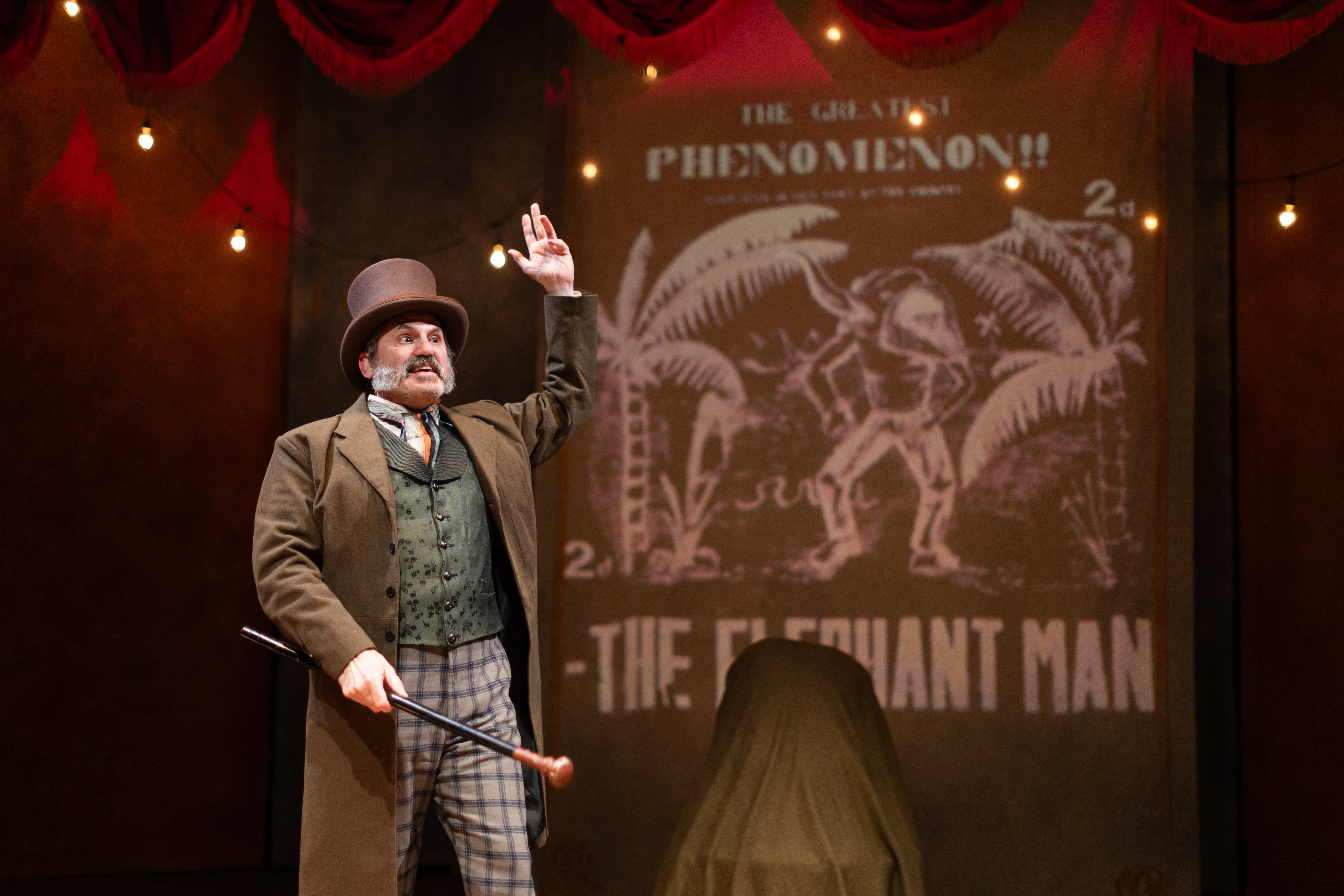
Eric Hill, a seasoned director at Berkshire Theatre Group, directs a fine cast in this troubling story. The play opens on a thrust stage depicting features of a circus Big Top with a red velvet curtain, faded bright colors, and a singular round platform on which one might find an elephant standing on one leg.
After a brief introduction to Frederick Treves, a young surgeon and teacher coming to the London Hospital to pursue a respected medical career, we meet Ross, manager of the Elephant Man, John (Joseph) Merrick, encouraging customers to pay to view this grotesque creature who is hidden under burlap draping and described as half man/half elephant. Treves, eager to meet and examine Merrick in the interest of science, pays to take him for the day.
As the audience, we see a projection of the real John Merrick as Treves describes and points to all his deformities, including an oversized disfigured head. Michael Wartella who plays Merrick stands in front of this projection, with a perfect physique, yet contorts his face, torso, and arm to resemble the awkward posture. He also demonstrates some difficulty in speaking yet eventually makes himself understood.
After not earning his keep at the circus, Merrick is robbed and abandoned by Ross, found by the police and sent to Treves at the hospital. Treves bathes him, feeds him and unsuccessfully tries to find others to help care for him. He struggles to convince Merrick that he finally has a home.
After being viewed as a freak, but ultimately pitied, Merrick receives multiple donations from the English public ensuring he can live safely and comfortably at the hospital. Suddenly others find many personal qualities they share with him, such as gentility, compassion and gratitude. Visits from a Bishop, reveal how much Merrick knows of the Bible and thinks about God. He also conveys how well read he is, and how deeply he thinks.

E. Gray Simons III in the Berkshire Theatre Group’s production of “The Elephant Man” by Bernard Pomerance, directed by Eric Hill. Photo: Tucker Bair. 
Michael Wartella in the Berkshire Theatre Group’s production of “The Elephant Man” by Bernard Pomerance, directed by Eric Hill. Photo: Tucker Bair. 
Lillian Anne Colvin, Ulla Collins, Hann Koczela, and Aaron Cho in the Berkshire Theatre Group’s production of “The Elephant Man” by Bernard Pomerance, directed by Eric Hill. Photo: Tucker Bair. 
Michael Wartella, Laura Shatkus, and Henry Smith in the Berkshire Theatre Group’s production of “The Elephant Man” by Bernard Pomerance, directed by Eric Hill. Photo: Tucker Bair. 
The cast of the Berkshire Theatre Group’s production of “The Elephant Man” by Bernard Pomerance, directed by Eric Hill. Photo: Tucker Bair. 
Henry Smith and Michael Wartella in the Berkshire Theatre Group’s production of “The Elephant Man” by Bernard Pomerance, directed by Eric Hill. Photo: Tucker Bair. 
Michael Wartella in the Berkshire Theatre Group’s production of “The Elephant Man” by Bernard Pomerance, directed by Eric Hill. Photo: Tucker Bair. 
While Treves and Carr-Gomm, the administrator of the hospital attempt to keep outsiders from staring at Merrick, they are eager for him to have friends. They introduce him to Mrs. Kendall, an actress, who truly gets in touch with his soul and peaks his sexual interests. They even discuss Romeo and Juliet and address the nature of true love. Treves, concerned that Merrick may be inappropriate with Mrs. Kendall, debates with him about viewing the naked body in surgery versus appreciating the naked body as an object of intimate love. Which view is more acceptable? A striking arc throughout this play is who makes decisions about free-will and desires? Meeting Merrick causes Treves to think about the good fortune in his life and wonder why so little of it consoles him.
In most scenes, Merrick is shown working diligently with his one good hand on a model of a church he has designed. The significance of this church, a spiritual home, along with his dexterity and artistry are all noted. Merrick is a gifted man who has had little chance to display his gifts.
The cast does a terrific job with this layered script, with some actors playing more than one role. Wartella as Merrick has a difficult physical job but, more importantly, successfully plays a tortured young man with a beautiful soul who is understanding of others more than others can begin to understand him. As he states, “…sometimes I think my head is so big because it is so full of dreams.” Notable is when he plays the healthy role of Treves in Treves’s dream, demonstrating who Merrick might have been in a physically fit body. His transition is perfect.
Harry Smith as Treves successfully displays numerous emotional conflicts as he continues to treat Merrick and realize he is unable to help him. By the play’s conclusion, Smith shows the torment and insight Merrick brings to Treves.
Laura Shatkus, a vibrant redhead, is a sarcastic and seductive Mrs. Kendall. She easily captivates Merrick and we wish, like Merrick, we can see more of her.
I have not mentioned the Pinheads: Manager Aaron Choi, Ulla Collins, and Hanna Koczela. They intermittently appear in the play as a display of freaks. They sometimes sing or respond repeatedly with, “Hello.” With tiny heads, masks, and a thatch of hair, they are in direct contrast to Merrick whose head is too heavy for his body. Their presence can be creepy and not easy to understand.
The rest of the cast, including Bishop Walsham How (Dan Woods), Ross (E. Gray Simons III), and Francis Carr-Gomm (Robert G. McKay) give wonderful performances and are veterans of BTG. We see the compassion of Woods, the greed and manipulativeness of Simons, and the authority of McKay.
Randall Parsons (Scenic Designer), Matthew Adelson (Lighting Designer), Scott Killian (Composer/Sound Designer) and Brad Peterson (Projection Designer) all work together beautifully to create this minimal yet atmospheric set where all pieces are painted with the Big Top design and serve multiple uses. Each scene of the play is titled and projected on a screen which hangs upstage.
Costumes by Amy Avilla include smart, well-constructed suits for the men, a beautiful corseted period dress for Miss Kendall, and bizarre looks fitting for the Pinheads. Throughout the play, white hand-constructed masks are worn by various incidental characters who are playing more than one part. Questions were heard in the audience about the meaning of these masks. They seem to highlight the uniformity of the ‘normal’ world in contrast to Merrick’s grotesque face. How much meaning can be inferred behind a mask? How much emotion can be expressed and understood in Merrick’s face? Yet these masks are never explained.
Hill ably stages this talented cast through Pomerance’s painful recreation of Merrick’s life. At times, it was difficult to see all cast members as I was sitting to the right of the stage. Nevertheless, performers emotionally reach the entire audience.
During intermission, many audience members read the poster in the lobby describing the biographical details of Merrick’s life. Were they just curious or were they trying to understand and empathize with this bright, sensitive and gentle man? This question posed by The Elephant Man continues to look for an answer.