

by Barbara Waldinger
One of the most important missions of the Great Barrington Public Theater is: “to develop and produce new plays, with a focus on playwrights and theater artists in the Berkshires.” True to form, the theater’s current production of MADAME MOZART, THE LACRIMOSA, was written, directed, performed, and set- designed by local theater artists.
Great Barrington Public Theater provides multiple outlets for playwrights to develop their work: Berkshire Voices, a group composed of playwrights, actors and directors meet once a week during fall and spring sessions at St. James Place in Great Barrington; periodic Skills Labs (run by Artistic Associate Director Judy Braha) connect directors and playwrights culminating in an in-person reading of short plays or scenes, and 3-4 public readings per year from Berkshire Voices give playwrights the opportunity to hear their work and receive feedback—one of which, DOG PEOPLE by Leigh Strimbeck, received a highly successful production last season.
This season’s MADAME MOZART, THE LACRIMOSA by Anne Undeland is the first commissioned work by the Great Barrington Public Theater. Inspired by a short story written by author/violinist Gerald Elias who sent it to Artistic Director Jim Frangione, the plot is a simple one: Mozart died mysteriously at the age of 35, leaving his brilliant Requiem in D Minor, commissioned by Count Von Walsegg (who tried to take credit for writing it) unfinished, and his wife and children impoverished. Undeland’s concept is that Constanze engineered the completion of this masterpiece not only because she needed the money to survive and protect her children, but also to cement Mozart’s legacy. It would be one hundred years before musicologists questioned whether or not Mozart completed it before his death.
Frangione was familiar with Undeland’s work, having previously produced WHARTON BETWEEN THE SHEETS (formerly MR. FULLERTON) at the GBPT and directed her LADY RANDY (the mother of Winston Churchill) at WAM. The playwright describes her modus operandi online: “to write great roles [for women 45 and older], where she’s the one who drives the action [and] has the fully-embodied experience. . .”. In her article “The Playwright’s Process” for Berkshires Week (July, 2024) Undeland writes: “A woman who breaks the rules always gets my attention.” A “historian at heart,” she spends much of her time researching her subject, but is clear that the result is historical fiction. Frangione knew that Constanze’s story would be in good hands.

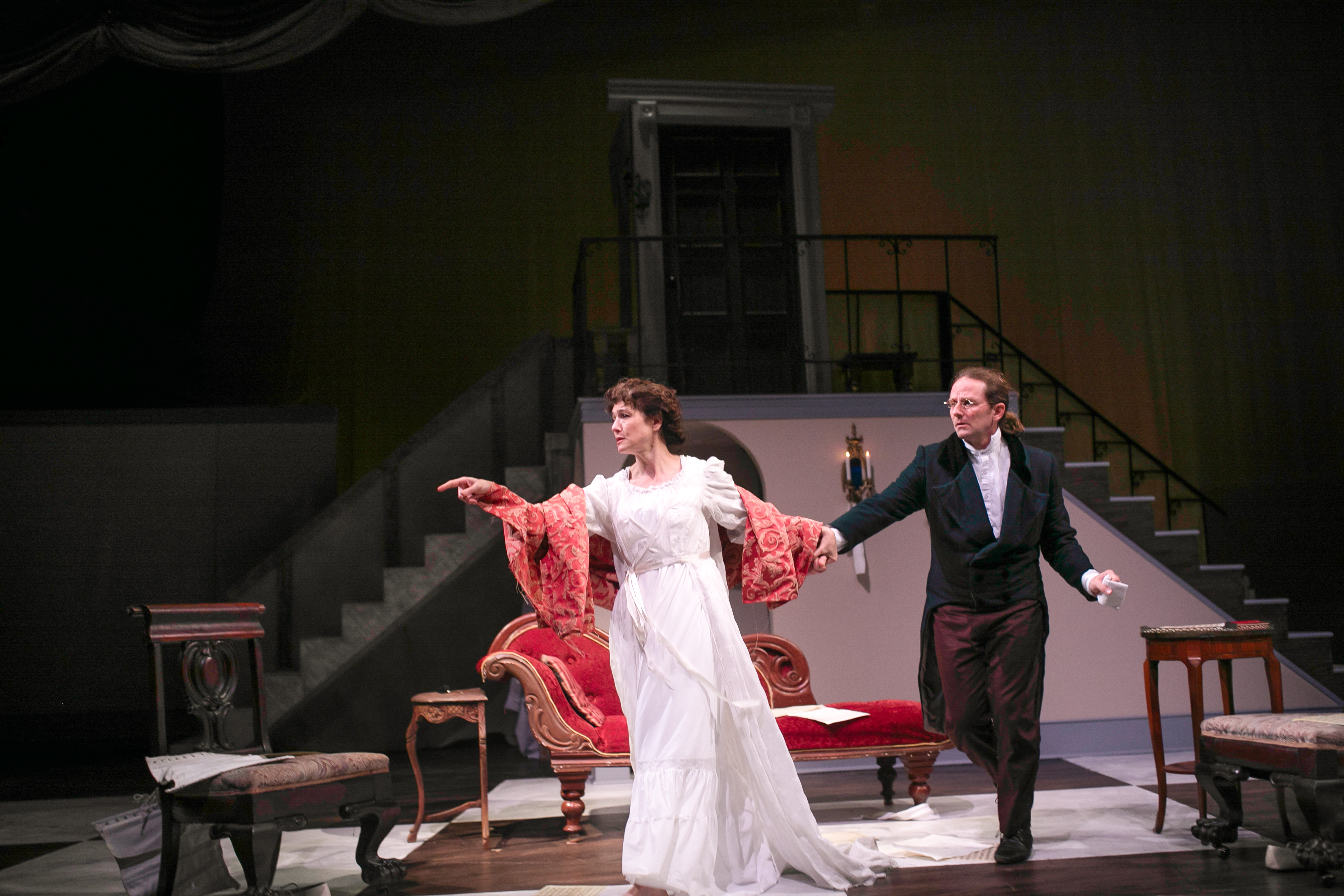
Tara Franklin and Ryan Winkles in Anne Undeland’s “Madame Mozart: The Lacrimosa” directed by Judy Braha at the Great Barrington Public Theater. Photo: Kate Drew Miller. 
Tara Frankli in Anne Undeland’s “Madame Mozart: The Lacrimosa” directed by Judy Braha at the Great Barrington Public Theater. Photo: Kate Drew Miller. 
Tara Franklin and Ryan Winkles in Anne Undeland’s “Madame Mozart: The Lacrimosa” directed by Judy Braha at the Great Barrington Public Theater. Photo: Kate Drew Miller. 
Tara Franklin and Ryan Winkles in Anne Undeland’s “Madame Mozart: The Lacrimosa” directed by Judy Braha at the Great Barrington Public Theater. Photo: Kate Drew Miller. 
Tara Franklin and Ryan Winkles in Anne Undeland’s “Madame Mozart: The Lacrimosa” directed by Judy Braha at the Great Barrington Public Theater. Photo: Kate Drew Miller. 
Tara Franklin and Ryan Winkles in Anne Undeland’s “Madame Mozart: The Lacrimosa” directed by Judy Braha at the Great Barrington Public Theater. Photo: Kate Drew Miller. 
Tara Franklin and Ryan Winkles in Anne Undeland’s “Madame Mozart: The Lacrimosa” directed by Judy Braha at the Great Barrington Public Theater. Photo: Kate Drew Miller. 
Tara Frankli in Anne Undeland’s “Madame Mozart: The Lacrimosa” directed by Judy Braha at the Great Barrington Public Theater. Photo: Kate Drew Miller. 
Tara Franklin and Ryan Winkles in Anne Undeland’s “Madame Mozart: The Lacrimosa” directed by Judy Braha at the Great Barrington Public Theater. Photo: Kate Drew Miller. 
Tara Franklin and Ryan Winkles in Anne Undeland’s “Madame Mozart: The Lacrimosa” directed by Judy Braha at the Great Barrington Public Theater. Photo: Kate Drew Miller. 
Tara Franklin and Ryan Winkles in Anne Undeland’s “Madame Mozart: The Lacrimosa” directed by Judy Braha at the Great Barrington Public Theater. Photo: Kate Drew Miller. 
Tara Franklin and Ryan Winkles in Anne Undeland’s “Madame Mozart: The Lacrimosa” directed by Judy Braha at the Great Barrington Public Theater. Photo: Kate Drew Miller. 
Tara Frankli in Anne Undeland’s “Madame Mozart: The Lacrimosa” directed by Judy Braha at the Great Barrington Public Theater. Photo: Kate Drew Miller. 
Tara Franklin and Ryan Winkles in Anne Undeland’s “Madame Mozart: The Lacrimosa” directed by Judy Braha at the Great Barrington Public Theater. Photo: Kate Drew Miller. 
Because Undeland often performed one-woman shows (including two at Ventfort Hall about Emily Dickinson and Fanny Kemble), her first iteration of this play was a solo reading that she wrote and performed. But when Frangione suggested that she add one more actor to play the other seven roles, Undeland agreed. Having developed WHARTON BETWEEN THE SHEETS with director Judy Braha, both of these gifted, infinitely creative female artists seized the opportunity to collaborate again on the journey of another extraordinary woman.
The first thing we notice upon entering the McConnell Theater at the Daniel Arts Center is that we are not going to be sitting in its comfortable, proscenium-shaped auditorium. We are guided to the stage itself, where the audience is seated on three sides facing the set, designated by Undeland as “historical fantasy. . .a dreamscape . . . maybe a stair and door unit, pages of the script scattered about, multiple points of light. . . and the over-the-top feeling of the Requiem itself.” The ingeniously inventive Juliana von Haubrich translated those words into a masterpiece of design, with a minimum of set pieces and a double staircase leading to and from a central door. And there are surprises galore. A perfect visualization of Undeland’s words!
This play has the good fortune of Mozart’s great music to accompany the action. Played by the talented young pianist Hudson Orfe (as the spirit of Mozart) on a baby grand piano, the music, much of it from the Requiem, segues at times to a recorded version. But since listening is passive, the always imaginative playwright chose to make Constanze a synesthete. Synesthesia is “a neurological condition where stimulation of one sense triggers experiences in another sense” like seeing colors when hearing sounds. That enabled Lighting Designer Matthew E. Adelson to have a field day with colored lights as the music soars.
Although Undeland speaks of the incredible team who miraculously brought her play to life, and rightfully so, some of her dreams would not be fulfilled by this first world premiere production. She would have liked for the piano to be an actual character in the play, in “conversation with Constanze,” responding and commenting on what is happening onstage musically. Further, she would have liked the recordings to overwhelm us with the majesty of the music. These goals will have to wait until the next iteration—not everything can be achieved in a three-week rehearsal period.
But the masterful, magical, transformational Ryan Winkles, playing “The People in Constanze’s Story,” gave this playwright (who says “I want to see something big”) everything she could possibly dream of and then some. Fooled at first by the early, more farcical scenes in the play (which require Winkles to exit and re-enter as different characters in record time without backstage dressers), we later come to understand that the actor is not just an acrobat but is a consummate performer. When he’s onstage long enough to engage in scenes that display his talent at characterization, especially as the vain, cruel and lecherous Sussmayr (a composer who completed the Requiem with the help of Constanze), he can be astonishing. As the Count, he is both outrageously funny and viciously conniving.
How challenging (and fun!) for Costume Designer George W. Veale VI—fashioning clothing for women, men and children in 1791, all easy to put on and take off, and placed exactly where Winkles enters/exits. And Braha must create the staging that will place Winkles in the right spot to find the clothing change he needs!
But this play is not just “presto chango.” Tara Franklin plays Constanze, whose grief at losing the man she adored must be re-directed towards the monumental task of finishing his work without attracting the suspicion of those with the knowledge and power to recognize the style of the original composer. Undeland seeks deep emotions “so vast the characters on stage can barely manage them.” Franklin delivers a truthful, grounded portrayal of Constanze’s difficult journey as she struggles to find her voice, to fight the patriarchy who would prevent her from achieving her goal. We applaud her as she wrests control from these ruthless men and stands up for herself and her husband, whose talent she will not allow them to erase.
The play works best in the later scenes, as the intensifying conflict gives rise to its climax at the first concert of the Requiem, with so much riding on it. This might have been a more powerful ending than the coda, which can feel like an add-on.
In future productions, more of Undeland’s outsized dreams may be realized, with enough time and finances. For now, let us celebrate what was accomplished with a creative team that did indeed work miracles.
MADAME MOZART, THE LACRIMOSA runs from July 10—July 27 at the Daniel Arts Center’s McConnell Theater, Bard College at Simon’s Rock, 84 Alford Road, Great Barrington, MA. For tickets call 413-372-1980 or online at GreatBarringtonPublicTheater.org.
Great Barrington Public Theater presents MADAME MOZART, THE LACRIMOSA by Anne Undeland. Director: Judy Braha.
Cast: Tara Franklin (Constanze Mozart), Ryan Winkles (The People in Constanze’s Story), Hudson Orfe (The Pianist).
Scenic Design: Juliana von Haubrich; Lighting Design: Matthew E. Adelson; Costume Design: George W. Veale VI; Sound Design: James McNamara; Musical Arranger: Hudson Orfe; Fight/Intimacy Choreography: Ryan Winkles. Production Stage Manager: Nathaniel Bokaer.
The performance runs 90 minutes with no intermission.