

by Barbara Waldinger
On January 27, 1997, August Wilson (playwright) debated Robert Brustein (director, critic, professor) in New York’s Town Hall about race in the American theatre. Wilson, who advocated for a separate theatre by, for, and about African Americans, argued: “When a little Japanese child is handed a Samurai doll before he goes to sleep, that’s a connection to his heritage. You don’t take the doll away and replace it with a G.I. Joe. With black theatre, we wish to champion our own values, our own culture. . . . My ancestors came over in chains, on slave ships. Inside all blacks is at least one heartbeat that beats with the blood of Africa.”
Wilson’s contribution to the theatre he craved was the American Century Cycle, writing a series of ten plays (one for each decade of the twentieth century) about the black experience in America. All but one take place in Pittsburgh’s Hill District, Wilson’s home. Shakespeare & Company, in collaboration with Actors’ Shakespeare Project in Boston, is currently producing THE PIANO LESSON, a Tony and Pulitzer Prize winner, and the fourth play in the cycle. Directed by Christopher V. Edwards, the Artistic Director of Actors’ Shakespeare Project, this is a first-rate production.
Having directed the play at ASP this past winter, Edwards has brought his cast and crew to Shakespeare & Company, where he previously directed Wilson’s other Pulitzer and multiple Tony award-winning FENCES, in 2023, and ART in 2021. THE PIANO LESSON opened on Broadway in 1990, following a production at the Yale Repertory Theatre that transferred to the Huntington Theatre Company in Boston. The play was revived on Broadway in 2023 with Samuel L. Jackson, and was twice adapted as a television film in 1995 and 2024. Many of the black actors we revere today owe their careers to the opportunity to perform in Wilson’s plays.
THE PIANO LESSON tells the story of two siblings in 1936: Berniece (Jade Guerra) who lives with her daughter, Maretha (Ariel Phillips) in the home of her uncle Doaker Charles (Jonathan Kitt) in Pittsburgh, and Boy Willie (Omar Robinson), temporarily visiting from Mississippi, determined to earn the money he will need to purchase the land his ancestors farmed for a white family, whose patriarch has recently died. His plan is to sell both a load of watermelons that Boy Willie and his friend Lymon (Anthony T. Goss) have brought with them in Lymon’s broken-down truck, as well as a 137-year-old piano belonging to both siblings, which has great value financially and spiritually, because of the intricate carvings on its legs of mask-like figures representing generations of their family. The major conflict of the play is the battle between Berniece and Boy Willie over the sale of the piano, expressed by Uncle Doaker’s oft-repeated line: “Berniece ain’t gonna sell that piano.”

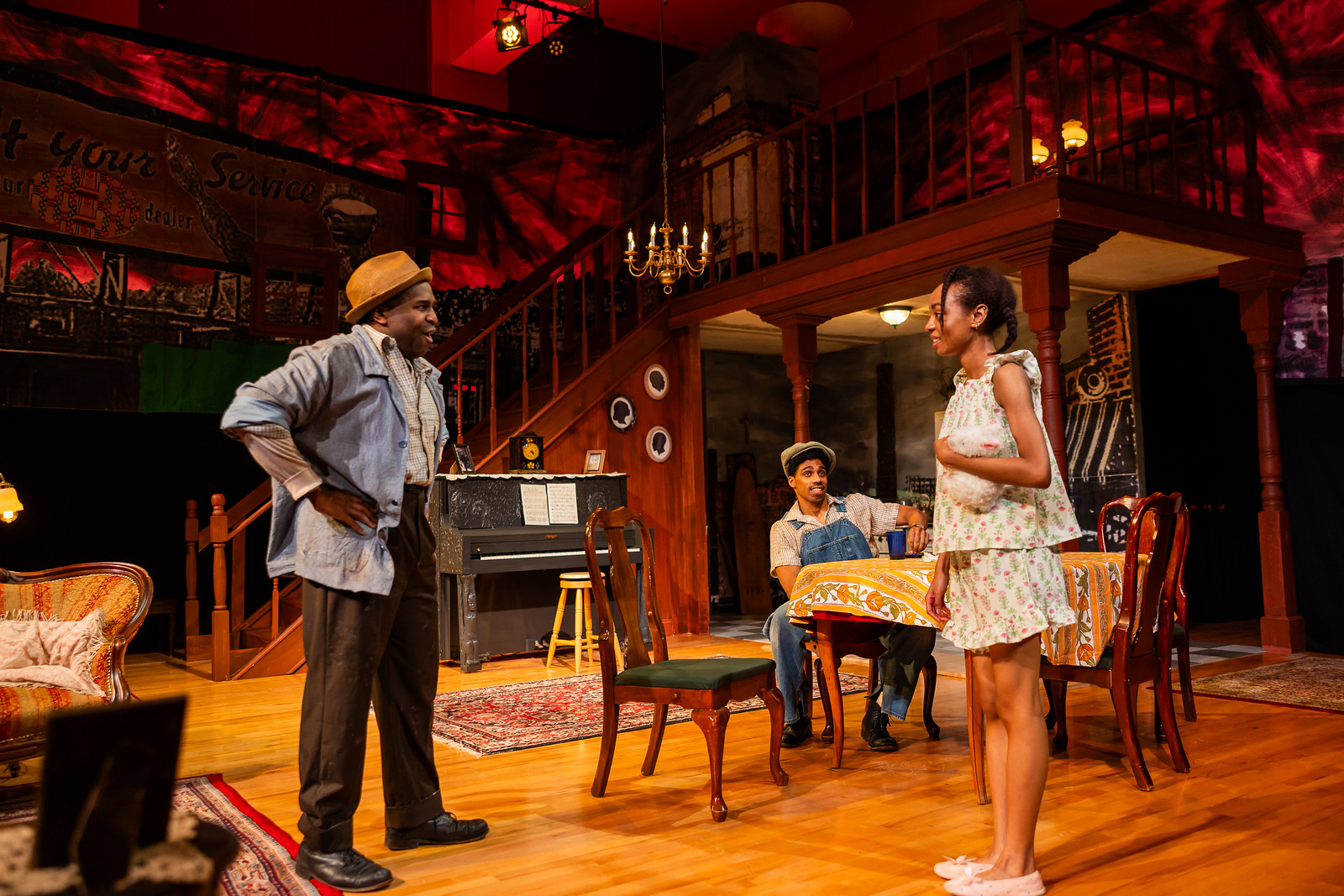
August Wilson’s “The Piano Lesson” directed by Christopher V. Edwards, at Shakespeare & Company. Photo: Nile Scott Studios. 
August Wilson’s “The Piano Lesson” directed by Christopher V. Edwards, at Shakespeare & Company. Photo: Nile Scott Studios. 
August Wilson’s “The Piano Lesson” directed by Christopher V. Edwards, at Shakespeare & Company. Photo: Nile Scott Studios. 
August Wilson’s “The Piano Lesson” directed by Christopher V. Edwards, at Shakespeare & Company. Photo: Nile Scott Studios. 
August Wilson’s “The Piano Lesson” directed by Christopher V. Edwards, at Shakespeare & Company. Photo: Nile Scott Studios. 
August Wilson’s “The Piano Lesson” directed by Christopher V. Edwards, at Shakespeare & Company. Photo: Nile Scott Studios. 
One of the miracles of this production, besides the ensemble of consummate performers, is the ability of the director and designers to stage it in the small Bernstein theatre with its limited space. The set (designed by Jon Savage) contains a kitchen and kitchen table that seats four, a working upright piano, a living room with a small couch, chair, and rug, and a staircase, part of which must be seen by the audience. There is no room for a front door, which is mimed, and a cast of eight actors need to find enough playing space to perform for nearly three hours. What an incredible feat of blocking is required to make this work! Lighting designer (James McNamara) uses onstage lighting fixtures, including a chandelier that sways and blinks, and creates walls above the set for his lighting effects. The sound designer (James Cannon) provides such powerful auditory effects that the ground seems to move beneath our seats. Wilson expertly exploits the potential of the supernatural and these designers make that happen. Costume designer (Nia Safarr Banks), dresses each of these actors in several different period costumes. A special shout-out to Banks’ s creation of Lymon’s fancy silk suit, pink shirt and eye-popping shoes that he hopes will attract the ladies.
We cannot overestimate the central importance of music in Wilson’s work. Music director Ranney Lawrence expertly selects the blues songs during the transitions, but most impressive is the music performed by the actors during the play. In an interview with John DiGaetani, Wilson explains: “My writing is primarily influenced by the blues. . . Blues was the cultural response of black Americans to the world they found themselves in. . . Contained in the blues is information about how to live your life within this world view. . . All you have to do is sing a song, and you’re passing along the information.” Watch and listen to the rhythm of the actors’ rendition of the prison song “Berta, Berta” to understand what Wilson means. (John L. DiGaetani, “A Search for a Postmodern Theater: Interviews with Contemporary Playwrights,”1991)
The cast is uniformly strong. Wilson gives his actors a chance to show us who they are, not only by their dialogue, but also in their poetic monologues. Just as jazz allows each instrument to improvise, Wilson’s characters each have their own stories to tell. And they are all wonderful storytellers. Omar Robinson’s Boy Willie is a born entertainer who can barely contain his excitement about his future as a landowner (which can lead to such quick delivery of his lines at the beginning that we can barely make out what he’s saying), while Jade Guerra’s Berniece takes the opposite tack: soft spoken, worn down by life and grief over the loss of her husband, but coming into her own when it counts at moments of heightened tension as the battle heats up. Daniel Rios Jr. has performed with Shakespeare & Company in the past, in A COMEDY OF ERRORS. His Avery is a self-made preacher, whose stories come from the Bible and from his passionate desire to establish his own church, but he is also a mortal man in love with Berniece, trying desperately to convince her to marry him. Jonathan Kitt’s Doaker is a dyed-in-the-wool railroad man, who has spent his life working on trains, which serve as a metaphor for the way he views the world—a quiet, gentle man who understands that if you get on the right train, it will eventually take you where you want to go. He often serves as a parent/mediator between his niece and nephew. Doaker’s visiting brother Wining Boy is played by “ranney,” one of Shakepeare & Company’s most admired actors, who starred in Edwards’ production of FENCES. Singing and playing the piano, “ranney” ‘s Wining Boy has faced sorrow and disappointment, not wanting to be known as merely a piano player but in trying to establish his own identity his self-destructive drinking and gambling get in the way. Anthony T. Goss plays Lymon, who is young, southern, poor, has spent three years with Boy Willie in prison, is being chased by the law, and now wants to live up north—he dreams of finding a woman he can live with. Quiet spoken and polite, he is the only man who has broken through Berniece’s tough armor. Brittani J. McBride’s Grace, with her outlandish outfits, nevertheless has standards to maintain and we admire her for trying; while Ariel Phillips’ Maretha, always subservient to her mother, dares to dream bigger, with the support of her uncle.
THE PIANO LESSON is often funny (Wilson says it is “as serious as a play can get but there are also a lot of funny things in it” though “the characters themselves don’t mean [the lines] to be funny.”) It is also a moving tribute to the history of blacks in America, to the Great Migration, and to the piano that symbolizes racism and its victims: the legacy of the ancestors, whose blood and tears their descendants may try to ignore at their peril.
THE PIANO LESSON runs from July 25—August 24 at the Elayne P. Bernstein Theatre, 70 Kemble St., Lenox. For tickets call 413-637-3353 or online at shakespeare.org
Shakespeare & Company presents THE PIANO LESSON by August Wilson. Director: Christopher V. Edwards. Cast: Anthony T. Goss (Lymon), Jade Guerra (Berniece), Jonathan Kitt (Doaker Charles), Brittani J. McBride (Grace), Ariel Phillips (Maretha), “ranney” (Wining Boy), Daniel Rios Jr (Avery), Omar Robinson (Boy Willie).
Associate Director: Regine Vital; Set Designer: Jon Savage; Light Designer: James McNamara; Costume Designer: Nia Safarr Banks; Sound Designer: James Cannon; Intimacy Director: Liv Dumaine; Music Director: Ranney Lawrence. Production Stage Manager: Anthony Feola.
The performance runs two hours and 50 minutes; including intermission.