

by Barbara Waldinger
To celebrate their tenth anniversary, the Berkshire Opera Festival has selected one of the most beloved, most frequently produced operas in the Verdi canon: LA TRAVIATA. According to Maestro Brian Garman, Conductor, Artistic Director and Co-founder of the company, Berkshire audiences have often requested this masterpiece, and now the BOF has delivered it in all its glory.
With a recently appointed President and CEO, Natalie Johnsonius Neubert, a multi-year contract with the Mahaiwe Performing Arts Center, and supportive, enthusiastic audiences, the BOF has indeed found a home here in the Berkshires. In addition to producing a full opera each season and various community events, in mid-August audiences were treated to a superb 10th Anniversary Concert, with a full 54 piece orchestra, 28 member Chorus and a group of brilliant singers performing excerpts from a range of operas.
Verdi, arguably Italy’s greatest composer, wrote 28 operas, 26 of which were tragedies. While his early operas were political, LA TRAVIATA hails from Verdi’s domestic period, when he wrote more personal, intimate works.
Living in Paris in the mid-nineteenth century, Verdi discovered the story for his opera after seeing a production of La Dame aux Camelias by Alexandre Dumas fils, about a young, terminally ill courtesan who sacrifices her love to protect the reputation of her lover’s family. Apparently Dumas fils (son of THE THREE MUSKETEERS author), based his plot on his own scandalous affair with courtesan Marie Duplessis. This universal theme—a fallen woman, the one who strayed (the translation of “La Traviata”)—led Verdi to call it “a subject for our time.” Consider some of the many adaptations of this story: the great 1936 film Camille with Greta Garbo, Puccini’s La Boheme, the Broadway productions Rent and Moulin Rouge, even the film Pretty Woman (which references this opera in one scene).
Though Verdi foresaw problems with the censors, he was never afraid of a challenge. He went on to write LA TRAVIATA with librettist Francesco Maria Piave, a long-standing collaborator.
Jonathon Loy, Director of Production and Co-founder of the BOF, spoke in an interview about his new concept for this production, based on extensive research: he reveals the grittiness of the life of a courtesan during the second half of the nineteenth century, which looks so glamorous on the surface. The lavish parties they hosted, so essential for meeting wealthy noblemen,were paid for by the courtesans themselves–women of the demi-monde in Paris—actresses, waitresses, often abused women whohad to claw their way into becoming high class prostitutes, totally dependent on the money they earned from their upper class clients—noblemen, military men, who did not treat them well. Loy discovered that these salons were fueled by drugs, hashish especially, at a time when no one knew about the effects of addiction. Notice the hypodermic needle used to soothe Violetta’s pain as her disease (tuberculosis) worsened.
On the cover of the Playbill we see a lovely woman—called a “famous escort” in the plot summary—wearing a dress made of white camellias (a flowering plant found in Asia), set against a red background, reminiscent of blood and bullfights, highlighting the French obsession with Spanish culture in the mid-nineteenth century. Both the flowers and the Spanish influence appear onstage: the vases and paintings of Violetta’s camillias on the set, costumes, and backdrops (red for menstruation and white to indicate that the women were available for sex), and the dazzling red drop– bright red with bulls outlined in black, painted by scenic designer Hannah Postlethwaite, based on Manet’s scenes of bullfights and matadors. Costume designer Brooke Stanton and her staff must have worked day and night creating the colorful muslin gowns accented by flowers, and outfitting the matador chorus and dancers in authentic Spanish garb. This production features a renowned flamenco dancer (Glenda Sol Koeraus) who performson one of the three long tables that serve as a variety of set pieces, partnered by supple Katie Harding in trousers. Though Verdi insisted that his performers dress in contemporary nineteenth century costumes, which was a huge departure from the usual historical/mythical/biblical attire of plays at the time, it was not until the second production that the Italian censors acceded to his demands.
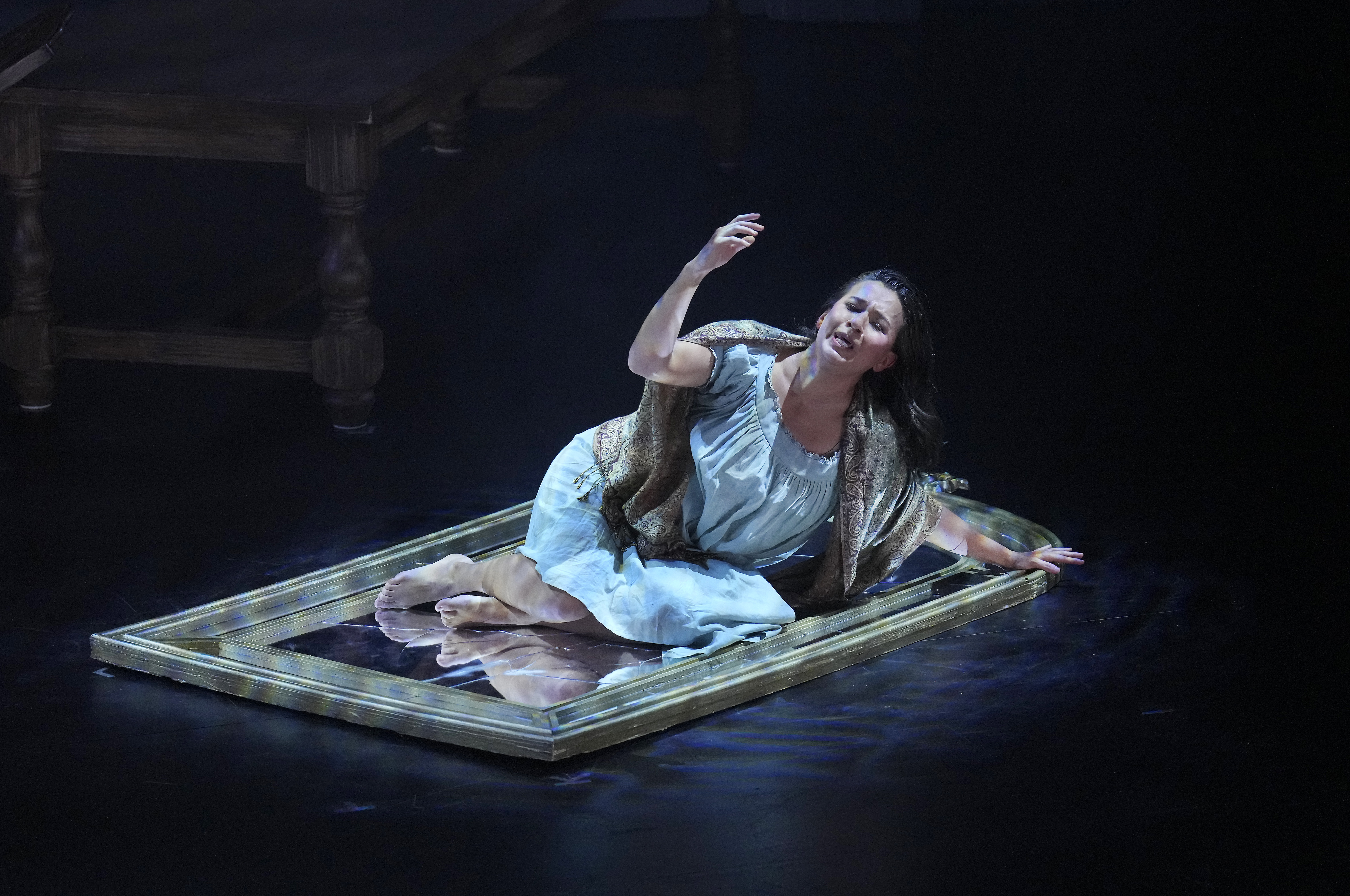
Postlewaithe designed three separate sets for this opera (which the program lists as three acts, but BOF combined into two, requiring a short pause during the second act for a set change): the salon containing the ubiquitous mirror, documenting the deteriorating condition of Violetta, the long tables, chairs, and a multi-use lavender chaise (complementing the deep purple drop of the first scene); a lovely blue flat with white clouds for the cottage that Violetta and her lover Alfredo inhabit for a short time; and the gray hovel in which the now-penniless Violetta is bedridden—all lit by Alex Jainchill and Alejandro Fajardo to express the moods suggested by each design.

Vanessa Becerra as Violetta in the Berkshire Opera Festival production of “La Traviata” by Giuseppe Verdi, directed by Jonathon Loy, conducted by Brian Garman. Photo: Ken Howard. 
Maximillian Jansen as Gastone and the ensemble in the Berkshire Opera Festival production of “La Traviata” by Giuseppe Verdi, directed by Jonathon Loy, conducted by Brian Garman. Photo: Ken Howard. 
Joshua Blue as Alfredo in the Berkshire Opera Festival production of “La Traviata” by Giuseppe Verdi, directed by Jonathon Loy, conducted by Brian Garman. Photo: Ken Howard. 
From left to right: Sol “La Argentinita”(flamenco dancer), Katie Harding (dancer), Kalia Kellogg (Annina), Vanessa Becerra as Violetta (center) in the Berkshire Opera Festival production of “La Traviata” by Giuseppe Verdi, directed by Jonathon Loy, conducted by Brian Garman. Photo: Ken Howard. 
Joshua Blue as Alfredo in the Berkshire Opera Festival production of “La Traviata” by Giuseppe Verdi, directed by Jonathon Loy, conducted by Brian Garman. Photo: Ken Howard. 
Tutti ensemble in the Berkshire Opera Festival production of “La Traviata” by Giuseppe Verdi, directed by Jonathon Loy, conducted by Brian Garman. Photo: Ken Howard. 
Vanessa Becerra as Violetta in the Berkshire Opera Festival production of “La Traviata” by Giuseppe Verdi, directed by Jonathon Loy, conducted by Brian Garman. Photo: Ken Howard. 
Weston Hurt (Germont), Vanessa Becerra (Violetta), Kalia Kellogg (Annina), Joshua Blue (Alfredo), and John Cheek (Dr. Grenvil) in the Berkshire Opera Festival production of “La Traviata” by Giuseppe Verdi, directed by Jonathon Loy, conducted by Brian Garman. Photo: Ken Howard. 
Vanessa Becerra as Violetta, Joshua Blue as Alfredo and the ensemble in the Berkshire Opera Festival production of “La Traviata” by Giuseppe Verdi, directed by Jonathon Loy, conducted by Brian Garman. Photo: Ken Howard. 
Joshua Blue as Alfredo in the Berkshire Opera Festival production of “La Traviata” by Giuseppe Verdi, directed by Jonathon Loy, conducted by Brian Garman. Photo: Ken Howard. 
Tutti Ensemble in the Berkshire Opera Festival production of “La Traviata” by Giuseppe Verdi, directed by Jonathon Loy, conducted by Brian Garman. Photo: Ken Howard. 
Vanessa Becerra as Violetta in the Berkshire Opera Festival production of “La Traviata” by Giuseppe Verdi, directed by Jonathon Loy, conducted by Brian Garman. Photo: Ken Howard. 
Vanessa Becerra as Violetta in the Berkshire Opera Festival production of “La Traviata” by Giuseppe Verdi, directed by Jonathon Loy, conducted by Brian Garman. Photo: Ken Howard. 
Vanessa Becerra as Violetta and Weston Hurt as Germont in the Berkshire Opera Festival production of “La Traviata” by Giuseppe Verdi, directed by Jonathon Loy, conducted by Brian Garman. Photo: Ken Howard. 
Sol “La Argentinita” (flamenco dancer) (center) and tutti ensemble in the Berkshire Opera Festival production of “La Traviata” by Giuseppe Verdi, directed by Jonathon Loy, conducted by Brian Garman. Photo: Ken Howard. 
Sol “La Argentinita” (flamenco dancer) (center) and tutti ensemble in the Berkshire Opera Festival production of “La Traviata” by Giuseppe Verdi, directed by Jonathon Loy, conducted by Brian Garman. Photo: Ken Howard. 
Sol “La Argentinita” (flamenco dancer) (center) and tutti ensemble in the Berkshire Opera Festival production of “La Traviata” by Giuseppe Verdi, directed by Jonathon Loy, conducted by Brian Garman. Photo: Ken Howard. 
Joshua Blue as Alfredo in the Berkshire Opera Festival production of “La Traviata” by Giuseppe Verdi, directed by Jonathon Loy, conducted by Brian Garman. Photo: Ken Howard. 
Vanessa Becerra as Violetta in the Berkshire Opera Festival production of “La Traviata” by Giuseppe Verdi, directed by Jonathon Loy, conducted by Brian Garman. Photo: Ken Howard. 
Vanessa Becerra as Violetta, Joshua Blue as Alfredo and the ensemble in the Berkshire Opera Festival production of “La Traviata” by Giuseppe Verdi, directed by Jonathon Loy, conducted by Brian Garman. Photo: Ken Howard. 
Tutti Ensemble in the Berkshire Opera Festival production of “La Traviata” by Giuseppe Verdi, directed by Jonathon Loy, conducted by Brian Garman. Photo: Ken Howard. 
Vanessa Becerra as Violetta in the Berkshire Opera Festival production of “La Traviata” by Giuseppe Verdi, directed by Jonathon Loy, conducted by Brian Garman. Photo: Ken Howard. 
From left to right: Sol “La Argentinita” (flamenco dancer) (center) and tutti ensemble in the Berkshire Opera Festival production of “La Traviata” by Giuseppe Verdi, directed by Jonathon Loy, conducted by Brian Garman. Photo: Ken Howard. 
Joshua Blue as Alfredo and Vanessa Becerra as Violetta in the Berkshire Opera Festival production of “La Traviata” by Giuseppe Verdi, directed by Jonathon Loy, conducted by Brian Garman. Photo: Ken Howard. 
Joshua Blue as Alfredo in the Berkshire Opera Festival production of “La Traviata” by Giuseppe Verdi, directed by Jonathon Loy, conducted by Brian Garman. Photo: Ken Howard. 
Vanessa Becerra as Violetta and Joshua Blue as Alfredo in the Berkshire Opera Festival production of “La Traviata” by Giuseppe Verdi, directed by Jonathon Loy, conducted by Brian Garman. Photo: Ken Howard. 
Vanessa Becerra as Violetta in the Berkshire Opera Festival production of “La Traviata” by Giuseppe Verdi, directed by Jonathon Loy, conducted by Brian Garman. Photo: Ken Howard. 
Vanessa Becerra as Violetta in the Berkshire Opera Festival production of “La Traviata” by Giuseppe Verdi, directed by Jonathon Loy, conducted by Brian Garman. Photo: Ken Howard. 
Weston Hurt as Germont in the Berkshire Opera Festival production of “La Traviata” by Giuseppe Verdi, directed by Jonathon Loy, conducted by Brian Garman. Photo: Ken Howard. 
Vanessa Becerra as Violetta in the Berkshire Opera Festival production of “La Traviata” by Giuseppe Verdi, directed by Jonathon Loy, conducted by Brian Garman. Photo: Ken Howard. 
Vanessa Becerra as Violetta and Weston Hurt as Germontin the Berkshire Opera Festival production of “La Traviata” by Giuseppe Verdi, directed by Jonathon Loy, conducted by Brian Garman. Photo: Ken Howard. 
Weston Hurt as Germont in the Berkshire Opera Festival production of “La Traviata” by Giuseppe Verdi, directed by Jonathon Loy, conducted by Brian Garman. Photo: Ken Howard. 
in the Berkshire Opera Festival production of “La Traviata” by Giuseppe Verdi, directed by Jonathon Loy, conducted by Brian Garman. Photo: Ken Howard. 
in the Berkshire Opera Festival production of “La Traviata” by Giuseppe Verdi, directed by Jonathon Loy, conducted by Brian Garman. Photo: Ken Howard. 
Vanessa Becerra as Violetta in the Berkshire Opera Festival production of “La Traviata” by Giuseppe Verdi, directed by Jonathon Loy, conducted by Brian Garman. Photo: Ken Howard. 
Vanessa Becerra as Violetta in the Berkshire Opera Festival production of “La Traviata” by Giuseppe Verdi, directed by Jonathon Loy, conducted by Brian Garman. Photo: Ken Howard. 
Vanessa Becerra as Violetta in the Berkshire Opera Festival production of “La Traviata” by Giuseppe Verdi, directed by Jonathon Loy, conducted by Brian Garman. Photo: Ken Howard. 
Vanessa Becerra as Violetta in the Berkshire Opera Festival production of “La Traviata” by Giuseppe Verdi, directed by Jonathon Loy, conducted by Brian Garman. Photo: Ken Howard. 
Stage movement, the domain of Loy and his fifteen -year collaborator, choreographer Sara Erde, not only involves dance but also the movement of the singers (more prevalent now that opera can be seen on HD screens throughout the country). From organizing the many partygoers on a relatively small stage, to finding expressive actions that won’t hinder vocal production,Loy and Erde encourage the singers to explore their environment to find what works for them.
Music has always been a highlight of the BOF. There is unfortunately no pit for the orchestra, which is visible, making sight lines tricky if a character lies on the ground. Three rows of seats have been removed to accommodate the large group of musicians, led by Maestro Garman. Verdi’s music can be hauntingly beautiful (written for a few instruments) alternating with highly dramatic sections (for the full orchestra), both handled masterfully in this production. Its main themes,previewed in the prelude, recur throughout the opera. Garman describes the music as the “bel canto style pared down to its simplest, most direct, and yet most profound expressions.” Waltz-like melodies are a signature of this opera.
Garman and Loy’s contacts with exceptional singers worldwideadds substantially to the reputation of the BOF. Violetta Valery, the title role, is sung by Vanessa Becerra, a lovely soprano who tackles this incredibly challenging assignment for the first time in her career. Singers who know the role say it is one of the most difficult for sopranos, who must use their voice in three ways: coloratura, lyric, and dramatic, while meeting the changing psychological demands of the character. An example of the different vocal requirements occurs in the first act when, after hearing Alfredo’s declaration of love, Violetta, alone, sings a two-part aria: in the first, Ah, fors’e’lui, she wonders if she is capable of loving Alfredo (slow, introspective, vulnerable), but in the second, rejecting the idea of love, she decides to keep her freedom Sempre libera (faster, wilder, with high notes and all sorts of vocal pyrotechnics, which Becerra’s coloratura achieves). Understandably, she seems to have focused on therigorous vocal demands, which does not leave much bandwidthfor mining the emotional richness of the role.
The performance of tenor Joshua Blue’s Alfredo succeeds both vocally and emotionally. If opera is about singing heightened emotions, Blue shows us how. He reacts to everything, even when he is just listening, at times a bit over the top, but we always know what he is thinking and feeling.
Baritone Weston Hurt, Alfredo’s father, who persuades Violetta to leave his son, is more prone to acknowledge the responses of other characters using his words and powerful voice, rather than his emotions, which must constantly change as he comes to understand the nobility of Violetta’s sacrifice. His outward-facing stance can sometimes lessen the effect of his all-important duet with Becerra, which Garman describes as “the core of the opera.”
There are no weak links among BOF’s roster of singers: noteErin Reppenhagen (Flora), Violetta’s friend and competitor; Yazid Gray as the jealous Baron, with his fabulous glittering costume; Maximillian Jansen, the fun-loving, sometimes drugged but caring Gastone; John Cheek’s solicitous doctor; and Kalia Kellogg as Violetta’s loyal, loving servant.
The BOF team has gone to great lengths in their production ofLA TRAVIATA. Judging from the appreciative response of the sold-out audience on opening night, their efforts have been rewarded, and deservedly so.
LA TRAVIATA performs on Saturday, August 23 at 1:00; Tuesday, August 26 at 7:30; and Friday, August 29 at 7:30 at the Mahaiwe Performing Arts Center. Tickets may be purchased by calling 413-528-0100 or online at www.mahaiwe.org.
Berkshire Opera Festival presents Verdi’s LA TRAVIATA. Directed by Jonathon Loy. Conducted by Brian Garman. Cast: Vanessa Becerra (Violetta Valery), Erin Reppenhagen (Flora Bervoix), Adam Partridge (The Marquis of Obigny), Yazid Gray (Baron Douphol), John Cheek (Doctor Grenvil), Maximillian Jansen (Gastone), Joshua Blue (Alfredo Germont), Kalia Kellogg (Annina), Nikolas Brannan (Giuseppe), Weston Hurt (Giorgio Germont), Jermaine Woodard Jr. (Messenger), Arjun Warrier (Flora’s servant), Glenda Sol Koeraus (solo dancer), Katie Harding (dancer).
Scenic Designer: Hannah Postlethwaite; Costume Designer: Brooke Stanton; Lighting Design: Alex Jainchill and Alejandro Fajardo; Hair and Make-Up Designer: Beckie Kravetz; Choreographer: Sara Erde; Chorus Master and Assistant Conductor: Luca Antonucci; Principal Pianist and Coach: Travis Bloom; Musical Preparation: Dakota Perez; Supertitle Author and Lecturer: Cori Ellison; Production Stage Manager: Cindy Knight.
Running Time: Two hours and 35 minutes, including a 25 minute intermission.
Berkshire Opera Festival at the Mahaiwe, 14 Castle Street, Great Barrington, MA. From August 23; closing August 29.