

by Barbara Waldinger
What could be better, when producing a play about conflicts within a family, than casting three superb actors (in a cast of five) who are a family? That is the case with the Dorset Theatre Festival in Vermont, currently running OTHER DESERT CITIES by Jon Robin Baitz.
Jayne Atkinson, who has performed in theatre, film and television for over three decades (including appearances on several of our Berkshire stages), plays Silda Grauman, the alcoholic sister of Baitz’s family matriarch Polly Wyeth (veteran stage, screen and television actor Laila Robins ). Atkinson’s real -life husband, longtime actor Michel Gill, plays Lyman Wyeth (patriarch and husband of Polly). Their son, actor Jeremy Gill (Trip Wyeth, younger son of Polly and Lyman), was cast, according to director Robert Egan in an interview, after “I spent an evening with him, watching him bartend” in New York. Rounding out the cast is Elizabeth Stahlmann (Brooke Wyeth, daughter of Polly and Lyman), who led the world premiere of Tectonic Theater Project’s Here There are Blueberries, winner of the Lucille Lortel Award for Outstanding Play. (Scheduled for a reading at Shakespeare and Company in October). Egan believes that OTHER DESERT CITIES “requires a very gifted group of actors to deliver it”—and his dream cast certainly delivers.
This is Egan’s second time directing Baitz’s play. Egan claims to have “directed over four hundred plays and developed thousands of plays,” during his tenure as Founding Artistic Director of L.A.’s Mark Taper Forum, Assistant Artistic Director of the Seattle Repertory Theatre, and Founding Artistic Director/Producer of the Ojai Playwrights Conference. He and Baitz have been close collaborators for over forty years in theatre, television, and film. After its 2011 premiere at Lincoln Center Theater, followed by a Broadway production later that year, Egan directed the West Coast premiere of 0THER DESERT CITIES at the Mark Taper Forum in 2012-13.
Baitz, whose play was a finalist for the 2012 Pulitzer Prize for Drama, also wrote The Substance of Fire (play and screenplay), The End of the Day, Three Hotels, and A Fair Country (1996 Pulitzer Prize finalist).
Though OTHER DESERT CITIES takes place in 2004, it could have been written today in our polarized, conflicted country. It is the story of Brooke Wyeth, a New York City writer, who flies to Palm Springs, California to visit her parents for Christmas, after having experienced six years of debilitating depression and hospitalization following a breakdown. Comfortable in their Republican bubble, the Wyeth paradise is disrupted by the liberal politics of their children and Silda. Brooke brings with her the manuscript of her long-awaited second book, about which she has told no one in the family except Aunt Silda, who is just out of rehab. After admitting to her parents and younger brother (a television producer), that the book is not a novel but a memoir, specifically about the suicide of her adored older brother, Henry following his involvement with a criminal left-wing radical group, Brooke is unprepared for the reaction of her family and the war that ensues.
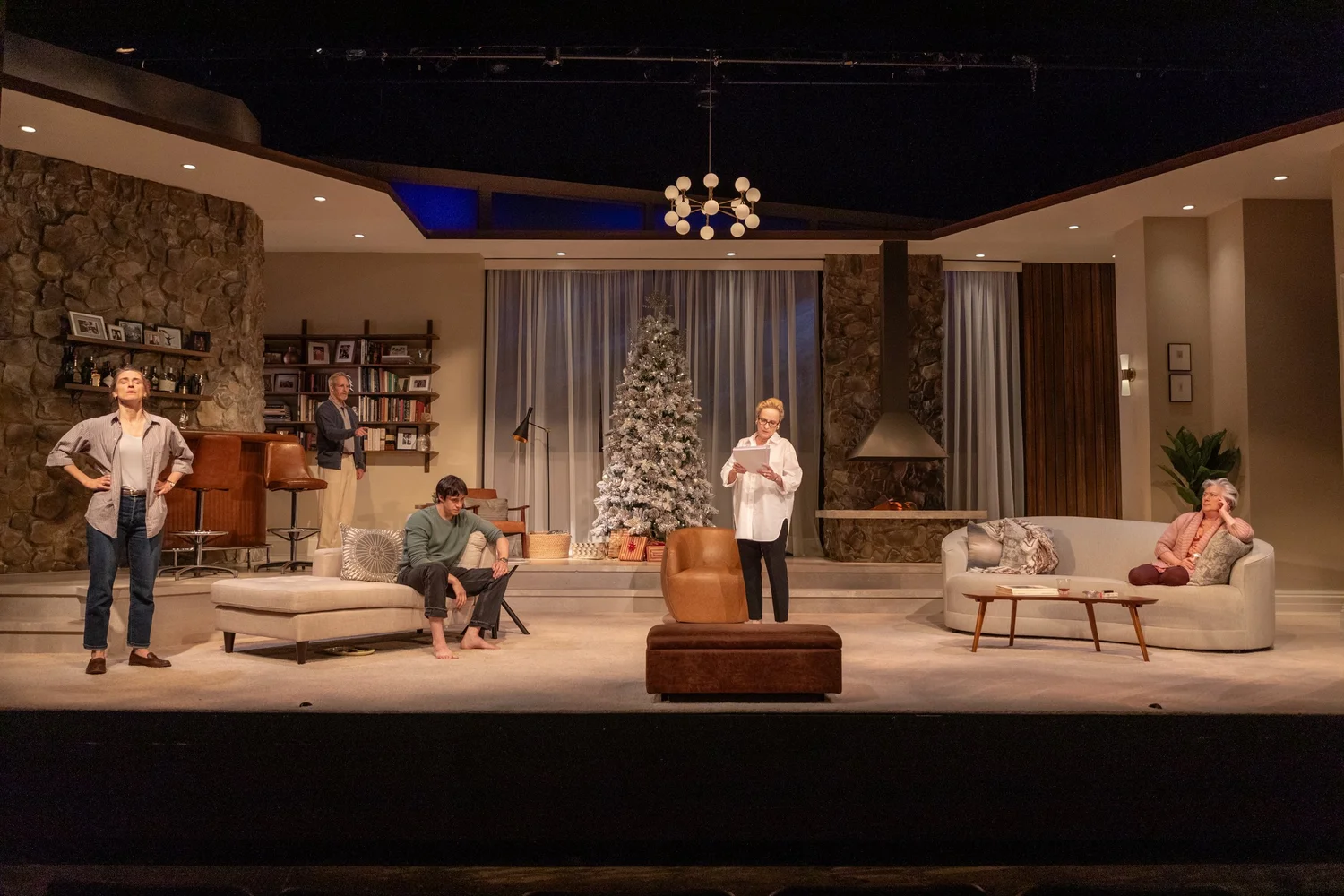
The set, designed by Christopher and Justin Swader, seems to come directly from a decorator’s handbook: shades of beige, camel, brown, multi-level, a lovely bar with stools, a gorgeous white Christmas tree, a painted outdoor scene of rocks and desert behind upstage sheer curtains, lit impeccably by Patricia M. Nichols. Sound designer Karl Fredrik Lundeberg provides lively jazz music during transitions, at times blasting to punctuate the dramatic ending of a scene. Costume designer Elvia Bovenzi Blitz has a field day creating California high couture designer outfits worn by everyone but the daughter, whose reliance on unfashionable denim is the subject of her mother’s ridicule.

“Other Desert Cities” by Jon Robin Baitz, directed by Robert Egan, at the Dorset Theatre Festival. Photo by Joey Moro. 
“Other Desert Cities” by Jon Robin Baitz, directed by Robert Egan, at the Dorset Theatre Festival. Photo by Joey Moro. 
“Other Desert Cities” by Jon Robin Baitz, directed by Robert Egan, at the Dorset Theatre Festival. Photo by Joey Moro. 
“Other Desert Cities” by Jon Robin Baitz, directed by Robert Egan, at the Dorset Theatre Festival. Photo by Joey Moro. 
“Other Desert Cities” by Jon Robin Baitz, directed by Robert Egan, at the Dorset Theatre Festival. Photo by Joey Moro. 
“Other Desert Cities” by Jon Robin Baitz, directed by Robert Egan, at the Dorset Theatre Festival. Photo by Joey Moro. 
“Other Desert Cities” by Jon Robin Baitz, directed by Robert Egan, at the Dorset Theatre Festival. Photo by Joey Moro. 
“Other Desert Cities” by Jon Robin Baitz, directed by Robert Egan, at the Dorset Theatre Festival. Photo by Joey Moro. 
“Other Desert Cities” by Jon Robin Baitz, directed by Robert Egan, at the Dorset Theatre Festival. Photo by Joey Moro. 
“Other Desert Cities” by Jon Robin Baitz, directed by Robert Egan, at the Dorset Theatre Festival. Photo by Joey Moro. 
“Other Desert Cities” by Jon Robin Baitz, directed by Robert Egan, at the Dorset Theatre Festival. Photo by Joey Moro. 
“Other Desert Cities” by Jon Robin Baitz, directed by Robert Egan, at the Dorset Theatre Festival. Photo by Joey Moro. 
“Other Desert Cities” by Jon Robin Baitz, directed by Robert Egan, at the Dorset Theatre Festival. Photo by Joey Moro. 
“Other Desert Cities” by Jon Robin Baitz, directed by Robert Egan, at the Dorset Theatre Festival. Photo by Joey Moro. 
“Other Desert Cities” by Jon Robin Baitz, directed by Robert Egan, at the Dorset Theatre Festival. Photo by Joey Moro. 
“Other Desert Cities” by Jon Robin Baitz, directed by Robert Egan, at the Dorset Theatre Festival. Photo by Joey Moro. 
“Other Desert Cities” by Jon Robin Baitz, directed by Robert Egan, at the Dorset Theatre Festival. Photo by Joey Moro. 
“Other Desert Cities” by Jon Robin Baitz, directed by Robert Egan, at the Dorset Theatre Festival. Photo by Joey Moro. 
“Other Desert Cities” by Jon Robin Baitz, directed by Robert Egan, at the Dorset Theatre Festival. Photo by Joey Moro. 
“Other Desert Cities” by Jon Robin Baitz, directed by Robert Egan, at the Dorset Theatre Festival. Photo by Joey Moro. 
“Other Desert Cities” by Jon Robin Baitz, directed by Robert Egan, at the Dorset Theatre Festival. Photo by Joey Moro. 
“Other Desert Cities” by Jon Robin Baitz, directed by Robert Egan, at the Dorset Theatre Festival. Photo by Joey Moro. 
“Other Desert Cities” by Jon Robin Baitz, directed by Robert Egan, at the Dorset Theatre Festival. Photo by Joey Moro. 
“Other Desert Cities” by Jon Robin Baitz, directed by Robert Egan, at the Dorset Theatre Festival. Photo by Joey Moro. 
One of the strongest elements in Baitz’s play is that his characters are complex and unpredictable, though they may appear to be easily recognizable at first. The Wyeths are a wealthy, intellectual couple—they speak intelligently, as do all of the characters in this play. Audiences will not be surprised to associate the clever, witty dialogue with the characters of West Wing, Baitz having written several episodes of that successful series. Robins’ Polly is a master of this rapid wisecracking style (think Allison Janney in West Wing), which she can rattle off so quickly that older audiences may miss some of her quips. She’s a tidal wave, washing over everyone who doesn’t agree with her, never missing an opportunity to be critical, especially with her daughter and sister. Yet, she has spent a year caring for her daughter, frightened that she may relapse; and when her older son faced legal trouble and her friends were nowhere to be seen, she wooed them back so that her husband’s political career would not be jeopardized.
Gill’s Lyman, is quiet, understated, and has a loving relationship with his daughter. An actor turned politician, like his friends Nancy and Ronald Reagan, Lyman has had a fascinating life. Yet, because he has always bottled up his emotions, when he feels cornered he can snap and fly into a rage. Watching Gill undergo this change is shocking, but we can accept it because of the skillful performances of both Gill and Robins, as they reveal the many layers of their characters.
Stahlmann and Jeremy Gill are absolutely convincing as siblings, especially effective in a lovely scene they have together, though Brooke and Trip are utterly different. Stahlmann offers a stunning portrayal of Brooke, broken and suffering but determined to fight back against the onslaught of her mother (and yes, father). After six years of mental illness, can she, buoyed by the love and support of her aunt Silda, publish this memoir, despite her parents’ objections and threats, that she so desperately needs to process the loss of her older brother?
Jeremy Gill’s Trip is a pot-smoking, laid back, California guy of few words (like his father), whose mother mocks his television series about fake trials adjudicated by guest stars. Though he attempts to avoid confrontations, and often tries to mediate the conflicts swirling around him, Gill is finally forced to state his honest opinion about his sister’s work.
Atkinson’s Silda, who has been a relapsing alcoholic for years, is aware that her sister Polly, (with whom she wrote screenplays for MGM long ago), now wants nothing more to do with her, which makes Silda’s dependence on her all the more unbearable for both of them. Yet Silda, like Polly, is also a force of nature—but in a completely opposite direction. Atkinson cuts loose with this character—from the moment we see her in her pajamas and flowering robe, to her colorful Pucci blouse, she is funny, lovable, magnetic, idealistic, never afraid of a fight—we want her to be well, we want to follow her everywhere—but she is self-destructive and cannot always come through for the people she loves. What a complex, bravura performance by this versatile actress!
When all is said and done, and the members of this family have bared their souls, Baitz’s writing, Egan’s sharp direction, and this exceptional cast unveil their humanity, vulnerability, and underlying love for one another.
OTHER DESERT CITIES, runs from August 22—September 6 at the Dorset Playhouse. Tickets may be purchased by calling 802-867-2223 or online at dorsettheatrefestival.org
Dorset Theatre Festival presents OTHER DESERT CITIES by Jon Robin Baitz, 104 Cheney Road, Dorset, Vermont. Directed by Robert Egan. Cast: Jayne Atkinson (Silda Grauman), Jeremy Gill (Trip Wyeth), Michel Gill (Lyman Wyeth), Laila Robins (Polly Wyeth), Elizabeth Stahlmann (Brooke Wyeth). Scenic Designers: Christopher & Justin Swader; Costume Designer: Eliva Bovenzi Blitz; Lighting Designer: Patricia M. Nichols; Sound Designer: Karl Fredrik Lundeberg. Assistant Director/Dramaturg: James Davis. Production Stage Manager: Adam Taylor Foster.
The production runs two hours and fifteen minutes, including an intermission.