

by Sierra Pasquale
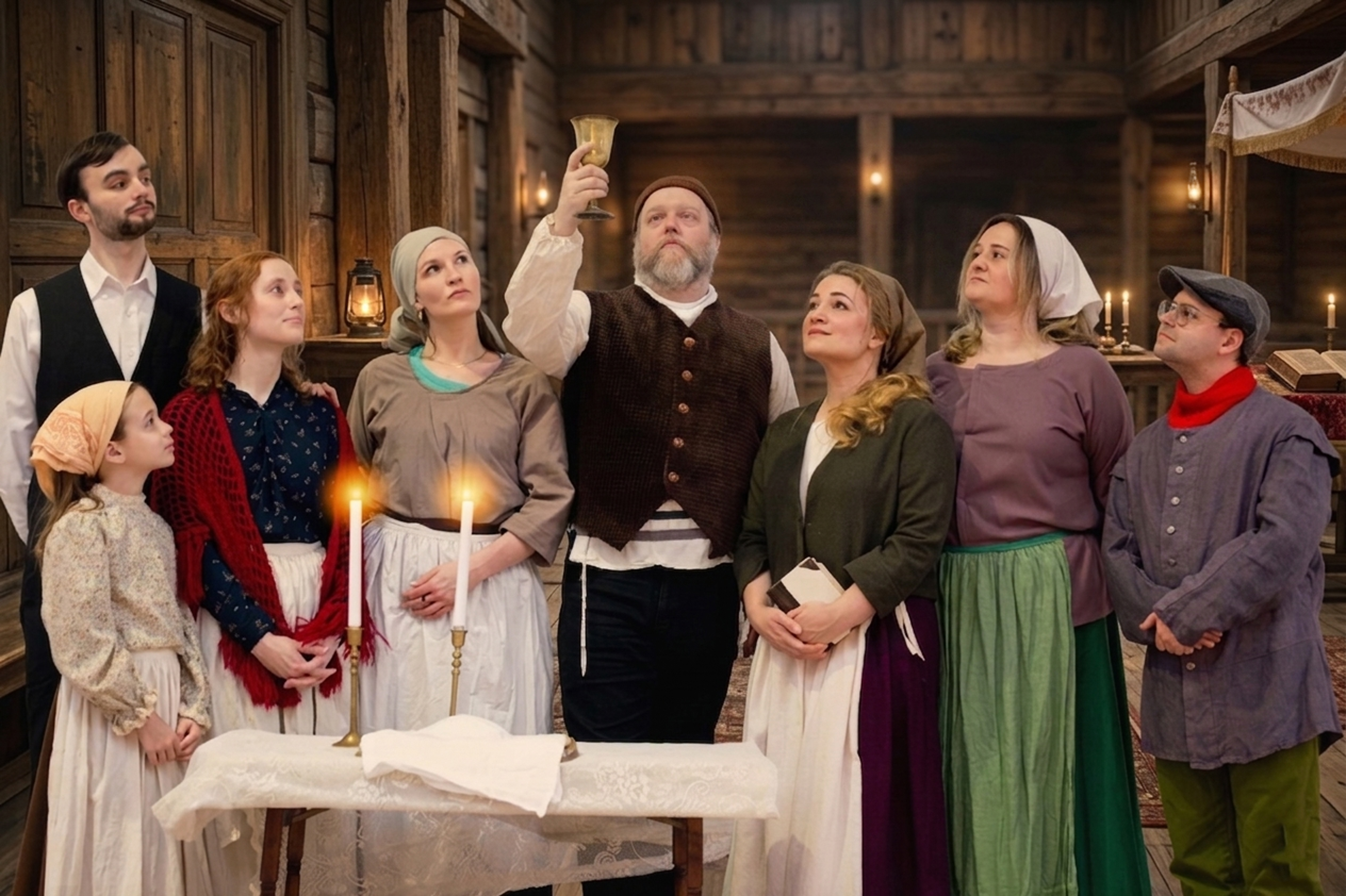
There is something uniquely difficult about reviewing Fiddler on the Roof. The show carries so much emotional and cultural weight that audiences often arrive already attached to it. Whether through the iconic 1971 film adaptation, high school productions, or memories of parents and grandparents humming “Sunrise, Sunset,” the musical exists less as a piece of theater and more as a cultural inheritance. Any production therefore has to walk a careful line between honoring tradition and finding enough freshness to justify revisiting material that audiences know almost by heart. This particular production by Home Made Theater lands somewhere squarely in the middle of that balancing act: respectful, competently staged, intermittently moving, but rarely transcendent.
At its best, the production understands the enduring appeal of the material. Written by Joseph Stein, with music by Jerry Bock and lyrics by Sheldon Harnick, the musical remains remarkably effective because its themes are universal beneath their specificity. Tevye’s struggle to reconcile tradition with a rapidly changing world still resonates deeply, especially in an era where questions of identity, displacement, and generational conflict continue to dominate public conversation. The production wisely leans into these emotional truths rather than trying to radically reinterpret the show for modern audiences. That restraint is both one of its strengths and one of its limitations.
Kenneth Kasch’s Tevye delivers a solid, grounded performance that anchors the evening. The role demands warmth, humor, stubbornness, and heartbreak in almost equal measure, and while this performance may not possess the overwhelming charisma associated with legendary portrayals (a VERY high bar!), it captures the character’s humanity effectively. The direct conversations with God feel conversational rather than theatrical, which works in the production’s favor. There is a sincerity to the performance that keeps the audience invested even when certain scenes drag slightly. “If I Were a Rich Man” was the highlight of my afternoon.
Golde (Milana Guadagno) is similarly well-handled. The chemistry between Tevye and Golde feels authentic in a lived-in, understated way, particularly during “Do You Love Me?” Frequently, a number that can easily veer into sentimentality. The scene works here because the actors allow the humor to emerge naturally from years of shared exhaustion and companionship. It becomes one of the evening’s more emotionally effective moments precisely because the production does not overplay it.
The daughters each bring enough individuality to keep their respective storylines emotionally distinct, though some performances are stronger than others. Tzeitel (Abigail Fast) and Motel’s (Simon Woods) storyline feels especially believable, aided by an earnest chemistry that gives emotional weight to their desire for agency within the confines of tradition. Hodel (Eryn Graham) and Perchik’s (Oliver McCloskey) scenes occasionally feel rushed, and their ideological conflict never fully ignites in the way the script intends. Chava’s (Sarah Cordts) storyline, meanwhile, emerges as perhaps the production’s strongest dramatic thread, particularly because the staging allows silence and distance to carry emotional meaning instead of relying solely on dialogue.


Musically (Richard Cherry), songs arrive exactly where audiences expect them to, but few are staged in a way that reveals something new about the material. “Matchmaker” is lively and entertaining, while “Sunrise, Sunset” earns its emotional response largely because the song itself is nearly impossible to resist. There are few moments where the music fully overwhelms the audience emotionally in the way great productions of the show can. The modest orchestra, however, shines with Elizabeth Sterling as the titular “Fiddler”.
Jerome Robbins’ original choreography for the musical became iconic because it merged stylized movement with genuine communal ritual. This production (Johnny Martinez) recreates much of that spirit competently, especially during the wedding sequence and bottle dance, which predictably earns one of the strongest audience reactions of the night. There is a certain safety to the movement, however, throughout the production. It feels polished without feeling dangerous or urgent. For a musical so deeply concerned with social upheaval and instability, the staging occasionally feels too comfortable.
Visually, the production embraces a traditional aesthetic. The set design (Vicki Hart) evokes the worn textures of Anatevka effectively enough, though it lacks the kind of visual imagination that can make the village itself feel like a living character. The limitations of the music hall stage notwithstanding. Costuming (Patti Jolie) is period-appropriate and believable without drawing much attention to itself.
Where the production succeeds most consistently is in its handling of tone. “Fiddler on the Roof” has always been a difficult balancing act between comedy and tragedy. Too much emphasis on nostalgia can flatten the story into sentimental comfort while too much emphasis on oppression can drain the show of its humor and warmth. This production mostly navigates that tension successfully. The first act allows space for comedy and communal joy, while the second act gradually darkens without feeling emotionally manipulative.
Still, the production occasionally struggles with pacing. Certain scenes linger longer than necessary, and transitions sometimes sap momentum from the narrative. The emotional descent in the second act feels more episodic than cumulative, which slightly weakens the devastating impact of the ending. The final moments still resonate because the material itself is so powerful, but the production never fully builds the overwhelming emotional inevitability that the strongest versions of the musical achieve.
Part of the challenge may simply be that modern audiences know this material too well. Fiddler on the Roof is so deeply embedded in the theatrical canon that productions must either uncover something genuinely fresh or execute the familiar with extraordinary precision. This production does neither completely. Instead, it offers a respectful, earnest, and occasionally moving interpretation that will likely satisfy audiences seeking a traditional staging without necessarily converting skeptics or redefining the material for a new generation.
That may sound like faint praise, but, here it is not. Not every production needs to reinvent a classic. Sometimes a show simply needs to remind audiences why it has endured for decades in the first place. This production accomplishes that. It captures the humanity at the center of the story, honors the musical’s emotional core, and provides an afternoon (or evening) of solid theater even if it rarely rises to the level of unforgettable. For audiences who love the musical, that may very well be enough.
Home Made Theatre presents “Fiddler on the Roof”. Book by Joseph Stein, Music by Jerry Bock, and Lyrics by Sheldon Harnick. Original New York Stage Production Directed and Choreographed by Jerome Robbins. Directed and Choreographed by Johnny Martinez, Musical Direction by Richard Cherry, Assistant Director Anne-Marie Baker, Assistant Choreographer Sarah Beaver, Scenic Design by Vicki Hart, Costume Design by Patti Jolie, Properties Design by Maura Pickett, Sound Design by Tom Moeller, Lighting Design by Katherine Maclellan and Stage Managed by Caitlin Wickes. With Kenneth Kasch as Tevye, Milana Guadagno as Golde, Abigail Fast as Tzeitel, Eryn Graham as Hodel, Sarah Cordts as Chava, Laurel Covey as Bielke, Savannah Brockway as Shprintze, Devra Cohen-Tigor as Yente, Simon Woods as Motel, Oliver McCloskey as Perchik, Richard Jones as Lazar Wolf, Carl Gibson as Rabbi, Diane Lachtrupp Martinez as Grandma Tzeitel, Julia Steidle as Fruma-Sarah, Scott Brown as Fyedka, Andrea Burger as Shaindel, Elizabeth Sterling as Fiddler, and the Ensemble of Sarah Brockway, Andrea Burger, Kim Crossway, Evan Giannini, Roslyn Hall-Wurst, Molly Kirker, Caroline Martindale, Diane Lachtrupp Martinez, Josef Mendez, Elizabeth Parizh, Diane Skibinski, Beverly Skoll, Julia Steidle, and Kiernan Wolpert. Performances Friday, May 15 and Saturday, May 16 at 7pm, Sunday, May 17th at 2pm at The Anthony “Skip” Scirocco Music Hall. Ticket information at homemadetheater.org.