

by Barbara Waldinger
Imagine a full-length musical with twenty-five vocal numbers, accompanied by keyboard, cello and percussion, staged on a simple, practical but stunning set, yet performed by only two actors. Directed by Gregg Edelman, John & Jen features Jake Bentley Young (John) and Samantha Gershman (Jen), who populate the stage with a whole world of unseen characters, in a non-stop display (except for intermission) of their prodigious talents.
Produced by the Berkshire Theatre Group at the Unicorn Theatre, the book of John & Jen was written by Tom Greenwald, who is also the lyricist (in attendance at the May 24th matinee) and Andrew Lippa, also serving as composer. The musical was originally produced at the Goodspeed Opera House in 1993. In a May 30, 2025 article by Music Theatre International called John & Jen: 30 Years Later, we learn that in 1990, Greenwald and Lippa were young actors looking for “a fifteen minute musical to showcase themselves.” It told the story of a brother and sister and was included two years later in a New York City showcase—but it was 10 minutes longer. Eventually it was produced in its current two-act length at the Goodspeed Opera House (1993), where Andrew Lippa had been working as a musician. In 1995 the Lamb’s Theatre produced its New York City premiere, and the show went on to numerous productions around the world. With two actors and three musicians, the musical is relatively inexpensive for theatre companies, a fact that Greenwald and Lippa felt would make it a desirable commodity. In her introduction to John & Jen at the Unicorn, Kate Maguire said the musical was workshopped at Berkshire Theatre Festival in 1994.
John & Jen chronicles the changing landscape in America, from 1952 to 1990. The first act is indeed about siblings and change: a brother six years younger than his big sister, as they cling together living in a home with an abusive father. Though Jen promises to always protect John, she can’t wait to leave home, start college, and be free, leaving him to deal with his father, a veteran who becomes his role model, encouraging his son to enlist in the Vietnam War.

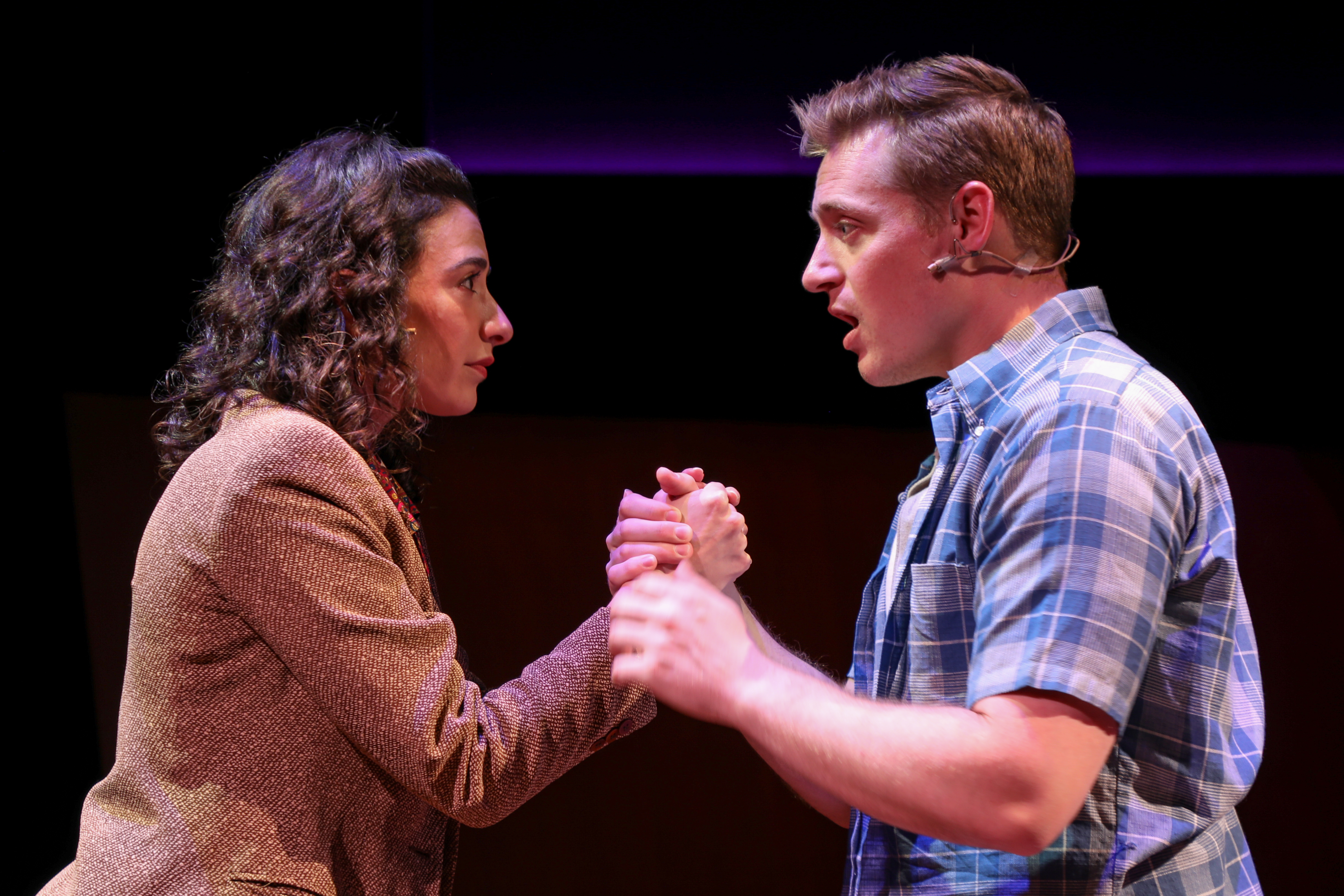
Samantha Gershman as Jen and Jake Bentley Young as John in Tom Greenwald and Andrew Lippa’s “John & Jen”, directed by Gregg Edelman, at the Berkshire Theatre Group’s Unicorn Theatre. Photo: Caelan Carlough. 
Samantha Gershman as Jen and Jake Bentley Young as John in Tom Greenwald and Andrew Lippa’s “John & Jen”, directed by Gregg Edelman, at the Berkshire Theatre Group’s Unicorn Theatre. Photo: Caelan Carlough. 
Samantha Gershman as Jen and Jake Bentley Young as John in Tom Greenwald and Andrew Lippa’s “John & Jen”, directed by Gregg Edelman, at the Berkshire Theatre Group’s Unicorn Theatre. Photo: Caelan Carlough. 
Samantha Gershman as Jen and Jake Bentley Young as John in Tom Greenwald and Andrew Lippa’s “John & Jen”, directed by Gregg Edelman, at the Berkshire Theatre Group’s Unicorn Theatre. Photo: Caelan Carlough. 
Jake Bentley Young as John in Tom Greenwald and Andrew Lippa’s “John & Jen”, directed by Gregg Edelman, at the Berkshire Theatre Group’s Unicorn Theatre. Photo: Caelan Carlough. 
The question is what to do for the second act? Though Lippa and Greenwald were still in their twenties, they wrote with great sympathy and understanding about a mother, still Jen but now a mature woman, having married a college boyfriend and moved to Canada to avoid the draft. She has returned to live in the U.S. alone with her baby son, named John. The same actor who played Jen’s brother now plays her son. The depth of feeling between mother and son is palpable. Lippa explains that what making a musical is about is “drawing characters the audience can believe in and care about.” Especially in the second act, these creators have successfully accomplished what they intended.
Because the first act has so much exposition to cover, beginning with John’s birth, childhood games and fears, racing to portray the sixties, as we watch Jen becoming a hippie at college and in New York City, Jake Bentley Young doesn’t have as much opportunity to display his many talents as he does in the second act. But in the second, he’s on fire: a dancer, a singer, a polished talk show host, a boy about to leave for camp all on his own—yet a child/young man who would do anything for his Mom. Samantha Gershman is heartbreaking in the second act, because she knows she must eventually let go and allow her son to grow up. On the other hand her baseball Mom’s exclamations, cheering, and critiques while John narrates the game, are as spot on as they are entertaining. Vocally the two actors are very different but equally strong: Gershman offers the big Broadway voice and moving interpretations of Lippa’s beautiful melodies while Young sometimes speaks his emotions, bursting to be expressed, during his songs—to great effect. But when they sing together at the same time, we can clearly hear the pain in each of them. This pain is also revealed in a comedic-turned-dark scene in which they take turns as talk show hosts, questioning and criticizing one another in devastating ways.
Scenic Designer Jason Simms has built for the actors a terrific playground, consisting of steps to sit and stand on, a curved flat center area, and a partial wall reminiscent of a skateboarder’s climbing hill. There are hiding places for props, and coats to hide costume pieces (kudos to Costume Designer Amanda Roberge for her skill in finding just the right few suggestions without burdening the actors), and neon-colored lighting that would attract any child’s attention, provided by Patricia M. Nichols, complete with rectangular lights on the upstage wall that take on a variety of gorgeous colors. Though the original director– Gabriel Barre at Goodspeed and the Lamb’s Theatre—highlighting the need for simplicity, suggested three boxes and a couple of chairs for the set, Simms’ intriguing design does not take focus away from this intimate, personal, work.
Bravo to director Gregg Edelman for his staging of this piece—emphasizing the characters and their relationships while maintaining a fluidity in which each scene and time period naturally melts into the next one —no need for transitions, and using the space organically so that movement doesn’t feel choreographed.
Music Director Nicolas Perez employs a keyboard and what sounds like a xylophone to punctuate the singing, speaking, and thoughts of the characters. How effective that is!
Final advice from Andrew Lippa about the play: “Trust the material. . . No concepts, please. Just tell the story.” And that’s what this cast, director, and designers do. What a superb way to begin the 2026 season!
JOHN & JEN runs from May 20—June 7 at Berkshire Theatre Group’s Unicorn Theatre, 6 East St., Stockbridge, MA. For tickets call 413-997-4444.
Berkshire Theatre Group presents JOHN& JEN, a musical. Music by Andrew Lippa, Lyrics by Tom Greenwald, and book by Tom Greenwald and Andrew Lippa.
Director: Gregg Edelman. Cast: Samantha Gershman (Jen) and Jake Bentley Young (John). Music Director: Nicolas Perez; Scenic Designer: Jason Simms; Costume Designer: Amanda Roberge; Lighting Designer: Patricia M. Nichols; Sound Designer: Joanna Lynne Staub; Fight Choreographer: Joseph Poulson; Cellist: Jillian Emerson; Percussionist: Emma Kroll. Production Stage Manager and Fight Captain: Jenn Gallo
The performance runs one hour 45 minutes including intermission.