

by Sierra Pasquale
Sarah DeLappe’s “The Wolves” has become one of the defining contemporary plays about adolescence, identity, and the often-chaotic process of growing up. Set entirely on an indoor soccer field, the play follows a girls’ soccer team through a series of pre-game warmups as they navigate friendships, politics, insecurities, ambitions, and tragedy. Rather than presenting a conventional narrative, DeLappe drops the audience into overlapping conversations and fragmented moments, asking us to piece together the lives of these young women from the margins of their interactions.
That approach has earned the play significant acclaim since its premiere, but it is also what makes “The Wolves” such a challenging piece to connect with. The script often feels more interested in observation than revelation. Conversations drift from world affairs to soccer injuries to adolescent gossip without always building toward a clear dramatic destination. While this naturalistic style accurately captures the rhythms of teenage conversation, it can also create a sense of emotional distance. The characters frequently feel like sketches rather than fully developed individuals, and the play’s larger themes sometimes emerge more through implication than dramatic action.
Sand Lake Center for the Arts‘ production embraces that observational quality wholeheartedly. Director Siobhan Shea notes in her program essay that she was initially drawn to the energy of the piece and wanted to create an immersive experience that placed the audience directly inside the insular world of the team. She also reveals that she did not read the script prior to casting and did not know how the play ended until the company’s first table read. While some may find that approach unconventional, it offers an interesting lens through which to view the production itself. Rather than presenting a deeply interpreted argument about the play, this staging often feels focused on capturing its immediacy and spontaneity.
The result is a production that succeeds most when it leans into the authenticity of the ensemble. The cast works hard to create the feeling of a real team, and there is a believable sense of shared history among the players. Much of the evening’s enjoyment comes from watching the performers react to one another, jockey for social status, and navigate the shifting alliances that define teenage friendships.


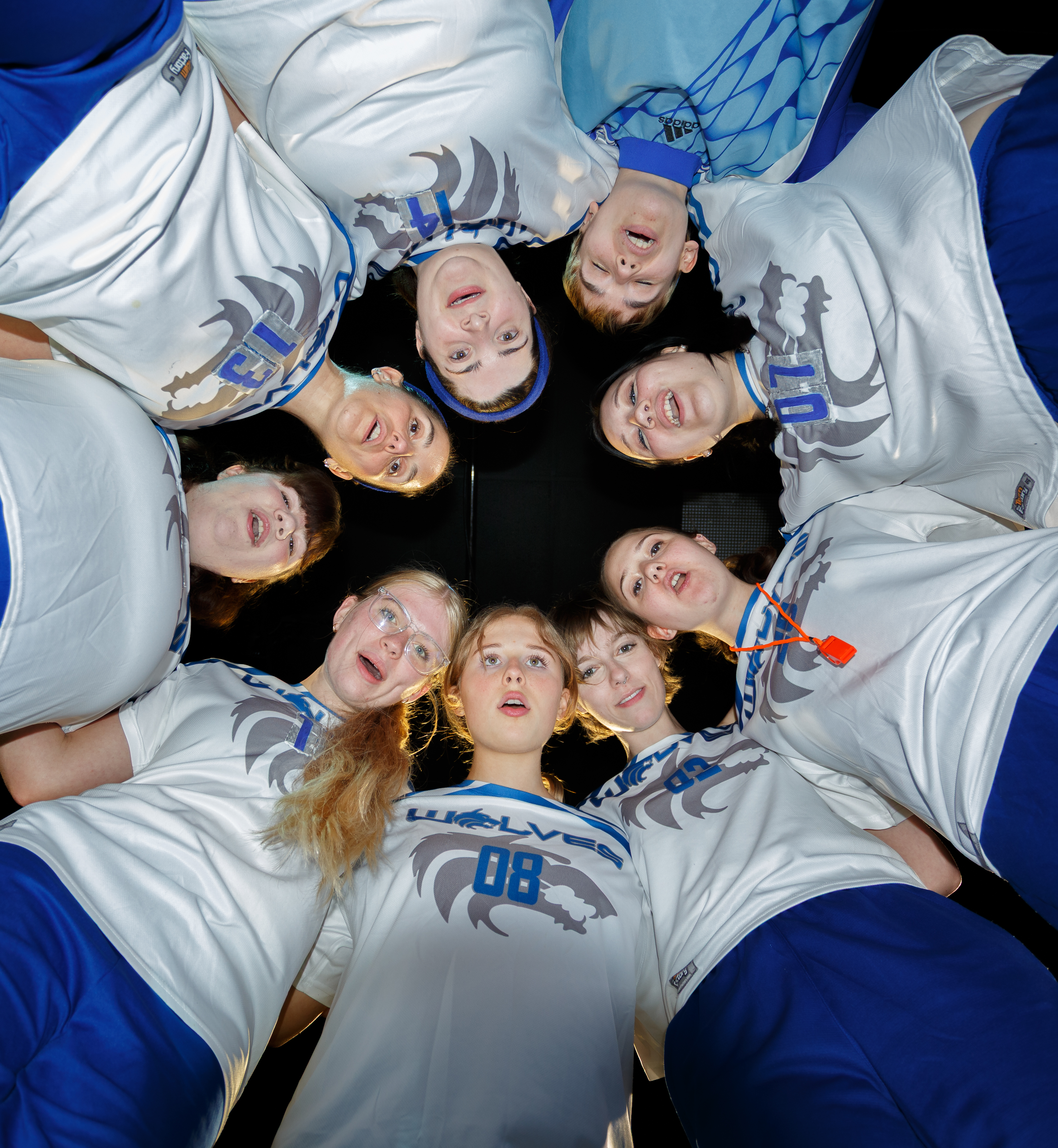
Cast of “The Wolves” by Sarah DeLappe. directed by Siobhan Shea, at the Sand Lake Center for the Arts. 
Cast of “The Wolves” by Sarah DeLappe. directed by Siobhan Shea, at the Sand Lake Center for the Arts. 
Cast of “The Wolves” by Sarah DeLappe. directed by Siobhan Shea, at the Sand Lake Center for the Arts. 
Cast of “The Wolves” by Sarah DeLappe. directed by Siobhan Shea, at the Sand Lake Center for the Arts. 
Cast of “The Wolves” by Sarah DeLappe. directed by Siobhan Shea, at the Sand Lake Center for the Arts. 
Cast of “The Wolves” by Sarah DeLappe. directed by Siobhan Shea, at the Sand Lake Center for the Arts. 
Cast of “The Wolves” by Sarah DeLappe. directed by Siobhan Shea, at the Sand Lake Center for the Arts. 
Several performers stand out within the ensemble structure. Sydney Davis brings a grounded presence to #00, while Camryn Beck finds humor and confidence in #07’s self-assured observations. Vivian Savage and Evalyn Craney contribute natural performances that help anchor the production’s youthful energy, while Jessie Rosenthal and Julianna Kopa bring welcome individuality to moments that could easily disappear into the rapid-fire dialogue. Perhaps the greatest challenge of “The Wolves” is making each player distinct despite the play’s intentionally overlapping conversations, and this cast generally succeeds in giving the audience enough to follow each character’s journey.
Visually, the production is effective in establishing the environment. Abigail Rose Decker’s set design captures the utilitarian atmosphere of an indoor sports facility without overwhelming the intimate playing space. The use of turf, lockers, and bleacher-style elements creates a recognizable world that supports the action. Costumes (Peggy Shea) likewise contribute to the team’s identity, with matching uniforms helping establish both unity and the subtle individuality that emerges among the players.
The production’s strongest asset may ultimately be its commitment to ensemble storytelling. The cast demonstrates impressive stamina throughout a script that requires constant movement, overlapping dialogue, and sustained focus. Even when the material itself becomes repetitive, the performers remain engaged and invested in the world they are creating.
My reservations, however, stem less from the production than from the play itself. “The Wolves” asks audiences to find meaning in accumulation rather than progression. For some viewers, that approach will feel revelatory; a portrait of adolescence that captures life as it is actually experienced. For others, it may feel frustratingly diffuse. I found myself admiring the craft of the performers more than becoming invested in the dramatic journey. The play repeatedly gestures toward larger themes but often stops short of exploring them in meaningful depth.
That tension leaves this production in an interesting position. The company has assembled a committed ensemble, created a believable environment, and delivered the play with sincerity and energy. Whether the evening ultimately resonates will likely depend on one’s feelings about DeLappe’s script itself. Those who admire the play’s fragmented realism will find much to appreciate here. Those looking for a more traditionally structured dramatic experience may leave respecting the effort while remaining unconvinced by the material.
Sand Lake Center for the Arts presents The Wolves by Sarah DeLappe. Directed by Siobhan Shea, with Assistant Director and Producer Thom Ingram, Set Design by Abigail Rose Decker, Lighting Design by Laura Darling and Jay Pascual, Costumes by Peggy Shea, Sound Design by Siobhan Shea, and Stage Management by Kimberly Collins. Featuring Evalyn Craney (#11), Sydney Davis (#00), Camryn Beck (#07), Ann Glackin (#14), Vivian Savage (#08), Jessie Rosenthal (#13), Julianna Kopa (#25), Allison Schmitt (#46), Ro Dell’Acqua (#02), and Jen Madison as Soccer Mom. Performed at Sand Lake Center for the Arts, 2880 NY-43, Averill Park, NY 12018. For tickets and additional information, visit www.slca-ctp.org/theatre