

by Paula Kaplan-Reiss
“The Zionists was born from a place of deep, personal pain. It was my way of trying to make sense of everything that was going on in the world-that is still going on in the world,” says S. Asher Gelman, playwright of The Zionists, A Family Storm appearing at Barrington Stage Company, after a premiere at Miami New Drama in April. Any Jewish American, as I am, can readily identify with these internal, and familial conflicts, sometimes tearing friends apart. Gelman lays it out brilliantly in his play. His director, Chloe Treat, and cast bring the mess to life, and then some.
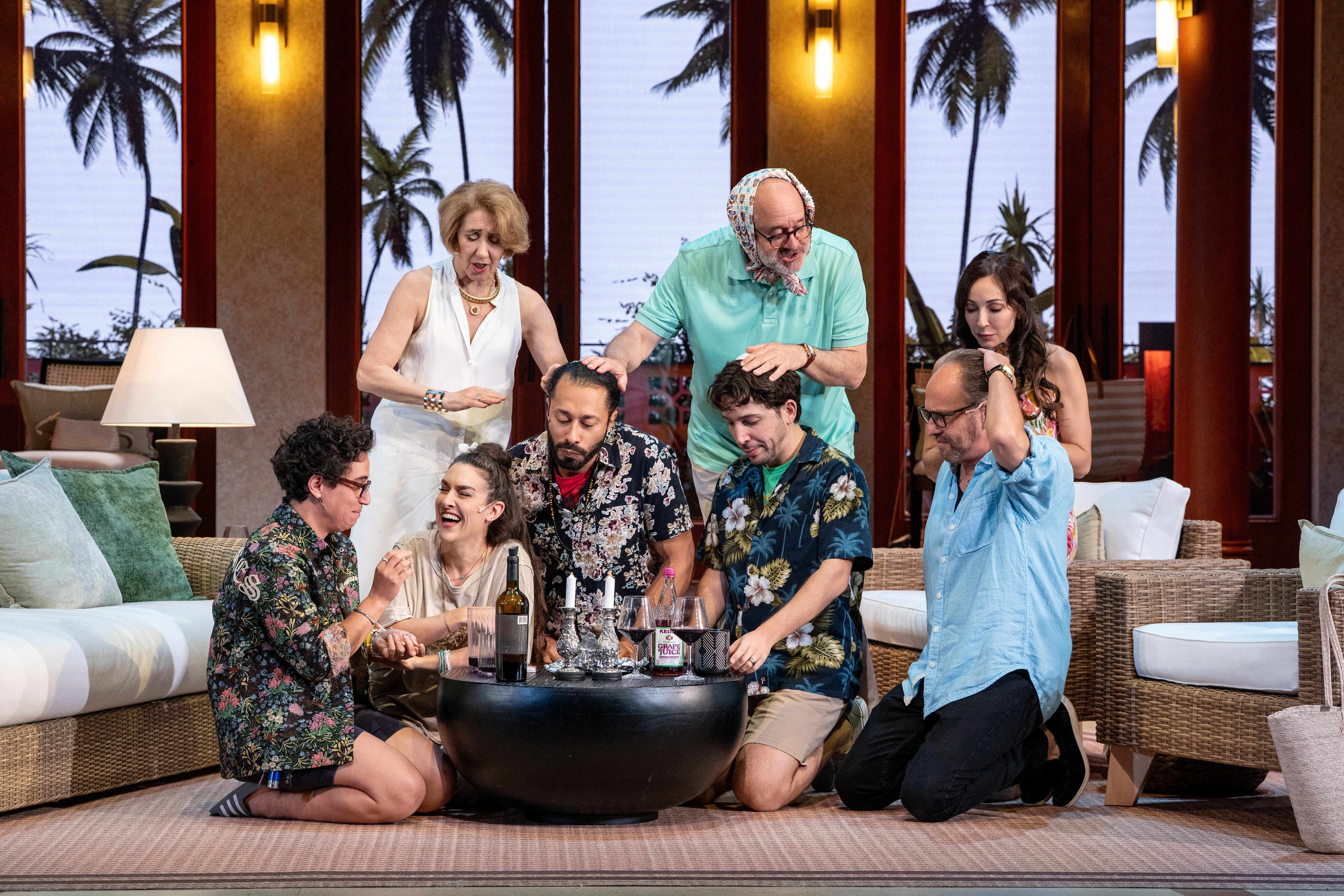
Broadway veteran, Joanna Glushak, as Ruth, the family matriarch brings her husband, two sons, a daughter and their partners to a fancy villa in Turks and Caicos for a reunion/vacation in November, 2024. The set, designed by Adam Koch, is stunning, drawing the audience into the luxury that money can buy which does not necessarily lead to family happiness.
This family is incredibly diverse and very devoted to their practice of Judaism. Ruth and her husband, Mitchell (Adam Grupper, another Broadway veteran) are a very successful couple and traditionally Jewish, but liberal while raising their three children. Shabbat is celebrated every Friday night. Traditions matter.
Their oldest son, David (Gregg Weiner), manages the family money and is married to Maria, (Yvette Gonzalez-Nacer) originally from Cuba, a convert to Judaism and a professor at Columbia. She is in her last trimester of a hard-won pregnancy.
Bex (Dani Stoller) has been living in Israel with her partner, Dana (Shira Alon), an Israeli from Iraq and former IDF Medic. Bex identifies as bisexual. They are parenting Bex’s daughter Noa who is not seen in the play.
Aaron, the youngest son, played by Coby Getzug, while strongly adhering to his Judaism, is anti-Zionist, and has started Sons of Abraham, an organization that raises money for Pro-Palestinian causes in response to the crisis in Gaza. He does so along with his partner, Zephyr (William De Meritt). Aaron is a recovering drug addict, sober for the past ten years. Very few family members trust him. Zephyr, a Jewish man of color, teaches kindergarten in a Jewish school.
Gelman has created a cast of color, converts, Israelis and LGBTQ characters, easily prone to disagree and address every issue we have read about since October 7, 2023 when Hamas massacred almost 1,200 Jews and kidnapped 250 hostages. In November, 2024, the hostages are not yet home and the war in Gaza is at full strength.

(L-R) Gregg Weiner, Yvette Gonzalez-Nacer, Adam Grupper, Dani Stoller, Shira Alon, Joanna Glushak, William DeMeritt, and Coby Getzug in S. Asher Gelman’s The Zionists: A Family Storm”, directed by Chloe Treat, at Barrington Stage Company. Photo: Daniel Rader. 
William DeMerritt and Joanna Glushak in S. Asher Gelman’s The Zionists: A Family Storm”, directed by Chloe Treat, at Barrington Stage Company. Photo: Daniel Rader. 
Joanna Glushak as Ruth in S. Asher Gelman’s The Zionists: A Family Storm”, directed by Chloe Treat, at Barrington Stage Company. Photo: Daniel Rader. 
Gregg Weiner and Yvette Gonzalez-Nacer in S. Asher Gelman’s The Zionists: A Family Storm”, directed by Chloe Treat, at Barrington Stage Company. Photo: Daniel Rader. 
William DeMeritt in S. Asher Gelman’s The Zionists: A Family Storm”, directed by Chloe Treat, at Barrington Stage Company. Photo: Daniel Rader. 
Joanna Glushak and Dani Stoller in S. Asher Gelman’s The Zionists: A Family Storm”, directed by Chloe Treat, at Barrington Stage Company. Photo: Daniel Rader. 
(L-R) Adam Grupper, Shira Alon, Yvette Gonzalez-Nacer, Gregg Weiner, Joanna Glushak, William DeMeritt, Dani Stoller, and Coby Getzug in S. Asher Gelman’s The Zionists: A Family Storm”, directed by Chloe Treat, at Barrington Stage Company. Photo: Daniel Rader. 
(L-R) Shira Alon, Dani Stoller, Joanna Glushak, Adam Grupper, William DeMeritt, Coby Getzug, Yvette Gonzalez-Nacer, and Gregg Weiner in S. Asher Gelman’s The Zionists: A Family Storm”, directed by Chloe Treat, at Barrington Stage Company. Photo: Daniel Rader. 
Coby Getzug in S. Asher Gelman’s The Zionists: A Family Storm”, directed by Chloe Treat, at Barrington Stage Company. Photo: Daniel Rader. 
Yvette Gonzalez-Nacer in S. Asher Gelman’s The Zionists: A Family Storm”, directed by Chloe Treat, at Barrington Stage Company. Photo: Daniel Rader. 
(L-R) Gregg Weiner, Adam Grupper, Joanna Glushak, and Coby Getzug in S. Asher Gelman’s The Zionists: A Family Storm”, directed by Chloe Treat, at Barrington Stage Company. Photo: Daniel Rader. 
(L-R) Gregg Weiner, Yvette Gonzalez-Nacer, Dani Stoller, Shira Alon, Adam Grupper, Joanna Glushak, Coby Getzug, and William DeMeritt in S. Asher Gelman’s The Zionists: A Family Storm”, directed by Chloe Treat, at Barrington Stage Company. Photo: Daniel Rader. 
(L-R back) Joanna Glushak, Adam Grupper, Yvette Gonzalez-Nacer (L-R front) Shira Alon, Dani Stoller, William DeMeritt, Coby Getzug, Gregg Weiner in S. Asher Gelman’s The Zionists: A Family Storm”, directed by Chloe Treat, at Barrington Stage Company. Photo: Daniel Rader. 
(L-R) Shira Alon, Dani Stoller, Joanna Glushak, and Adam Grupper in S. Asher Gelman’s The Zionists: A Family Storm”, directed by Chloe Treat, at Barrington Stage Company. Photo: Daniel Rader. 
Joanna Glushak and Adam Grupper in S. Asher Gelman’s The Zionists: A Family Storm”, directed by Chloe Treat, at Barrington Stage Company. Photo: Daniel Rader. 
Shira Alon and Dani Stoller in S. Asher Gelman’s The Zionists: A Family Storm”, directed by Chloe Treat, at Barrington Stage Company. Photo: Daniel Rader. 
Gregg Weiner, Joanna Gulshak, and Coby Getzug in S. Asher Gelman’s The Zionists: A Family Storm”, directed by Chloe Treat, at Barrington Stage Company. Photo: Daniel Rader. 
Joanna Glushak as Ruth in S. Asher Gelman’s The Zionists: A Family Storm”, directed by Chloe Treat, at Barrington Stage Company. Photo: Daniel Rader. 
in S. Asher Gelman’s The Zionists: A Family Storm”, directed by Chloe Treat, at Barrington Stage Company. Photo: Daniel Rader.
Not surprisingly, at the end of hurricane season in the Mediterranean, a storm is brewing at the resort, threatening to intensify. Eight characters are forced to interact and eventually address the elephant in the room, which is Aaron’s pro-Palestinian organization. Initially, they try to speak and listen. The weather inside and out is unsafe as family members let loose with emotion and anger, with no peaceful place to retreat.
As we often see in political disagreements, very few people are successful at changing the minds of others. While Aaron is very confident in his belief that Gazans are suffering at the hands of the Israelis, his foundation has had profound effects on the lives of family members, of which he is unaware. A newspaper linking the foundation to Aaron and his family’s wealth has thwarted his mother’s political ambitions, challenges Maria’s standing and safety as a professor at Columbia, and hampers Bex’s ability to wrest custody from the biological father of her daughter without handing over a large sum of money.
Credit to Director Treat and the cast for gripping the audience as their debate unfolds and anger mounts. The points of conflict are all too familiar, including Israel’s existence, formation, and right to exist, the history of the Jews, the question of who is the victim and who is justified? Who is the refugee? Does Zionism equal racism? Can a Jew be anti-Zionist? The Holocaust. Genocide. Apartheid. All are hot-button words guaranteed to be used to offend and defend. Aaron vehemently states, “Israel makes the world a more dangerous place for Jews!” This is a definite change in how the world sees Israel.
The play goes back and forth in time, enabling us to see each couple several months before this vacation, but after October 7th. Surprisingly, the most moving and effective scene takes place between Ruth and Mitchell as Ruth decides to plan this getaway in the hopes of bringing the family together. Glushak and Grupper have wonderful chemistry and use of humor as they show their devotion to their longstanding marriage and children. In fact, both characters plead for family peace at different times. Mitchell yells, “Stop bringing the fight home! Stop letting this thing rip us apart! Can we just… be a family? Is that so hard? To be a family?”
Getzug and Weiner, as Aaron and David, demonstrate the most hostility and long held rage for each other. Aaron resents not being trusted because of his past drug use, and for being the family joke, He is derided as the gay boy who is poor at sports. David is infuriated that Aaron took up all their mother’s attention when he was addicted to drugs and hospitalized. Their fight gets ugly and turns violent at the same time as the storm kicks up. Family members occupying one villa are further apart than they were when they arrived.
Ruth pleads, “You are my children. My three miracles. I will NEVER let you go! Nobody loves you like I do! Nobody loves you like I do! I don’t know how to be your mother if we can’t be a family. If WE can’t do this, what hope is there for the rest of the world?”
Therein lies the parallel of how Gelman sees the conflicts we experience at home and with our connection to Israel. Do we have hope? Can we ever agree? Gelman does not have the answer, but each actor brings a distinct point of view to his/her roles.
Koch as the scenic designer, Bryce Cutler as the Video and Projection Designer, and Solomon Weisbard as the Lighting Designer, enable us to see the stage divided into three separate homes when the family is not at the villa. The projections behind the set show a continual storm with palm trees blowing and rain coming down in sheets. Co-Sound Designers, Salomon Lerner and Andy Evan Cohen create a very believable storm, along with thunder and lightning, varying in intensity. At the same time, projections enable the audience to know the location and date for each scene.
Costume designer, Anya Klepkov, dresses each character appropriately and attractively. What is most impressive, however, is the speed with which each actor changes, depending on the time of day depicted in each scene.
Clearly, audience members who identify as Jewish, Israeli, or Palestinian will be the most riveted to this important, timely play. Gelman bravely shares how families with complex relationships can struggle with trying to make sense out of religion, culture, and violence, with no easy or reachable conclusion. So many of us try to decide when to speak up, when to stay silent, and when to ignore. Gelman gives all of us a voice. Watch and listen. The Zionists, A Family Storm at Barrington Stage is yelling loud and clear.
Barrington Stage Company, in association with Midnight Theatricals and Miami New Drama, presents The Zionists, A Family Storm by S. Asher Gelman, directed by Chloe Treat. CAST: Joanna Glushak as Ruth, Adam Grupper as Mitchell, Gregg Weiner as David, Yvette Gonzalez-Nacer as Maria, Dani Stoller as Bex, Shira Alon as Dana, Coby Getzug as Aaron, William De Meritt as Zephyr. CREATIVE TEAM: Stage manager Amy Rauchwerger, set designer Adam Koch, costume designer Anya Klepkov, video and projection designer Bryce Cutler, lighting designer Solomon Weisbard, co-sound designers Salomon Lerner and Andy Evan Cohen.
Performances are Tuesday through Saturday at 7:30 p.m., with matinees Saturdays and Sundays at 2:00 p.m. at the Boyd-Quinson Stage, 30 Union Street, Pittsfield, MA.
Tickets range from $49 to $120. For tickets and information, call 413-236-8888 or visit BarringtonStageCo.org.