

by Barbara Waldinger
Playwright Chess Jakobs, proud of his black, Jewish and queer background, loves history. Accordingly, his debut play, The American Five, now being performed at Berkshire Theatre Group’s Unicorn Theatre, highlights five brilliant individuals, all members of minorities that have been historically marginalized, who planned the 1963 March on Washington for Jobs and Freedom, where Dr. Martin Luther King Jr. delivered his powerful“I Have a Dream” speech.
The five range from the most well-known—Dr. King and his wife Coretta Scott King—to three others who were essential to the struggle for Civil Rights but who, says Jakobs in an interview with NPR, “they don’t talk about in most of our historical books”: Bayard Rustin, Stanley Levison, and Clarence B. Jones. Jakobs’s play won the Helen Hayes Award for Best New Play and earned eight other nominations at Ford’s Theatre, where it was commissioned and performed.
Determined to resurrect the contributions of one woman and four black men, including a Jew and a gay mentor to Dr. King, the playwright has written a passionate and compelling piece of theatre with humanity and wit, directed by Gerry McIntyre in a high-octane, face-paced performance that propels us on a journey we will not soon forget.
This cyclical play begins and ends in a hotel room in Washington D.C. around 3:00 am on August 28, 1963 the day of the March, where the characters are wrestling with the speech that will be delivered by Dr. King. The first act flashes back to the 1950s for the exposition: Martin meeting Coretta for the first time, personally seeking trusted advisors to join his team, testing their willingness to fight for freedom and justice with all the sacrifices that will entail, and the decision to go ahead with a March that could easily fail or turn dangerous. But it is the second act and its hyperfocus on the details of the March and Dr. King’s speech that holds us completely spellbound.

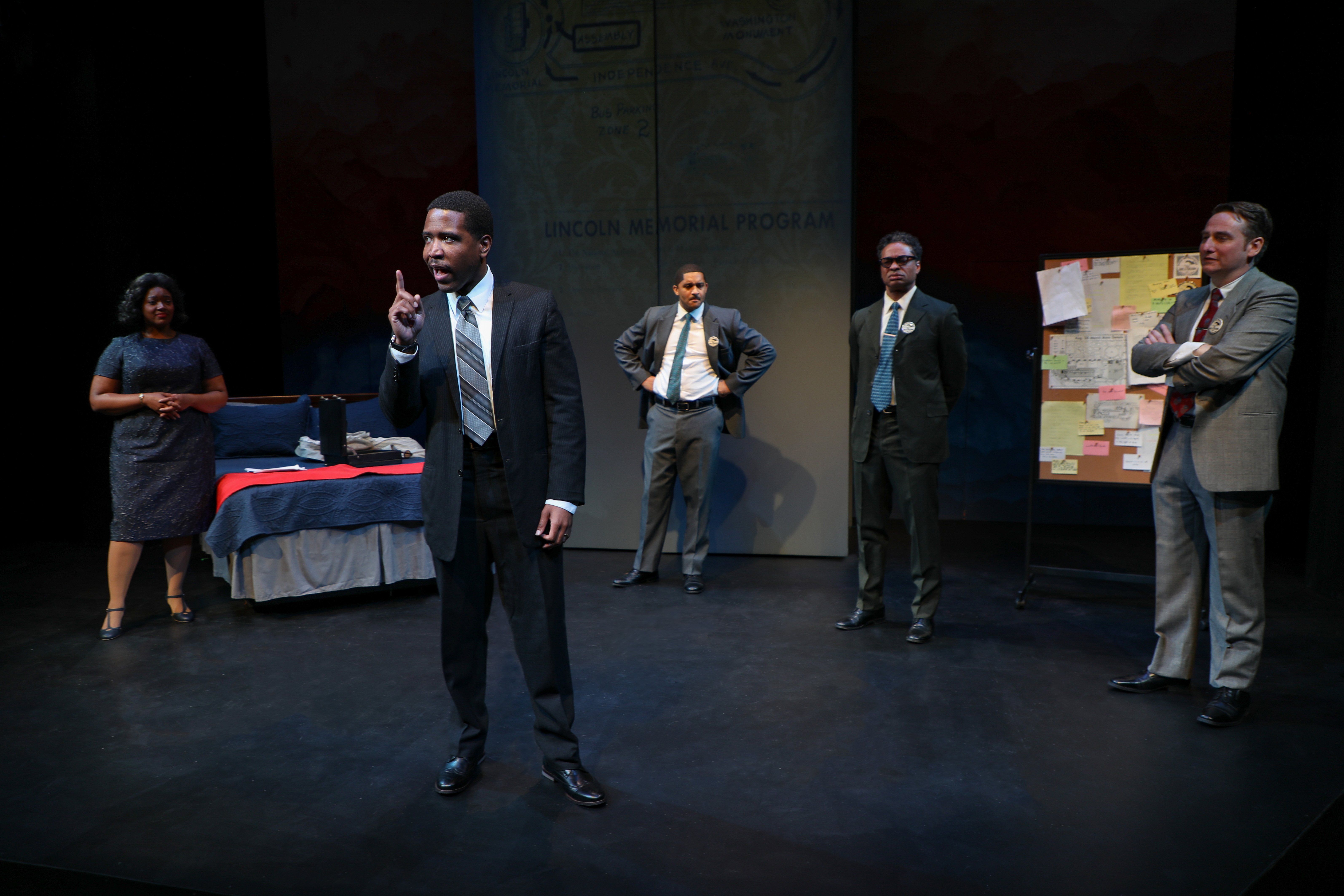
“The American Five” by Chess Jakobs, directed by Gerry McIntyre, at the Berkshire Theatre Group. Photo: Caelan Carlough. 
“The American Five” by Chess Jakobs, directed by Gerry McIntyre, at the Berkshire Theatre Group. Photo: Caelan Carlough. 
“The American Five” by Chess Jakobs, directed by Gerry McIntyre, at the Berkshire Theatre Group. Photo: Caelan Carlough. 
“The American Five” by Chess Jakobs, directed by Gerry McIntyre, at the Berkshire Theatre Group. Photo: Caelan Carlough. 
“The American Five” by Chess Jakobs, directed by Gerry McIntyre, at the Berkshire Theatre Group. Photo: Caelan Carlough. 
“The American Five” by Chess Jakobs, directed by Gerry McIntyre, at the Berkshire Theatre Group. Photo: Caelan Carlough. 
“The American Five” by Chess Jakobs, directed by Gerry McIntyre, at the Berkshire Theatre Group. Photo: Caelan Carlough. 
“The American Five” by Chess Jakobs, directed by Gerry McIntyre, at the Berkshire Theatre Group. Photo: Caelan Carlough. 
“The American Five” by Chess Jakobs, directed by Gerry McIntyre, at the Berkshire Theatre Group. Photo: Caelan Carlough. 
The performances are uniformly effective, each actor creating a complex, multi-faceted character. Sydney Elisabeth as Coretta Scott King delivers a strong monologue to her husband demanding respect and consideration for her rights, while Brett Diggs as Clarence B. Jones, lawyer, Civil Rights activist, advisor to Dr. King and recipient of the Presidential Medal of Freedom in 2024, offers impassioned arguments about what he believes should be the purpose of Dr. King’s speech. The following three actors are standouts: Destan Owens plays Bayard Rustin, chief architect of the March on Washington, lifelong advocate for the Civil Rights movement, a pioneer of nonviolent protest, and openly gay. Everything about Owens’s characterization, from his suit to his glasses, his posture and careful diction, suggests a man of profound thought and deep convictions. Yet, because of the discrimination he has suffered, he’s “the best at what I do but I’ll always just be known as that Black Faggot trailing behind Dr. King.” The four others are married with families, but the loneliness and lack of love in his life is terrible, leaving him with a palpable, touching sadness.
Stanley Levison is the Jewish lawyer and businessman who helped shape Dr. King’s speeches and writings. At first rejected as an advisor because of his color, Levison objects: “I’m not white, I’m Jewish,” to which Dr. King replies, “I can work with that.” Played to perfection by Harry Smith (who recently played Dr. Treves in BTG’s Elephant Man), we are with him in every detail of his performance: from his childlike enthusiasm and hugs, to the glorious smile that lights up his face, to the hurt he suffers when false government accusations against him force him to give up speaking to or seeing Dr. King, and finally, to the challah he offers his black friends.
Rashun Carter portrays Dr. King with humor and conviction. There’s no question of imitation here—Carter creates his own Dr. King, who sometimes, in his quiet moments, sounds and looks a bit like President Obama. We believe it when the others regard him as a born leader and understand why he is so persuasive in convincing Coretta to marry him and in talking his advisors into giving up everything for the fight of their lives and its impact on future generations.
Alex Hill’s projections on three upstage screens add immeasurably to the context of the play: illustrating the time period and the historical struggles of those involved in protests on buses, marches, gatherings of all kinds, in addition to the recognizable celebrities seen at the 1963 March. How clever of the Scenic Designer, Baron E. Pugh, to enable those screens to fit together, forming a solid wall with sliding doors through which actors can enter and exit! Thanks to Pugh also for the movable furniture (a bed, desks, tables, chairs, a bulletin board) that can quickly and easily be wheeled on and offstage by actors and black clad stagehands. Sound Designer Amoirie Perteet provides music of the time, softly during scenes, louder during transitions when they accompany the projections. Costume Designer Danielle Preston’s period clothing–suits for the men and many dresses for Coretta—never feel like costumes, so comfortable are the actors in their garments.
This production is tight—McIntyre fills every moment with clear, precise action. Each performer enters with a mission that will be thwarted or fulfilled. From the explosive beginning, the audience is drawn into Jakobs’s contemporary dialogue, McIntyre’s pinpoint direction and choreography, and its interpretation by actors who are fully committed.
What is the message for us today? Jakobs delivers it loudly and clearly: for Clarence B. Jones this March must be solely about freedom for Negroes. He responds to Levison who tells him: “This fight isn’t just about Negroes anymore!” with: “If it’s not now then when will it BTG
be!?. . . It is about the color of our skin. Where we come from. That is why they enslaved us.” But it is Levison’s (and Jakobs’s) ideas about diversity, equity and inclusion (remember them?) that find their way into Dr. King’s speech.
THE AMERICAN FIVE runs from June 18—July 11 at Berkshire Theatre Group’s Unicorn Theatre, 6 East St., Stockbridge. For tickets call 413-997-4444. https://www.berkshiretheatregroup.org/
Berkshire Theatre Group presents THE AMERICAN FIVE by Chess Jakobs. Director: Gerry McIntyre. Cast: Rashun Carter (Martin Luther King Jr.), Brett Diggs (Clarence Jones), Sydney Elisabeth (Coretta Scott King), Destan Owens (Bayard Rustin), Harry Smith (Stanley Levison).
Scenic Designer: Baron E. Pugh; Costume Designer: Danielle Preston; Lighting Designer: Sam Rushen; Sound Designer: Amoirie Perteet; Projections Designer: Alex Hill, Intimacy Coordinator: Vik Abbott-Main. Production Stage Manager: Jason Hindelang.
The performance runs two hours including a ten-minute intermission.