

by Barbara Waldinger
What could be more satisfying for a theatre critic with a penchant for opera than to attend a bel canto performance of a Donizetti opera with “fleshed out characters” who “all have a real arc”? (Program: Director’s Note by Jonathon Loy) It was in his later years that Gaetano Donizetti changed the trajectory of Romantic opera by focusing on psychological portraits of his characters, dramatizing emotions through music. Add a plot, based on a true story, with echoes of Shakespeare’s Romeo and Juliet, Measure for Measure, and Hamlet; magnificent singers—and you have Lucia di Lammermoor, the most glorious production of the Berkshire Opera Festival since its inception in 2014—now playing at the Mahaiwe Performing Arts Center in Great Barrington.
Although the opera was written in 1835, the action is set in Scotland in 1703, before Scotland and England were joined in their 1707 Act of Union, a time of clan feuds, and religious and political conflicts. Salvadore Cammarano, the librettist, loosely adapted the opera from Sir Walter Scott’s novel, The Bride of Lammermoor (1819), inspired by the real story of Janet Dalrymple and Archibald, Lord Rutherfurd’s secret, doomed love affair. Janet’s mother found out and forced her daughter into a politically advantageous marriage to Sir David Dunbar. But Janet stabbed her husband on their wedding night, went mad and died. Scott changed their names and Cammarano changed several plot points, resulting in the opera’s story of Lucia Ashton, whose brother Enrico, Lord of Ravenswood, forced his sister to marry the wealthy Lord Arturo Bucklow who will support him, destroying the relationship between Lucia and the man she loves, Edgardo di Ravenswood, sworn enemy of the Ashtons.
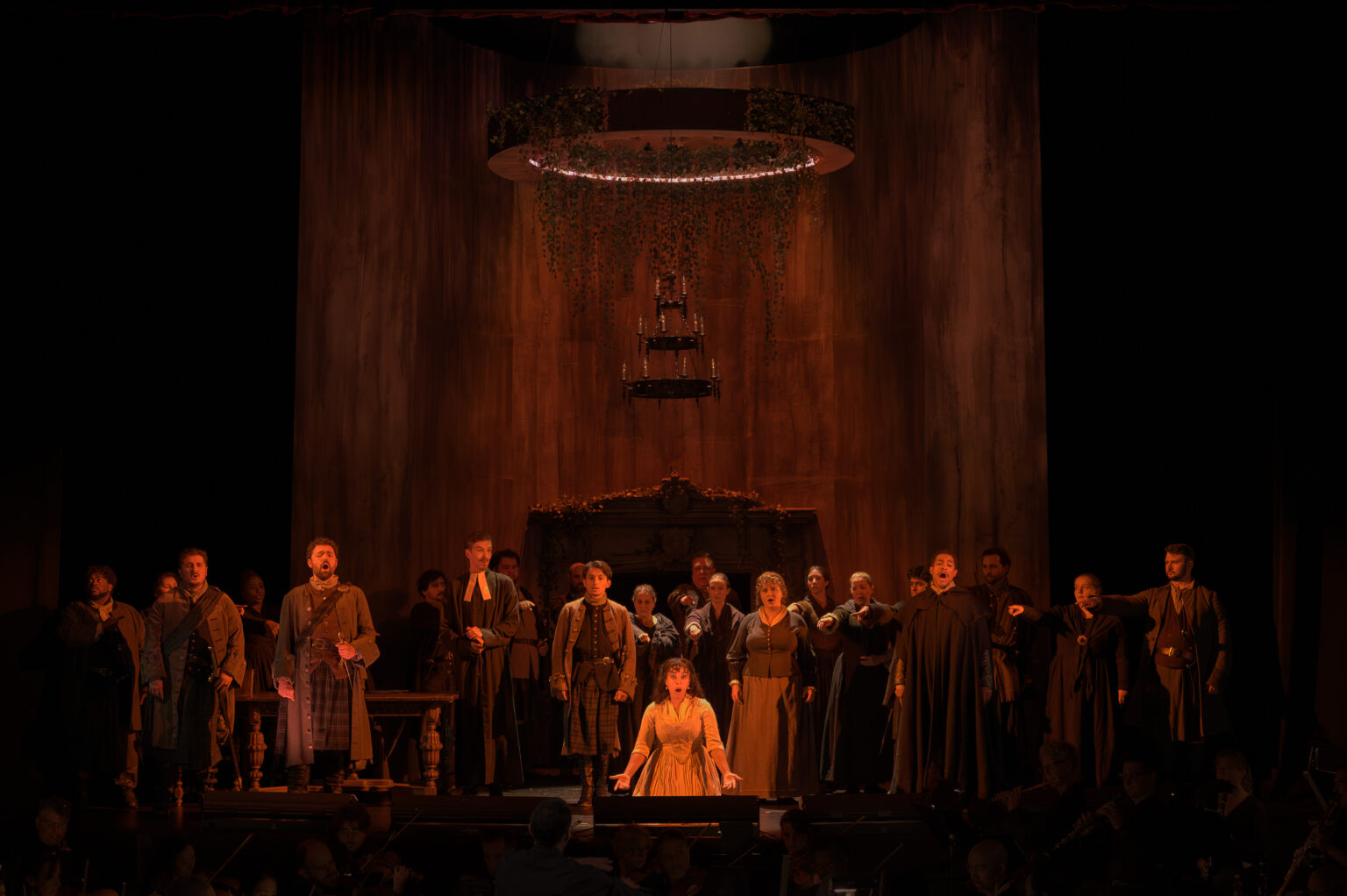
Director Jonathon Loy, having read and loved the novel, researched Scottish folklore and re-introduced several elements in the book by Sir Walter Scott. Loy and Scenic Designer Cameron Anderson created a ring, covered with vines, suspended in the air throughout the production, that will take on metaphorical significance towards the end of the play. In Act One, there is a round stone fountain directly below the ring, which, according to an ancient legend, is haunted by a water nymph whose lover broke his vow to her on that spot. There is a preponderance of the supernatural in Scott’s novel, with his “village witches,” a sort of Greek chorus who possess second sight: they can foresee the future. Loy emphasizes Lucia’s second sight, explaining that it allows her a “much-needed agency over her plight,” a feminist interpretation that provokes his interesting question concerning whether she is actually mad or just using madness, like Hamlet, to “take matters into her own hands.”
For the Act Two dark indoor scenes at Ravenswood, there is a fireplace that Loy calls “the greatest image in the novel,” through which Lucia emerges in her famous mad scene. It cuts into a semi-circular marble wall upstage in the castle, against which the chorus just fits, obscuring Lucia’s entrance until she wanders in. The scenery is minimal, but symbolic and effective, thanks to Anderson and Lighting Designer Alex Jainchill.
Dramaturg Cori Ellison’s lecture before the opening of the opera was packed with insightful information about the gestation of Lucia di Lammermoor, Donizetti, librettist Cammarano, and musical highlights. One of the latter is the extraordinary addition of the glass armonica, invented in the eighteenth century, often left out in productions of this opera and replaced by a flute. The armonica consists of rotating glass bowls of diminishing size, which create an otherworldly sound when they are touched by wet fingers, causing friction. Because Maestro Brian Garman, the Conductor, wants to foreground the genius of Donizetti in using the armonica in a duet with Lucia to represent musically her descent into madness (and probably there is no room to add instruments to the orchestra pit) he places the armonica in a box on stage left, overhanging the stage. For an earlier duet between Lucia and a harp, Garman places the harpist in a box on stage right, across from the armonica, and both are beautifully lit by Jainchill.
One unusual blocking element of Loy’s is positioning the singers, during cathartic moments, to kneel, sit, or even lie on the stage floor, perhaps creating a vocal challenge for them.
Singers in major roles, elegantly attired in Scottish dress by Costume Designer Brooke Stanton, are not only well-versed in bel canto style, but are also actors who understand that they represent complex characters with powerful needs.
Soprano Christine Lyons, playing Lucia, is as gifted at vocal ornamentation and birdlike trills as she is in her dramatic ability, especially during the mad scene. Ornamentation is not just art for Lucia, it is, according to Cori Ellison, “her emotional thesis statement.” In her duets with the armonica and harp, Lyons matches the instruments note for note. And as highlighted by Loy, Lucia’s character is strong, despite the trauma that she suffers: her grief, anger and determination can be heard in Lyons’ breathtakingly expressive voice.

Other standouts include tenor Terrence Chin-Loy (Edgardo), whose duet with Lyons in the first act, and whose bravura solo at the end of the opera are stunning. He and baritone Dean Murphy as Enrico play complicated adversaries: Enrico moves from vicious cruelty to his sister to terrible guilt for what he has done; while Edgardo vacillates between blaming Lucia for signing the marriage contract and realizing that she was forced by her brother, between hatred for Enrico and attempting to cool his rage for Lucia’s sake. Their vocal prowess accompanied by Donizetti’s music allows them to fully explore these contradictions. Bass Stefan Engerstrom (Raimondo the chaplain), thin and tall with a commanding voice, vacillates between convincing Lucia to obey her brother (reminding us of Moliere’s Tartuffe), trying to maintain peace, and finally pitying Lucia.
The famous sextet, now in the first act (because three acts have been condensed into two, there are several short pauses during each of the two acts) is a brilliant example of Donizetti’s ability to have six singers each conveying different emotions all at once–“a musical evocation of chaos” (Ellison). With these consummate performers, it was masterful.
There remain only two performances—the evenings of August 25 and 28–to see this remarkable production. It’s a simple story that follows Aristotle’s rules of tragedy, with spectacular performances, a combination of drama, music that reveals inner thoughts and feelings, and virtuoso singing all reinforcing each other, and more talent than can be listed in a mere printed program.
LUCIA DI LAMMERMOOR performs on August 22 at 1:00, August 26 at 7:30 and August 28 at 7:30 at the Mahaiwe Performing Arts Center, 14 Castle Street, Great Barrington. Tickets may be purchased by calling 413-528-0100 or online at www.mahaiwe.org.
Berkshire Opera Festival presents LUCIA DI LAMMERMOOR, score by Gaetano Donizetti, libretto by Salvadore Cammarano. Directed by Jonathon Loy. Conducted by Maestro Brian Garman. Cast: Scott Ruben La Marca (captain of the Ravenswood guard), Dean Murphy (Lord Enrico Ashton); Stefan Egerstrom (Raimondo Bidebent, chaplain); Christine Lyons (Lucia), Christina Grohowski (Alisa, Lucia’s attendant), Terrence Chin-Loy (Sir Edgardo di Ravenswood), Luke Norvell (Lord Arturo Bucklaw).
Scenic Designer: Cameron Anderson; Costume Designer: Brooke Stanton; Lighting Designer: Alex Jainchill; Hair and Make-Up Designer: Beckie Kravetz; Chorus Master and Assistant Conductor: Luca Antonucci; Principal Pianist and Coach: Curtis Serafin; Musical Preparation: Dakota Perez; Supertitles Author: Cori Ellison. Production Stage Manager: Cindy Knight.
The production runs two hours and 45 minutes with one 25- minute intermission.