

by Sierra Pasquale
Jekyll & Hyde was highly anticipated. Frank Wildhorn’s score went through more workshop productions, concept albums, and regional tryouts than almost any show in modern musical theater history before it finally reached Broadway in 1997. For anyone who came of age with the concept album or caught it during its original run, the show carries a weight of memory that a community theater production must reckon with, whether it wants to or not. SLOC Musical Theater‘s current production, directed by Jake Goodman, doesn’t try to outrun that history. It leans into the material’s melodrama and lets the show’s considerable vocal demands do most of the work.
The result is a Jekyll & Hyde that is vocally confident, briskly paced, and unafraid of the story’s gothic excess, even when a few of its choices don’t entirely land.
For those unfamiliar with the show (or novella by Robert Louis Stevenson), Jekyll & Hyde follows Dr. Henry Jekyll, a brilliant and idealistic physician convinced that human nature can be surgically divided into its good and evil components. When the medical establishment refuses to sanction his research, Jekyll tests his formula on himself, unleashing Edward Hyde, a violent alter ego who gives voice to every impulse Jekyll has spent his life suppressing. As Hyde’s crimes escalate, Jekyll finds himself increasingly unable to control when the transformation happens or to whom, and the people closest to him, his fiancée Emma (Blake Zardezed), his loyal friend Utterson (Stephen Foust), and Lucy (Hannah M. DeStefano), a music hall singer drawn into his double life, are pulled into the wreckage.
It is a story built for a big voice in the title role, and that is where this production stakes its claim. Having seen the original Broadway production toward the end of its run, with Sebastian Bach of Skid Row fame in the role, I’ll admit no local production was ever going to match that particular…spectacle. Bach brought an arena-rock ferocity to Hyde that was as much rock concert as musical theater. James W. Alexander instead, gives Jekyll and Hyde his own considerable instrument and pushes it hard, and he comes closer to that Broadway-sized impact than a community stage has much right to.
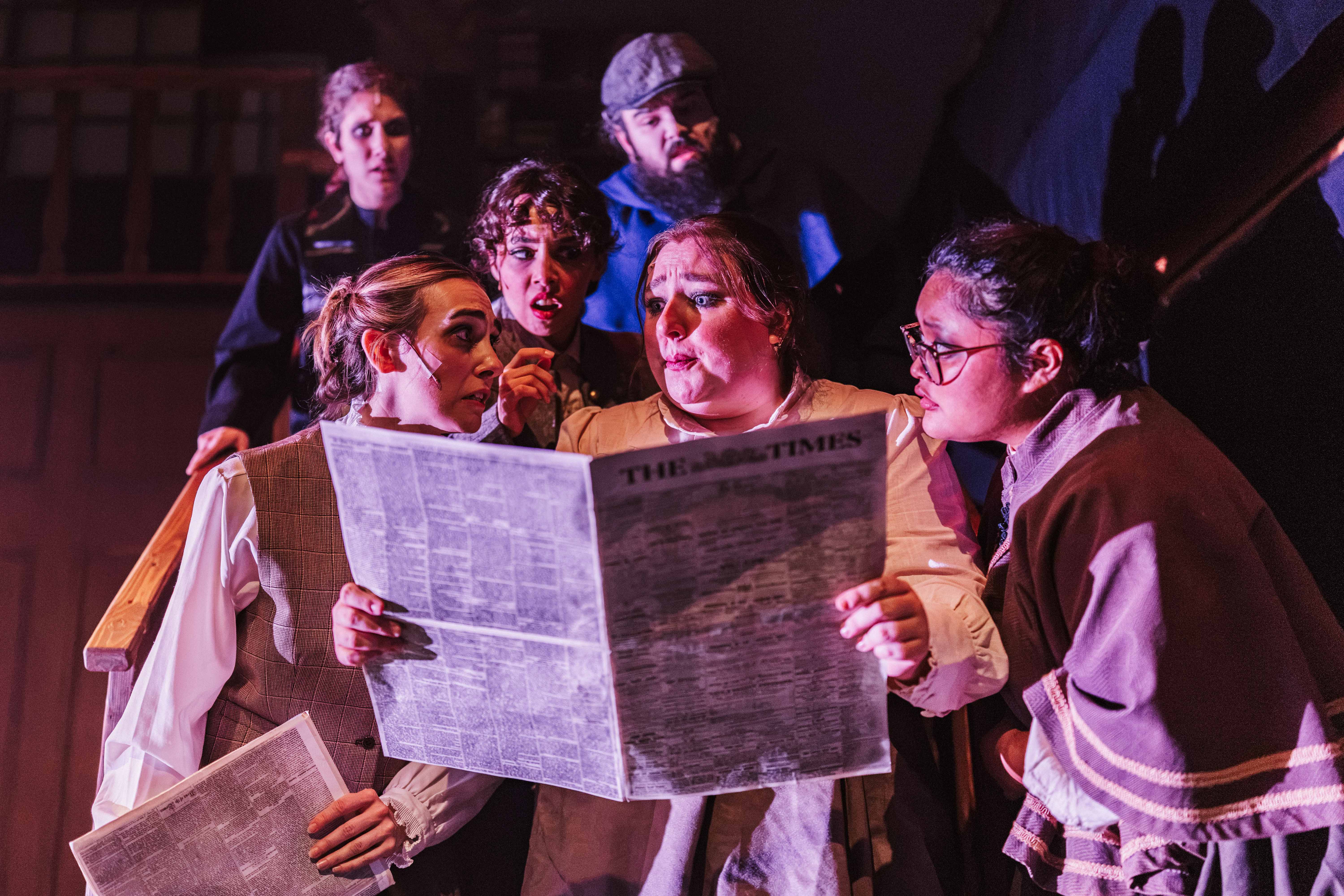
He is not carrying the show alone. Across the board, the cast sings well, and the ensemble deserves real credit. Some of the evening’s most striking moments come not from the leads but from the harmonies the ensemble builds underneath them. There is a haunting, layered quality to their choral work that gives the production’s darker numbers real weight and makes Victorian London feel populated rather than just a backdrop for two people’s psychological crisis.
Hannah M. DeStefano and Blake Zardezed deserve their own recognition here as well. As Lucy and Emma, respectively, the two women Jekyll’s double life pulls in opposite directions, they bring real vocal power to roles that often get overshadowed by the title character’s pyrotechnics. Their duet, “In His Eyes,” is one of the score’s most demanding moments, asking two very different voices to intertwine while the characters themselves remain unaware of how much they share, and DeStefano and Zardezed handle it beautifully. Their voices blend with a clarity and control that lands the song’s quiet irony without ever undercutting its emotional pull.
Where the production is less successful is in establishing the social world the story depends on. Jekyll & Hyde only works if the audience feels the gulf between Jekyll’s genteel, aristocratic circle and the music-hall underworld where Lucy lives and works. The show’s entire moral architecture rests on that class divide. Here, the two worlds blur together more than they should. The “seedy” side of London never feels meaningfully distinct from the drawing rooms of the wealthy, which softens some of the story’s sharper edges and makes Lucy’s precariousness a bit harder to feel in your gut. Molly Waters’s set design is sparse and functional, which suits the production’s brisk pace, but a little more visual differentiation between the two Londons would have gone a long way.
That pace, to the production’s credit, never flags. Director Jake Goodman and music director Dan Galliher keep the show moving briskly from number to number, and even at two and a half hours the evening doesn’t drag.

The SLOC Musical Theater production of “Jekyll & Hyde”, directed by Jake Goodman. Photo: Andrew Elder of Best Frame Forward. 
The SLOC Musical Theater production of “Jekyll & Hyde”, directed by Jake Goodman. Photo: Andrew Elder of Best Frame Forward. 
The SLOC Musical Theater production of “Jekyll & Hyde”, directed by Jake Goodman. Photo: Andrew Elder of Best Frame Forward. 
The SLOC Musical Theater production of “Jekyll & Hyde”, directed by Jake Goodman. Photo: Andrew Elder of Best Frame Forward. 
The SLOC Musical Theater production of “Jekyll & Hyde”, directed by Jake Goodman. Photo: Andrew Elder of Best Frame Forward. 
The SLOC Musical Theater production of “Jekyll & Hyde”, directed by Jake Goodman. Photo: Andrew Elder of Best Frame Forward. 
The SLOC Musical Theater production of “Jekyll & Hyde”, directed by Jake Goodman. Photo: Andrew Elder of Best Frame Forward. 
The SLOC Musical Theater production of “Jekyll & Hyde”, directed by Jake Goodman. Photo: Andrew Elder of Best Frame Forward. 
Set by Molly Waters for the SLOC Musical Theater production of “Jekyll & Hyde”, directed by Jake Goodman. Photo: Chris Foster. 
The one number that didn’t work for me was “The Confrontation,” the pivotal duet in which Jekyll and Hyde face each other directly. This production makes a specific staging choice for that number that, while clearly intended to heighten the drama, ends up working against the song’s central idea. Jekyll’s whole tragedy is that he cannot fully separate himself from Hyde, that the two are one person struggling against himself, and the way this production stages their face-off creates a literal separation between them that undercuts that tension rather than sharpening it. I’ll leave the specifics alone so as not to spoil the moment for anyone still planning to see the show, but it was the one point in the evening where a technical choice worked against the material rather than for it.
Elsewhere, the design team supports the production well. David Caso’s lighting and Matthew Mascelli’s sound work do a lot of the atmospheric heavy lifting that the set design leaves on the table, while Theodore “Zede” Stefanik-Corah’s costumes and Jennifer Canale’s hair and makeup design help capture the time period well, but leave some grittiness to be desired. Joshua DeMarco’s choreography gives the ensemble numbers, particularly “Façade” and “Murder, Murder”, a lively, propulsive energy that matches the show’s quicker pace.
None of this is the Jekyll & Hyde of 1997, and it was never going to be. What SLOC has built instead is a fast-moving, well-sung production that trusts its cast to carry the show’s big emotions, even when a design choice or two doesn’t fully serve the material. For a story about the impossibility of keeping our better and worse selves cleanly separated, there’s something fitting about a production that is strongest exactly where it lets its performers loose and a little shakier wherever it reaches for a clever effect instead.
SLOC Musical Theater presents Jekyll & Hyde. Conceived for the stage by Steve Cuden and Frank Wildhorn. Book and lyrics by Leslie Bricusse. Music by Frank Wildhorn. Directed by Jake Goodman. Featuring James W. Alexander as Dr. Henry Jekyll/Mr. Edward Hyde; Hannah M. DeStefano as Lucy Harris; Blake Zardezed as Emma Carew; Stephen Foust as Gabriel John Utterson; Christopher W.J. Henderson as Sir Danvers Carew; Neal Gallini-Burdick as Simon Stride; Jacob Frenyea as the Bishop of Basingstoke; John L. Favreau as General Lord Glossop; Rory Alexa as Nellie; Simon Woods as Lord Savage; Elizabeth L. Kielty as Lady Beaconsfield; Josef Mendez as Sir Archibald Proops/Poole; and Thomas Raimo as Spider, with featured dancers/ensemble Gillian Belarmino, Ashley Polidore, Emma Rask, Ari Silva, Sammy Wilson, and Keira Woods, and ensemble members Rachel DeAngelus (swing), Tara Fox, and Becky Wilczak. Music direction by Dan Galliher. Choreography by Joshua DeMarco. Scenic design by Molly Waters. Costume design by Theodore “Zede” Stefanik-Corah. Lighting design by David Caso. Sound design by Matthew Mascelli. Hair and make-up design by Jennifer Canale. Property design by Gary M. Hoffmann. Fight choreography by Molly Waters. Produced by Sara Fredericks and John Meglino. Stage Manager: Ella Mboma. Assistant Director: Grace Glastetter.
Jekyll & Hyde runs September 11–13 and 17–20, 2026, at SLOC Musical Theater, 427 Franklin Street, Schenectady, New York. Performances are Thursday through Saturday at 8 p.m. and Sunday at 3 p.m., with an ASL-interpreted performance on September 13 at 3 p.m. Running time is 2 hours and 30 minutes, including intermission. Tickets and additional information are available through SLOC Musical Theater at 518-730-7370 or https://sloctheater.org/project/jekyll-and-hyde-2026/.