

by Macey Levin
The Ancram Center For The Arts is currently presenting Caryl Churchill’s intriguing and provocative “A Number.” The play is indicative of Churchill’s style and themes as her work often explores abuses of power or subtle control over others. The structure of her plays is sometimes fragmented or surrealistic. Some of her best known works are “Cloud Nine” and “Top Girls.”
In “A Number” a sixty-year-old man named Salter (John Wojda) converses with his three sons, two of whom are clones, all portrayed by Drew Ledbetter as Bernard (B1), Bernard (B2) and Michael Black.
After his mother died, the original son– B1– who was put up for adoption, returns many years later to confront his father. He has learned about the clones and is angry that Salter would approve this without informing him. He also resents the painful upbringing he experienced. Saltre responds that he wanted to raise another child in a more loving manner. B1 harbors angry feelings toward B2.
B2 angrily makes the observation that there may be myriad copies of him. How would their actions affect his life? Michael Blake, the third clone, seems to be leading a normal, peaceful life as a math teacher, married with a family but there is a hollowness to his emotional responses.
The four characters portray radically contrasting personalities as the thematic elements of the play pose questions-where is our individuality found? Is it in our genes or our family’s influences amidst other surrounding forces. The sons wonder what if all the other clones are like them… “How am I me?” These questions are complemented by Salter’s reflections on the reasons he tried to excuse his actions as a failing parent.

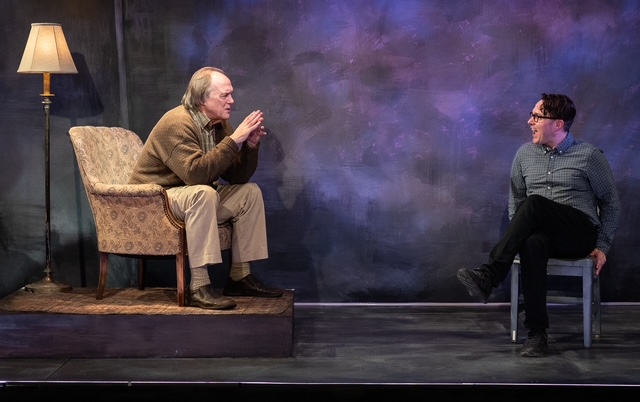
John Wodja and Drew Ledbetter in the Ancram Center for the Arts’ production of Caryl Churchill’s “A Number”, directed by Jeffrey Mousseau. Photo by B Docktor. 
John Wodja and Drew Ledbetter in the Ancram Center for the Arts’ production of Caryl Churchill’s “A Number”, directed by Jeffrey Mousseau. Photo by B Docktor. 
John Wodja and Drew Ledbetter in the Ancram Center for the Arts’ production of Caryl Churchill’s “A Number”, directed by Jeffrey Mousseau. Photo by B Docktor. 
John Wodja and Drew Ledbetter in the Ancram Center for the Arts’ production of Caryl Churchill’s “A Number”, directed by Jeffrey Mousseau. Photo by B Docktor. 
Set design by JSarah Edkins for the Ancram Center for the Arts’ production of Caryl Churchill’s “A Number”, directed by Jeffrey Mousseau. Photo by B Docktor. 
The conversations/arguments between father and sons explore the nature of family and self. Each man examines his reactions to life experiences and what is to be learned through interaction with one another, as well as an enigmatic father. B1 and B2 are more combative than Michael who is sedate while living a fairly comfortable existence.
Wojda effectively provides Salter a varied arrangement of emotions… anger regret, self-doubt and compassion. All these and others create a picture of a man who has lived a difficult life. He sometimes earns the audience’s empathy and occasionally resentment. He and Ledbetter convincingly play off each other’s anxiety and confusion
Ledbetter as the three clones is a marvel as he portrays three distinct but somewhat similar men. For each, his manner changes as does his speech patterns and phrasing allowing his emotional levels to bring them alive with finely nuanced alteration.
The scenic design by Sarah Edkins is very simple. On a virtually bare stage Salter sits in an easy chair on a raised platform while Ledbetter changes the placement of a straight back desk chair for the three clones suggesting the relationship of each to his father. Matthew E. Adelson’s subtle lighting changes the colors and patterns during a fadeout on a backdrop. This implies the personality and emotional level of the younger men. Jeffrey Mousseau’s direction employs a tight, disciplined approach to the characterizations and plot elements. All the clones are believably human in this very difficult play by Churchill. It is a pleasure and an emotional experience to see “A Number.”
A Number by Caryl Churchill; Director: Jeffrey Mousseau; Cast: Drew Ledbetter (B1,
B2, Michael Black) John Wodja (Salter); Scenic Design: Sarah Edkins; Lighting Design:
Matthew E. Adelson; Costume Design: Alicia J. Austin; Sound Design, Original Music:
Liam Bellman-Sharpe; Producton Manager: Evan Anderson; Stage Manager: Hannah
Schiffer; Technical Director: Parker Krey; Running time: one hour, no intermission;
Ancram Center for the Arts, 1330 Co. Rte 7, Ancram, NY 12502; October 1-4; 8-11 2026;
For tickets and information: www.ancramcenter.org or 518-329-0114