

by Barbara Waldinger
Google’s AI Overview defines a tour de force as “an impressive or extraordinary achievement, performance, or creation that demonstrates a high degree of skill strength, or ingenuity. . . [it] seems to go beyond normal expectations.” This description captures Mark H. Dold’s astounding work in VANYA, now playing at Barrington Stage Company’s Boyd-Quinson Theater.
The play is written by Simon Stephens, co-creator of the London production along with Andrew Scott (who performed it in London’s West End and in NY), and director Sam Yates. Stephens’ script is an adaptation of Chekhov’s Uncle Vanya with all eight characters played by one actor alone onstage. Though VANYA follows Chekhov’s plot, the language is contemporary and the names are anglicized.
Whereas other solo pieces containing multiple characters may present one at a time (think Anna Deavere Smith, John Leguizamo, Lily Tomlin), VANYA has scenes involving a group of characters speaking to one another, all truthfully and uncannily played here by Dold.
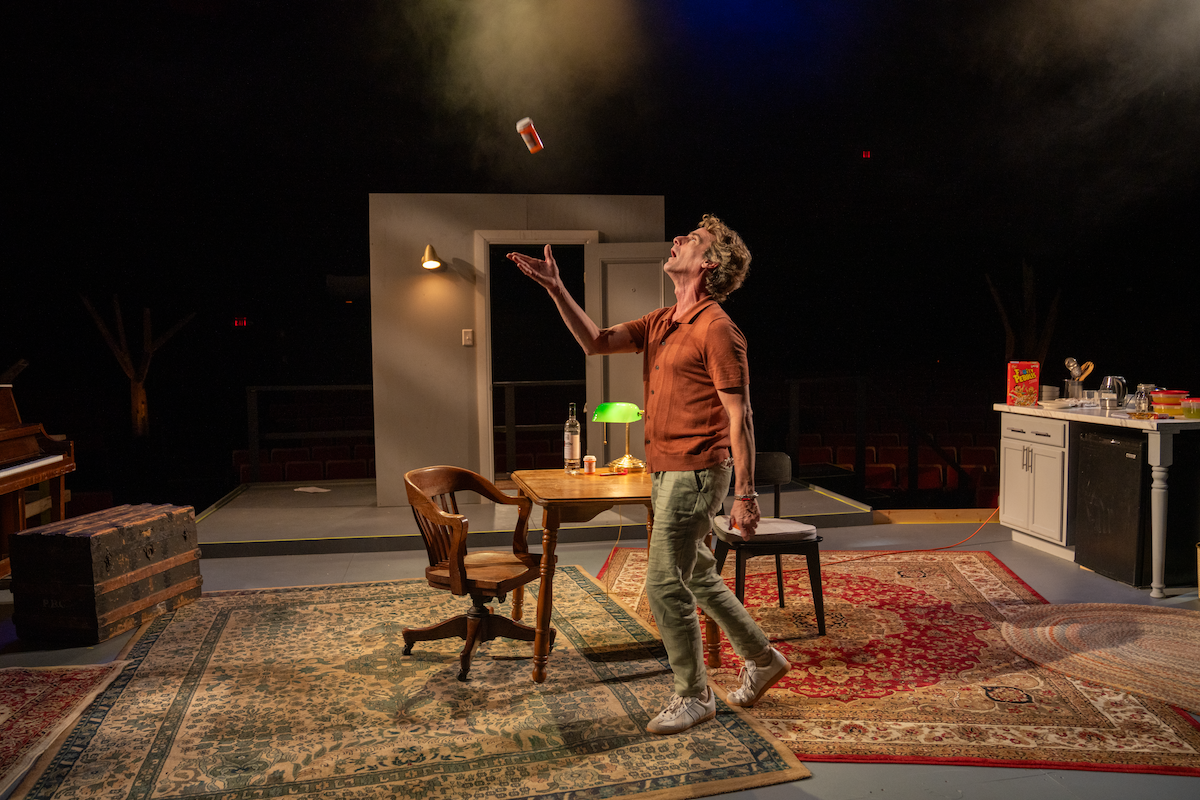
The set, designed by David Lander (set and lighting), is a marvel in itself. In accordance with Artistic Director Alan Paul’s dream, “to have audiences experience Barrington Stage’s spaces in unexpected ways,” theatregoers sit onstage, rather than in the auditorium, where the seats remain empty, except for the removal of the orchestra section nearest the stage to accommodate an extension of the playing area. Audience members are ushered onto a curved ramp that leads them to their seats—several rows of risers—ending at the back wall of the theatre.
The extension or thrust contains a door with a partial wall on its left and right so that the actor can exit in either direction as one character and enter through the door as another. There are numbered seats: if you can choose your own, try for the first couple of rows where sightlines are best.
Placed in the empty auditorium are tall wooden structures that resemble dead trees, highlighting the play’s message that forests are being decimated.
The production is filled with sound, designed by Sean Doyle, emanating from the booth backstage next to the risers, from classical music to Jacques Brel, Scott Joplin, to quirky, off-color noises seemingly produced by Vanya. Lander’s lighting is striking—from onstage lamps to intense spotlights.

Mark H. Dold in the Barrington Stage Company production of “Vanya” by Simon Stephens, directed by Alan Paul. Photo: Andrew Cromartie. 
Mark H. Dold in the Barrington Stage Company production of “Vanya” by Simon Stephens, directed by Alan Paul. Photo: Andrew Cromartie. 
Mark H. Dold in the Barrington Stage Company production of “Vanya” by Simon Stephens, directed by Alan Paul. Photo: Andrew Cromartie. 
Mark H. Dold in the Barrington Stage Company production of “Vanya” by Simon Stephens, directed by Alan Paul. Photo: Andrew Cromartie. 
Mark H. Dold in the Barrington Stage Company production of “Vanya” by Simon Stephens, directed by Alan Paul. Photo: Andrew Cromartie. 
Mark H. Dold in the Barrington Stage Company production of “Vanya” by Simon Stephens, directed by Alan Paul. Photo: Andrew Cromartie. 
Mark H. Dold in the Barrington Stage Company production of “Vanya” by Simon Stephens, directed by Alan Paul. Photo: Andrew Cromartie. 
Mark H. Dold in the Barrington Stage Company production of “Vanya” by Simon Stephens, directed by Alan Paul. Photo: Andrew Cromartie. 
Mark H. Dold in the Barrington Stage Company production of “Vanya” by Simon Stephens, directed by Alan Paul. Photo: Andrew Cromartie. 
Mark H. Dold in the Barrington Stage Company production of “Vanya” by Simon Stephens, directed by Alan Paul. Photo: Andrew Cromartie. 
Mark H. Dold in the Barrington Stage Company production of “Vanya” by Simon Stephens, directed by Alan Paul. Photo: Andrew Cromartie. 
Mark H. Dold in the Barrington Stage Company production of “Vanya” by Simon Stephens, directed by Alan Paul. Photo: Andrew Cromartie. 
Mark H. Dold in the Barrington Stage Company production of “Vanya” by Simon Stephens, directed by Alan Paul. Photo: Andrew Cromartie. 
Mark H. Dold in the Barrington Stage Company production of “Vanya” by Simon Stephens, directed by Alan Paul. Photo: Andrew Cromartie. 
Set by David Lander for the Barrington Stage Company production of “Vanya” by Simon Stephens, directed by Alan Paul. 
For those who don’t remember Uncle Vanya, the play takes place in late nineteenth-century rural Russia, on one of many estates that have fallen on hard times as an agrarian economy is replaced by industrialization, and aristocratic landowners have become a dying breed. The estate is being managed by the hard-working Vanya (Ivan), whose deceased sister Anna was actually its owner, and Sonia, his niece. Whatever money they earn is sent to Alexander (father of Sonia and former husband of Anna), a selfish, pedantic professor (a filmmaker in Stephens’ adaptation), now the husband of the young, beautiful Helena. Anna’s mother Elizabeth, who idolizes the professor, is also a resident on the estate. Alexander and Helena, bored to tears living in the country, want to return to the excitement of city life, but don’t have the money to do so. Chekhov’s alter ego Dr. Astrov (Michael), a neighboring landlord and frequent visitor, bemoans the destruction of the land caused by man’s utter contempt for the natural world. Suffering from tuberculosis, Chekhov, a doctor, writes this play about human misery, seeing only suffering and ruin all around him. In a 2024 article in the New York Times Magazine, playwright Jon Robin Baitz regards Uncle Vanya as a mirror of our post-pandemic world: “Nobody hears anybody else, because listening hurts too much; when the most comforting activity imaginable is a long, solitary walk followed by an even longer interlude of silence.”
Yet, as Dold tells us when he himself introduces the play, Chekhov considered it a comedy, and indeed the actor mines the humor in this group of misfits living on the estate, even as they lament their unfulfilled, wasted lives.
How can one actor playing eight different roles help the audience to identify which character he’s portraying at any given moment? That is the brilliance of Dold’s performance. He uses props (a dish towel for Sonia, dark glasses for Ivan), gestures, movements, distinct vocal changes—all the tools in his astonishingly creative toolbox. No wonder director Alan Paul talks of their work together as “thrilling.” Oh, to be a fly on the wall during that challenging rehearsal process!
How, for example, can a male actor succeed in playing both Sonia and Helena in their emotional scenes together? Using a higher vocal pitch is not enough. It must be clear which woman is speaking. And how can the sexual scenes be effective if both Helena and Dr. Astrov are played by the same actor? The skill at work in all of these scenes is breathtaking.
By the time this play is over, if we hadn’t been sure already, we will have become absolutely confident that there is nothing that Mark H. Dold is incapable of enacting convincingly on a stage.
VANYA runs from October 8-24 at Barrington Stage Company’s Boyd-Quinson Theater, 30 Union Street, Pittsfield. For tickets call 413-242-6411 or online at barringtonstageco.org.
Barrington Stage Company presents VANYA by Simon Stephens. Directed by Alan Paul. Cast: Mark H. Dold (Maureen/Michael/Ivan/Alexander/Liam/Helena/Sonia/Elizabeth). Co-Created by Simon Stephens, Andrew Scott, & Sam Yates after Anton Chekov’s Uncle Vanya. Scenic and Lighting Design: David Lander; Sound Design: Sean Doyle. Production Stage Manager: Leslie Sears.
The production runs one hour, forty-five minutes with no intermission. (Be aware that once the play begins, any audience member who needs to step out will not be able to be seated onstage again.)