

by Sierra Pasquale
Neil Simon’s Broadway Bound is the last chapter of his Eugene trilogy, and it arrives at the Sand Lake Center for the Arts with a great deal of good will already in the room. Director Peter Quinones had planned to follow last year’s Brighton Beach Memoirs with Biloxi Blues, the trilogy’s middle play, but chose instead to reunite the Jerome family while the cast was still available. Most of last year’s company returns, and it shows. These actors do not need to be introduced to one another. Circle Theatre Players’ production trusts that familiarity, and it pays off. Staged in the Center’s intimate, renovated church space, the show feels close enough to touch, which suits a play about people living on top of one another.
The result is a warm, finely acted evening whose strongest work belongs to the older generation, even though the play is nominally about the young.
For those who have not met the Jeromes, Broadway Bound is set in 1949 in the same cramped Brighton Beach house, a couple of blocks from the ocean. Eugene (Benjamin Hogan) and his older brother Stanley (Adam Erickson) are trying to break into professional comedy writing, mining their own family for material. Around them the household is straining. Their mother Kate (Suzanne Rayome) holds things together by sheer force of will, their father Jack (John Rayome) is increasingly restless, and Kate’s father Ben (Bill Douglas) is a committed socialist with little patience for the postwar world. Kate’s sister Blanche (Lisa Bryk) drifts between the family’s modest existence and a more comfortable one. When the brothers’ material is broadcast on the radio for the first time, the family hears a thinly veiled portrait of itself played for laughs, and the question of what a writer owes the people he writes about comes to the fore.
It is an ensemble piece, but the production’s center of gravity is Suzanne Rayome’s Kate. Kate is a demanding role because Simon gives her both the family’s comic engine and its deepest sadness. She is the woman who keeps score of every grievance and who can also, in a single quiet speech, remind us of the girl she once was. Rayome never lets those two things cancel each other out. Her Kate is funny because she is tired and anxious, not in spite of it, and when the play turns toward its more painful moments nothing in the performance shifts gears, because the sorrow has been present since her first entrance.
Bill Douglas is every bit her equal as Ben, a role that can easily tip into either cranky-grandpa caricature or sentimental saint. Douglas finds the dignity in Ben’s stubbornness without sanding off the difficulty. Ben’s convictions are principled and also a little maddening, and Douglas lets us feel both. He is a reminder of how much a seasoned stage actor can do with stillness. The moments when he simply sits and listens to the family’s chatter tell us as much about Ben as his lines do.
The rest of the company is excellent too. Lisa Bryk brings warmth and complexity to Blanche, a woman caught between worlds and between her obligations to her sister and her own wishes. John Rayome plays Jack as neither villain nor victim, which is exactly the hard balance the role requires. Hogan and Erickson, the youngest members of the cast, have a convincing brotherly rapport, with the teasing, competition, and loyalty that Simon’s best sibling scenes depend on, and their comic timing in the writing scenes is crisp. Even the smaller roles are fully inhabited, and I never felt a weak link anywhere in the evening.
The production also makes a smart choice with the radio. The sketches and broadcasts that thread through the play are performed by actors who are heard but not seen, a “show within the show,” as the director’s note puts it. The voices give the 1949 world a texture beyond the walls of the house, and they make the brothers’ dream of getting out feel tangible. It is a modest, effective solution to a staging challenge.
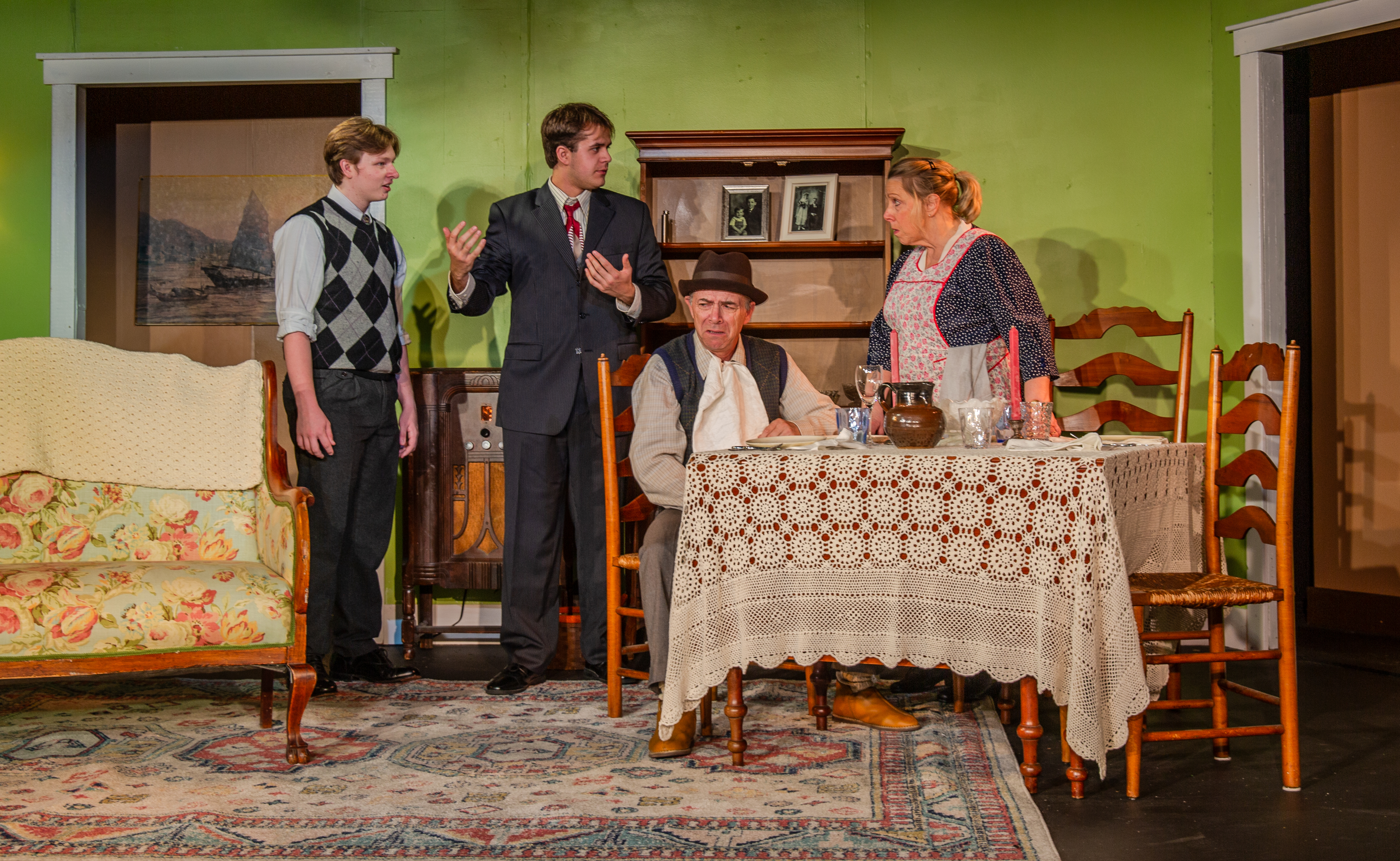
Adam M. Coons’s set deserves particular praise. The Jerome house is built to feel cramped, with rooms pressed close together and very little air between them. On a small stage this could easily have felt like a limitation, but here it is the point. We understand immediately why these people get on each other’s nerves, why nobody can have a private conversation, and why the family’s secrets seep through every doorway.

Suzanne Rayome as Kate Jerome and Benjamin Hogan as Eugene Jerome in the Circle Theatre Players production of Neil Simon’s “Broadway Bound”, directed by Peter Quinones, at the Sand Lake Center for the Arts. 
Bill Douglas as Ben and Lisa Bryk as Blanche in the Circle Theatre Players production of Neil Simon’s “Broadway Bound”, directed by Peter Quinones, at the Sand Lake Center for the Arts. 
John Rayome as Jack Jerome in the Circle Theatre Players production of Neil Simon’s “Broadway Bound”, directed by Peter Quinones, at the Sand Lake Center for the Arts. 
Benjamin Hogan as Eugene, Adam Erickson as Stanley, Bill Douglas as Ben, and Suzanne Rayome as Kate Jerome in the Circle Theatre Players production of Neil Simon’s “Broadway Bound”, directed by Peter Quinones, at the Sand Lake Center for the Arts. 
Bill Douglas as Ben and Lisa Bryk as Blanche in the Circle Theatre Players production of Neil Simon’s “Broadway Bound”, directed by Peter Quinones, at the Sand Lake Center for the Arts. 
Suzanne Rayome as Kate Jerome and John Rayome as Jack Jerome in the Circle Theatre Players production of Neil Simon’s “Broadway Bound”, directed by Peter Quinones, at the Sand Lake Center for the Arts. 
Benjamin Hogan as Eugene Jerome and Suzanne Rayome as Kate Jerome in the Circle Theatre Players production of Neil Simon’s “Broadway Bound”, directed by Peter Quinones, at the Sand Lake Center for the Arts. 
Adam Erickson as Stanley and Benjamin Hogan as Eugene in the Circle Theatre Players production of Neil Simon’s “Broadway Bound”, directed by Peter Quinones, at the Sand Lake Center for the Arts. 
Suzanne Rayome as Kate Jerome and Lisa Bryk as Blanche in the Circle Theatre Players production of Neil Simon’s “Broadway Bound”, directed by Peter Quinones, at the Sand Lake Center for the Arts. 
John Rayome as Jack Jerome and Suzanne Rayome as Kate Jerome in the Circle Theatre Players production of Neil Simon’s “Broadway Bound”, directed by Peter Quinones, at the Sand Lake Center for the Arts. 
Adam Erickson as Stanley and Benjamin Hogan as Eugene in the Circle Theatre Players production of Neil Simon’s “Broadway Bound”, directed by Peter Quinones, at the Sand Lake Center for the Arts. 
Bill Douglas as Ben, Lisa Bryk as Blanche, and Suzanne Rayome as Kate Jerome in the Circle Theatre Players production of Neil Simon’s “Broadway Bound”, directed by Peter Quinones, at the Sand Lake Center for the Arts. 
Bill Douglas as Ben, Suzanne Rayome as Kate Jerome and Benjamin Hogan as Eugene Jerome in the Circle Theatre Players production of Neil Simon’s “Broadway Bound”, directed by Peter Quinones, at the Sand Lake Center for the Arts. 
What I admired most is that the same design also communicates separation. The walls that crowd the family together are also the walls that divide them. In many scenes characters share a space physically while remaining emotionally sealed off from one another, one person in the kitchen, another in a bedroom, a conversation happening on one side of a partition that the other side can almost hear but not quite. The design makes visible what the dialogue implies, that this is a house full of people who live close together and still fail to reach each other. That tension between proximity and distance runs through the whole evening, and the set expresses it with real economy. It is the kind of design that does its work without calling attention to itself.
The costumes by Lisa Morgan, the wig work of Rocky Bonsal, and the lighting and sound of William White and Sam Quinones place us in the postwar years without turning the stage into a museum display, and they keep the transitions between the family’s world and the radio world smooth and unobtrusive.
Here I want to be candid about my reservations, and about the possibility that I am reading the play too narrowly. At its core, Broadway Bound is about a young man’s rise toward a comedy-writing career, and the structure of the evening invites us to root for Eugene and Stanley as they get their break. That part of the story left me cooler than the rest. We have spent a very long time in the theater hearing about the formative struggles and eventual successes of men, and I found myself less invested in whether the brothers’ sketch would land than in what was happening to the people around them. The older generation, and Kate above all, is where the play’s emotional stakes actually live. By the time the boys’ prospects improve, the play has been quietly telling us what that success costs the people who made it possible and who are being left behind.
Perhaps that is the point. Simon is not simply celebrating his stand-in’s ambition. He is also writing an elegy for a household and a way of life, one that his own rise helped to dissolve. Seen that way, the real subject is not the aspiring writer but the mother who must watch her family scatter and the father-in-law whose world is shrinking around him. This production seems to understand that, and it lets Kate and Ben carry the evening’s weight, which is why those performances linger longest in the memory. It is also worth remembering that the Jeromes are not an abstraction of comfortable privilege. They are a working-class Jewish family in 1949 Brooklyn, living within memory of the Depression and the war, with little margin for error at home. Even so, a contemporary audience may reasonably feel that the story’s attention rests on a familiar figure, and that its most compelling characters are the ones the plot treats as supporting.
This is a polished, affectionate, and often moving production. It is not flawless. The play meanders in places, and the strand following the brothers’ careers is, to my taste, its least compelling stretch. But the staging is clear and confident, the pace is well judged, and the design thoughtfully supports the themes. Whatever one thinks of Simon’s choice of protagonist, this company gives the play a warmth and honesty that are hard to fake, and they remind us that the most affecting stories in this house belong to the people who stay behind.
Circle Theatre Players at Sand Lake Center for the Arts presents Broadway Bound. Written by Neil Simon. Directed by Peter Quinones. Featuring Lisa Bryk as Blanche; Suzanne Rayome as Kate; Bill Douglas as Ben; Benjamin Hogan as Eugene; Adam Erickson as Stanley; and John Rayome as Jack, with Shawn Morgan as the Announcer, Robin Shrager Suitor as Mrs. Pitkin, and Adam M. Coons as Chubby Waters. Assistant Director: Sophie Morelli. Stage Manager: Amber Ramey. Set design by Adam M. Coons. Costume design by Lisa Morgan. Lighting design by William White, with lighting consultant Laura Darling. Sound design by Sam Quinones. Wig design and styling by Rocky Bonsal.
Broadway Bound runs October 16, 17, 23 and 24 at 7:30 p.m. and October 18 and 25 at 2:30 p.m. at Sand Lake Center for the Arts, 2880 NY-43, Averill Park, New York. Tickets and additional information are available through SLCA at 518-674-2007 or https://www.slca-ctp.org/. Broadway Bound is presented by arrangement with Concord Theatricals on behalf of Samuel French, Inc.