

by Barbara Waldinger
In a January 18, 2024 article for PBS’s American Experience entitled: “Scenes from Nazi Summer Camp,” Kirstin Butler writes: “In the years leading up to WW II, children across the United States spent their summers learning archery and antisemitism.” These camps were owned and operated by the German American Bund, a pro-Nazi organization formed by citizens of German descent. They created a program modeled after the Hitler Youth, indoctrinating children as young as six, in an estimated 15-25 locations, from the northeast–New York, New Jersey and Pennsylvania –to Michigan, Illinois, Wisconsin and California. WAM Theatre’s current production, Camp Siegfried by Bess Wohl, tells the unsettling story of two teenagers in one such camp in Yaphank, Long Island, in 1938.
Wohl, a prolific playwright and filmmaker, was the 2026 recipient of multiple awards (Tony, Pulitzer Prize, Outer Critics Circle Award) for her play LIBERATION. Camp Siegfried premiered in 2021 at London’s Old Vic Theatre and in the U. S. at New York’s Second Stage Theater the following year.
Wohl’s script for Camp Siegfried does not name the characters, who are called “Her”(Aristaia Yanakakis-Carroll), a fragile, confused sixteen-year-old girl and “Him” (Taylor Dam), a seventeen-year-old boy with low self-esteem, powerful relatives in the Nazi party, and unrealized dreams. The script uses standard type to indicate that the boy is speaking, while the girl’s lines are in italics (of course). Why are they nameless? Do they represent the majority of German/American teenagers who were sent to these camps to toughen them up? Become like the brave Siegfried, hero of Wagner’s Ring of the Nibelung? Will these kids be cogs in Hitler’s white nationalist machine trained to take over the world? Yet in the course of the play we learn many specifics about their past and their characters’ journeys as they fall in love, struggle to figure out who they are with respect to each other, the authoritarian structure surrounding them, and where they are heading.
Camp Siegfried takes its time as the characters progress from their initial awkwardness to feeling more comfortable with each other, and are finally able to express the abuse they have both suffered and the self-hate it engendered. When they become more connected, the production finds its center and for a while it seems that they have both finally discovered a modicum of happiness in their lives. But at the same time, because of their daily dose of indoctrination and physical hardship, they also begin to exhibit the cruelty towards one another that they are forced to learn in this place.
Director Genée Coreno’s work with the actors involves navigating the many changes in each character during the course of this ninety-minute piece—perhaps too many for one play. She is helped by Ryan Winkles, serving as an Intimacy coordinator and Fight director, and Assistant Director/Stage Manager Nathaniel Bokaer.

Aristaia Yanakakis-Carroll as Her in WAM Theatre’s production of “Camp Siegfried” by Bess Wohl, directed by Genée Coreno. Photo by Outdoor Chronicles Photography. 
Aristaia Yanakakis-Carroll as Her in WAM Theatre’s production of “Camp Siegfried” by Bess Wohl, directed by Genée Coreno. Photo by Outdoor Chronicles Photography. 
Aristaia Yanakakis-Carroll as Her in WAM Theatre’s production of “Camp Siegfried” by Bess Wohl, directed by Genée Coreno. Photo by Outdoor Chronicles Photography. 
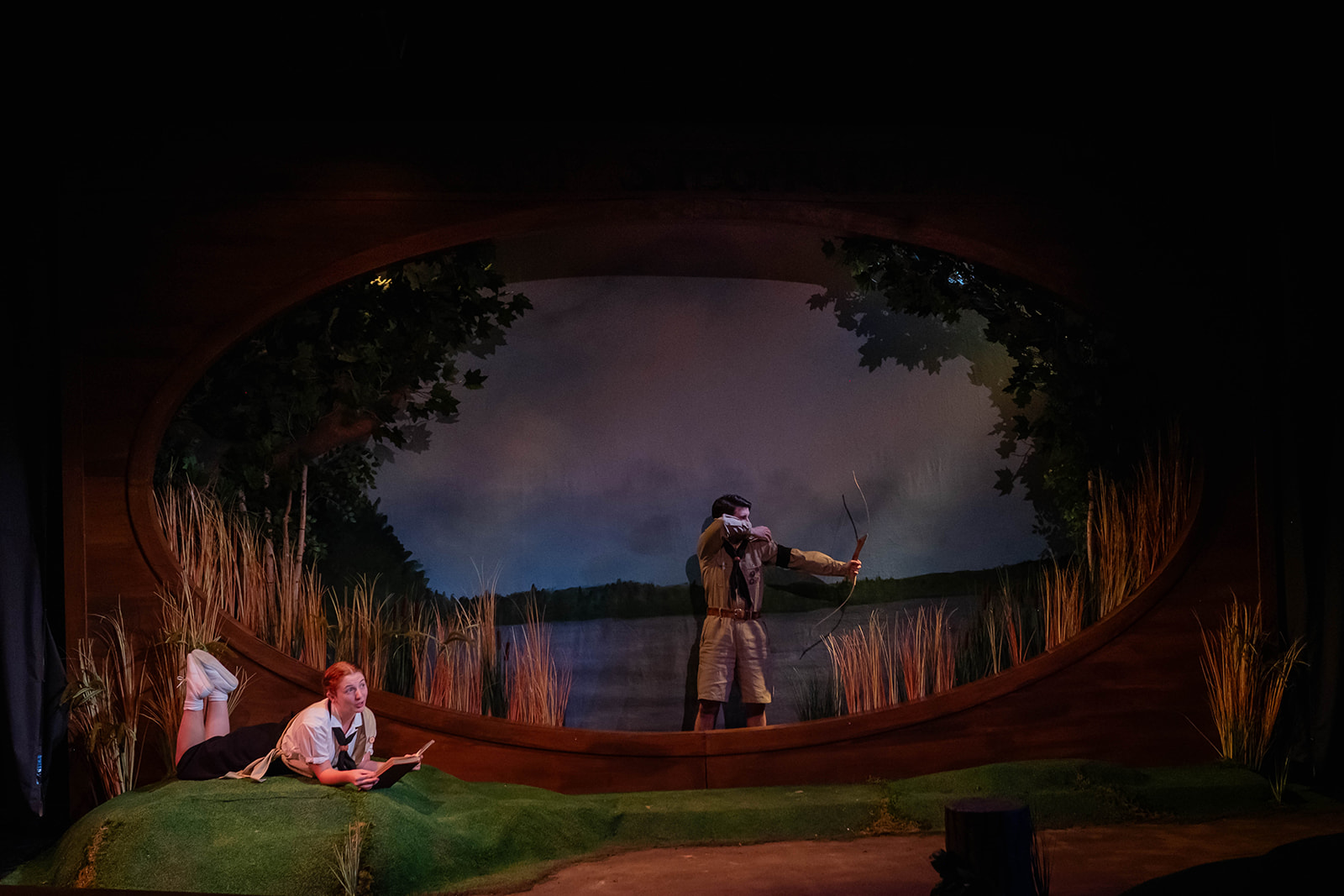
Taylor Dam as Him and Aristaia Yanakakis-Carroll as Her in WAM Theatre’s production of “Camp Siegfried” by Bess Wohl, directed by Genée Coreno. Photo by Outdoor Chronicles Photography. 
Aristaia Yanakakis-Carroll as Her in WAM Theatre’s production of “Camp Siegfried” by Bess Wohl, directed by Genée Coreno. Photo by Outdoor Chronicles Photography. 
Taylor Dam as Him in WAM Theatre’s production of “Camp Siegfried” by Bess Wohl, directed by Genée Coreno. Photo by Outdoor Chronicles Photography. 
Taylor Dam as Him and Aristaia Yanakakis-Carroll as Her in WAM Theatre’s production of “Camp Siegfried” by Bess Wohl, directed by Genée Coreno. Photo by Outdoor Chronicles Photography. 
Taylor Dam as Him and Aristaia Yanakakis-Carroll as Her in WAM Theatre’s production of “Camp Siegfried” by Bess Wohl, directed by Genée Coreno. Photo by Outdoor Chronicles Photography. 
Taylor Dam as Him and Aristaia Yanakakis-Carroll as Her in WAM Theatre’s production of “Camp Siegfried” by Bess Wohl, directed by Genée Coreno. Photo by Outdoor Chronicles Photography. 
Taylor Dam as Him and Aristaia Yanakakis-Carroll as Her in WAM Theatre’s production of “Camp Siegfried” by Bess Wohl, directed by Genée Coreno. Photo by Outdoor Chronicles Photography. 
Taylor Dam as Him and Aristaia Yanakakis-Carroll as Her in WAM Theatre’s production of “Camp Siegfried” by Bess Wohl, directed by Genée Coreno. Photo by Outdoor Chronicles Photography. 
Taylor Dam as Him and Aristaia Yanakakis-Carroll as Her in WAM Theatre’s production of “Camp Siegfried” by Bess Wohl, directed by Genée Coreno. Photo by Outdoor Chronicles Photography. 
Aristaia Yanakakis-Carroll as Her in WAM Theatre’s production of “Camp Siegfried” by Bess Wohl, directed by Genée Coreno. Photo by Outdoor Chronicles Photography. 
Taylor Dam as Him in WAM Theatre’s production of “Camp Siegfried” by Bess Wohl, directed by Genée Coreno. Photo by Outdoor Chronicles Photography. 
Taylor Dam as Him in WAM Theatre’s production of “Camp Siegfried” by Bess Wohl, directed by Genée Coreno. Photo by Outdoor Chronicles Photography. 
Taylor Dam as Him and Aristaia Yanakakis-Carroll as Her in WAM Theatre’s production of “Camp Siegfried” by Bess Wohl, directed by Genée Coreno. Photo by Outdoor Chronicles Photography. 
Taylor Dam as Him and Aristaia Yanakakis-Carroll as Her in WAM Theatre’s production of “Camp Siegfried” by Bess Wohl, directed by Genée Coreno. Photo by Outdoor Chronicles Photography. 
Taylor Dam as Him and Aristaia Yanakakis-Carroll as Her in WAM Theatre’s production of “Camp Siegfried” by Bess Wohl, directed by Genée Coreno. Photo by Outdoor Chronicles Photography. 
Taylor Dam as Him and Aristaia Yanakakis-Carroll as Her in WAM Theatre’s production of “Camp Siegfried” by Bess Wohl, directed by Genée Coreno. Photo by Outdoor Chronicles Photography. 
Taylor Dam as Him and Aristaia Yanakakis-Carroll as Her in WAM Theatre’s production of “Camp Siegfried” by Bess Wohl, directed by Genée Coreno. Photo by Outdoor Chronicles Photography. 
Taylor Dam as Him and Aristaia Yanakakis-Carroll as Her in WAM Theatre’s production of “Camp Siegfried” by Bess Wohl, directed by Genée Coreno. Photo by Outdoor Chronicles Photography. 
Taylor Dam as Him and Aristaia Yanakakis-Carroll as Her in WAM Theatre’s production of “Camp Siegfried” by Bess Wohl, directed by Genée Coreno. Photo by Outdoor Chronicles Photography. 
Taylor Dam as Him and Aristaia Yanakakis-Carroll as Her in WAM Theatre’s production of “Camp Siegfried” by Bess Wohl, directed by Genée Coreno. Photo by Outdoor Chronicles Photography. 
Taylor Dam as Him and Aristaia Yanakakis-Carroll as Her in WAM Theatre’s production of “Camp Siegfried” by Bess Wohl, directed by Genée Coreno. Photo by Outdoor Chronicles Photography. 
Aristaia Yanakakis-Carroll as Her in WAM Theatre’s production of “Camp Siegfried” by Bess Wohl, directed by Genée Coreno. Photo by Outdoor Chronicles Photography. 

Taylor Dam as Him and Aristaia Yanakakis-Carroll as Her in WAM Theatre’s production of “Camp Siegfried” by Bess Wohl, directed by Genée Coreno. Photo by Outdoor Chronicles Photography. 
Taylor Dam as Him and Aristaia Yanakakis-Carroll as Her in WAM Theatre’s production of “Camp Siegfried” by Bess Wohl, directed by Genée Coreno. Photo by Outdoor Chronicles Photography. 
Taylor Dam as Him and Aristaia Yanakakis-Carroll as Her in WAM Theatre’s production of “Camp Siegfried” by Bess Wohl, directed by Genée Coreno. Photo by Outdoor Chronicles Photography. 
Taylor Dam as Him and Aristaia Yanakakis-Carroll as Her in WAM Theatre’s production of “Camp Siegfried” by Bess Wohl, directed by Genée Coreno. Photo by Outdoor Chronicles Photography. 
Taylor Dam as Him in WAM Theatre’s production of “Camp Siegfried” by Bess Wohl, directed by Genée Coreno. Photo by Outdoor Chronicles Photography. 
Set by Nora Marlow Smith for the WAM Theatre’s production of “Camp Siegfried” by Bess Wohl, directed by Genée Coreno. 
Coreno, also the Artistic Director of WAM Theatre, has found additional help from her crackerjack design team. Scenic designer Nora Marlow Smith has enlarged the playing area in front of the wide black curtain by creating an additional one behind the curtain. What the audience sees as they enter is a simple scene: a couple of mounds of grass with a path in between, a tree stump and a bench. But once the curtain opens, there is an oval-shaped wooden frame with the name of the camp on the top and a vision of tall grass and a lake on the upstage wall beyond. The actors enter the oval by climbing over the lower section of the frame, which places them onto a path stretching across the upstage area and ending backstage. The two side sections of the theatre have been roped off, causing the center section to appear full, changing the feel of this three-sided theatre into a proscenium.
Costume designer Stella Schwartz provides accurate historical costumes, using a subtle approach, adding black ties, armbands, and other Nazi paraphernalia to the characters’ clothes as the play progresses. In a way, the costumes trace the success of the Nazi propaganda.
This is a prop-heavy production, showing the difficult manual labor required of the characters. Technical director and Props designer Katie Polebaum supplies the wood and axe for chopping, the wagon for pulling the wood, wooden pieces the characters use to build a dock that also serves as a platform, and many other items. There is a complex soundscape (by Sound designer and Composer Masatora Goya) that accompanies scenes (birds, events going on in the camp, bands playing, cheering and applause), transitions, and adds otherworldly melodies and chords. Lighting designer Madeline Hebert divides the scenes and highlights the action for us.
Coreno arranged an enlightening panel discussion following the performance on October 25th, entitled: “Who Gets to Belong? Race, Jewish Life, Queerness & Immigration in the Berkshires.” In addition to Coreno, panelists included Rabbi Emerita Barbara Cohen, Wendy Healey (Ventfort Hall Executive Director), Louise Heller (representing the Tenement Museum), and Dara Kaufman (Executive Director of the Jewish Federation of the Berkshires, this year’s recipient of WAM’s generous donation policy). Rabbi Cohen talked about the February 20, 1939 Nazi Rally at Madison Square Garden (organized by the German Bund) that held 20,000 participants, and the eugenics movement in the 1920s and 30s, claiming that we are all both victims and perpetrators. We learned about the anti-minority bias of Ventfort Hall and the Pittsfield Country Club, and the 1948 Displaced Persons Act that allowed many refugees into the U.S. but refused visas to Holocaust survivors.
Most importantly for us today, Dara Kaufman emphasized the importance of teaching tolerance in our schools, because once antisemitism rears its ugly head in our communities, the exclusion of all minorities, a chief tenet of Nazi ideology, will follow.
CAMP SIEGFRIED runs from October 16—November 1 at the Elayne P. Bernstein Theatre, 70 Kemble St., Lenox. For tickets call 413-274-8122 or online at WAM Theatre.
WAM Theatre presents CAMP SIEGFRIED by Bess Wohl. Director: Genée Coreno. Cast: Aristaia Yanakakis-Carroll (Her) and Taylor Dam (Him). Scenic Designer: Nora Marlow Smith; Costume Designer: Stella Schwartz; Lighting Designer: Madeline Hebert; Sound Designer/Composer: Masatora Goya; Fight and Intimacy Coordinator: Ryan Winkles; Technical Director/Props Designer: Katie Polebaum; German Dialect Coach: Louise Heller. Production Stage Manager (and Assistant Director): Nathaniel Bokaer.
The production runs 90 minutes with no intermission.