
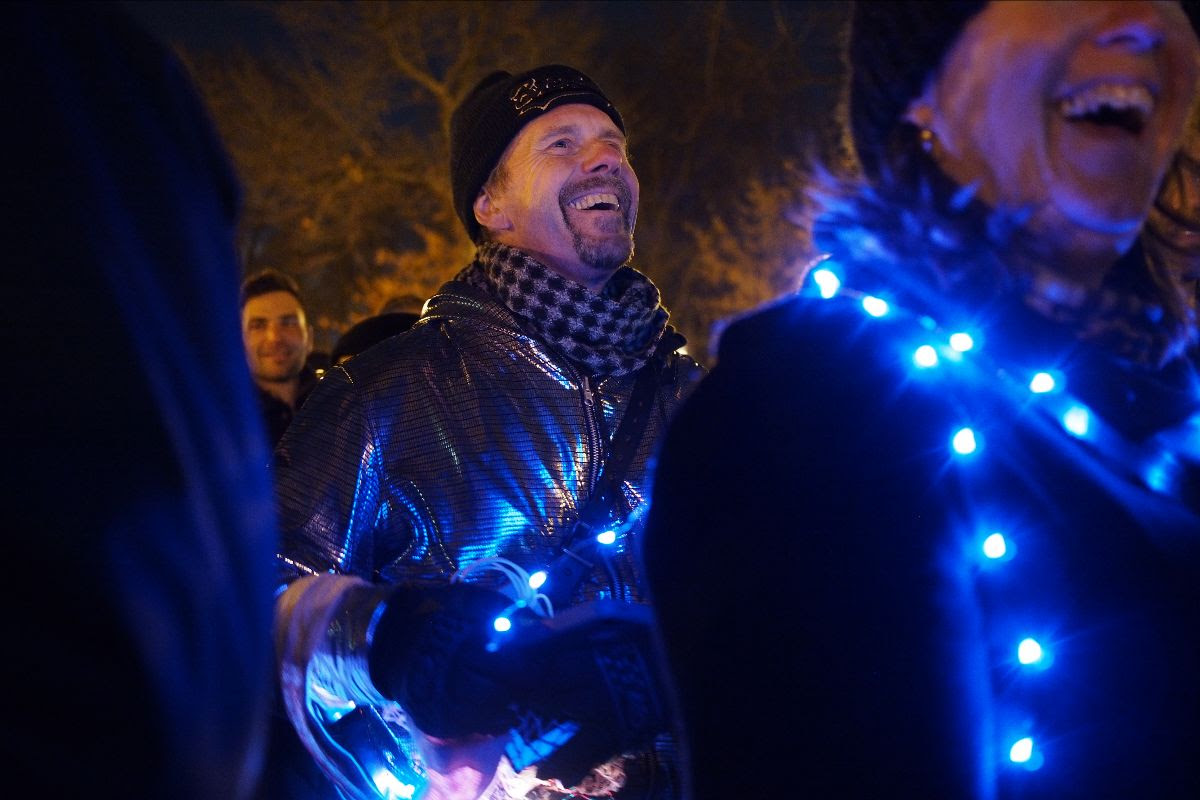
Phil Kline’s global holiday soundwalk
UNSILENT NIGHT
returns for its 35th year in New York City—led by Kline himself—on
Sunday, December 13 at 6pm
as dozens of cities around the world stage their own Unsilent Nights
Powered by the audience, Kline’s shimmering soundscape is performed
on boomboxes and amplified phones carried through city streets
Each participant plays ONE of the four separate tracks simultaneously,
together unfolding a magically out-of-sync, enveloping tapestry of sound
as the walking symphony sets off into the night
HOW TO PARTICIPATE:
unsilentnight.com/participate
FREE as always
PARTICIPATING CITIES IN 2026
(This list is ever-growing; visit unsilentnight.com/
Claremont, NH: December 6
presented by Aaron Almanza
Greenfield, MA: December 5
presented by Susan Maiorana and Ann Marie Dobosz
Kinderhook, NY: Date TBA
presented by Chelsea Faulkner
Kingston, NY: December 11
presented by Kevin Muth
Pittsfield, MA: December 18
presented by Berkshire Music School and Hot Plate Brewing Co.
New York, NY — This December, composer Phil Kline’s participatory sound-sculpture UNSILENT NIGHT—a beloved holiday tradition and pioneering work of public sound art—parades through dozens of cities across the United States, Canada, and Europe. Streets, parks, and sidewalks will come alive with “a shimmering sound-wall of bells and chimes that is dreamlike to wander through in the December nip” (The Village Voice).
This year’s flagship New York City event takes place Sunday, December 13, 2026 at 6:00 p.m. For the 35th year in a row, Phil will lead a massive chorus of boomboxes and amplified phones from the West Village to the East Village. Participants gather at the arch in Washington Square Park, and less than an hour and mile later, end up in Tompkins Square Park.
What began in December 1992 as a stroll through Greenwich Village with a few friends has grown into a global phenomenon. Driven by word of mouth, Unsilent Night has to date been presented in 180 cities across five continents by cultural institutions, universities, and local grassroots communities alike.
The piece is universally accessible and simple to present, celebrated not just for its “nebula of phosphorescent sound” (The New York Times), but for the community it builds. While each participant carries just one part of the four-track score, together the crowd creates the emotionally enveloping experience.
“Though one could think of Unsilent Night as a piece of experimental music, it’s also a sentimental gesture,” says Kline. “I was thinking of my childhood, the frosty December nights in Ohio, and Christmas caroling. The memories of twinkling lights on houses and the puffs of frosty breath as we sang were still vivid for me. Then, years later I gathered a group of friends, handed out boomboxes loaded with my cassettes and we counted one, two, three, PLAY! I had no idea what to expect, but the gentle echoes of lower Manhattan were alive, soothing, pulsing, mysterious and uplifting. Forty-five minutes passed in a flash—and when it ended, someone called out, ‘Rewind!’ Thirty-five years later, we’re still hitting play.”
ABOUT UNSILENT NIGHT
Unsilent Night is an original composition by Phil Kline, written specifically to be heard outdoors in the month of December, always as a free event. It takes the form of a promenade in which the audience becomes the performer (each participant gets one of four tracks of music that they play simultaneously), walking a carefully chosen route through a city’s streets.
It started in winter 1992, when Phil had an idea for a public artwork in the form of a holiday caroling party. He composed a four-track electronic piece that was 45 minutes long (the length of one side of a cassette tape), invited some friends who gathered in Greenwich Village, gave each person a boombox with one of four tapes in it, and instructed everyone to hit PLAY at the same time. What followed was a sound unlike anything they had ever heard: an evanescence filled the air, reverberating off buildings and streets as the crowd walked a pre-determined route, creating a mobile sound sculpture different from every listener’s perspective. “In effect, we became a city-block-long stereo system,” says Phil. The piece was so popular that it became an annual tradition, and then an international phenomenon.
Phil Kline originally designed the piece to incorporate the unreliability, playback delay, and quavering tones of cassette tapes. “Today most people use digital audio players, so I make the audio available in that format as well—but there’s something about the twinkling, hallucinatory effect of a warbling cassette tape that I enjoy,” he says.
The studio recording of UNSILENT NIGHT, which layers all the tracks, is available on Bang on a Can’s Cantaloupe Music label.
ABOUT PHIL KLINE
A veteran of New York’s downtown scene, Phil Kline is known for his range and unpredictability. Across vast boombox symphonies, chamber music, song cycles, and stage works, his compositions are hailed for originality, beauty, and sly subversion. From Akron, Ohio, Phil came to New York City to study poetry with Kenneth Koch and David Shapiro at Columbia. He then cofounded the No Wave band the Del-Byzanteens with Jim Jarmusch, Jamie Nares, and Lucy Sante, collaborated with Nan Goldin on The Ballad of Sexual Dependency soundtrack, and played guitar for 12 years in the notorious Glenn Branca Ensemble.
Early compositions evolved from performance art and used large numbers of boombox tape players, such as in Bachman’s Warbler and the global holiday soundwalk Unsilent Night. Other notable works include Exquisite Corpses for the Bang on a Can All-Stars; The Blue Room and Other Stories, a string quartet for Ethel; and Dawn Chorus, a septet based on the song of the Western Meadowlark, commissioned for the U.S. National Parks System centennial and premiered in Badlands National Park.
A master of song cycles and found text, Phil gained wide acclaim for Zippo Songs—drawn from poems Vietnam vets inscribed on their cigarette lighters—and Rumsfeld Songs, set to the Defense Secretary’s Pentagon briefings. Written for his muse Theo Bleckmann, these works helped spark a new generation of political protest music. The recording was named “Best of the Year” by numerous outlets including The New York Times, The New Yorker, and Gramophone, and topped WNYC’s New Sounds countdown. A song cycle about a different kind of American madness followed: Florida Man, also written for Bleckmann (with string orchestra). Phil’s most recent song cycle is Ghost Story for soprano Nicoletta Berry and Yarn/Wire, commissioned by the Isabella Stewart Gardner Museum in Boston.
Phil is currently immersed in music theater projects, including a surreal comic opera workshopped at the Guggenheim’s Works & Process. He frequently sets his own texts, notably in the Mass John the Revelator for the early music vocal group Lionheart, and the Sinatra-inspired monodrama Out Cold—another tour de force for Bleckmann, which premiered at the BAM Next Wave Festival.
In 2026, he debuted Force of Nature, a pair of soundwalks commissioned by PS21 in Chatham, NY—including one for the breakout winter festival “The Dark” that was featured on the cover of The New York Times Arts section. His music is available on Cantaloupe, Starkland, and CRI.