

by Barbara Waldinger
Premiering on May 3, 1960 at the compact Sullivan Street Playhouse in Greenwich Village, NYC, THE FANTASTICKS ran there for forty-two years: the longest-running off-Broadway musical in American history. How many Baby Boomers, including this reviewer, remember attending the play with its original cast (including Jerry Orbach as El Gallo), and singing its songs for years afterwards? How excited we were when the Mac-Haydn Theatre announced that THE FANTASTICKS would close their 2024 season! But alas, the production did not live up to our high (maybe too high?) expectations.
Director John Saunders, the Producing Artistic Director of the Mac, has been responsible for such wonderful, even miraculous work over the years on a tiny stage, onto which talented and energetic performers, using every possible entrance and exit, burst forth, as though blasted out of a canon. Maybe that is one of the problems: the misguided attempt to “Mac-Haydnize” THE FANTASTICKS. In the seventeenth century, Moliere formed a traveling company that toured the provinces of France. The actors and their belongings were transported in a horse-driven wagon. The stage was a small, open-air platform, a trunk carried their props and costumes. Commedia dell’arte companies did the same in Italy. That is the type of setting that Tom Jones (Book writer and Lyricist) and Harvey Schmidt (Composer) tried to create for THE FANTASTICKS. In his forward to the Thirtieth Anniversary edition of the play, Jones describes the challenges involved in writing and rewriting what started out as a “little one-act musical,” finally settling on two acts and an “open stage”—“a presentational theatre which would exalt in theatrical devices rather than trying to hide them.” For example, note the opening stage directions: “This play should be played on a platform. There is no scenery but occasionally a stick may be held up to represent a wall. Or a cardboard moon may be hung upon a pole to indicate that it is night.”
Though the plot was inspired by a French late nineteenth-century play called LES ROMANESQUES by Edmond Rostand (who wrote CYRANO DE BERGERAC), the style was completely different: Jones wanted a narrator to relate the story (as in OUR TOWN), who would speak directly to the audience, performers remained onstage throughout, there was no attempt at realistic props or sets, and of course actors broke into song much of the time. Everyone and everything would be in full view of the audience. The magic of the theatre was in the hands of the performers, the musicians, and in the hearts of the audience. Though it seems as though the Mac’s stage would be perfect for this because of its intimate size, that’s not quite what happened.
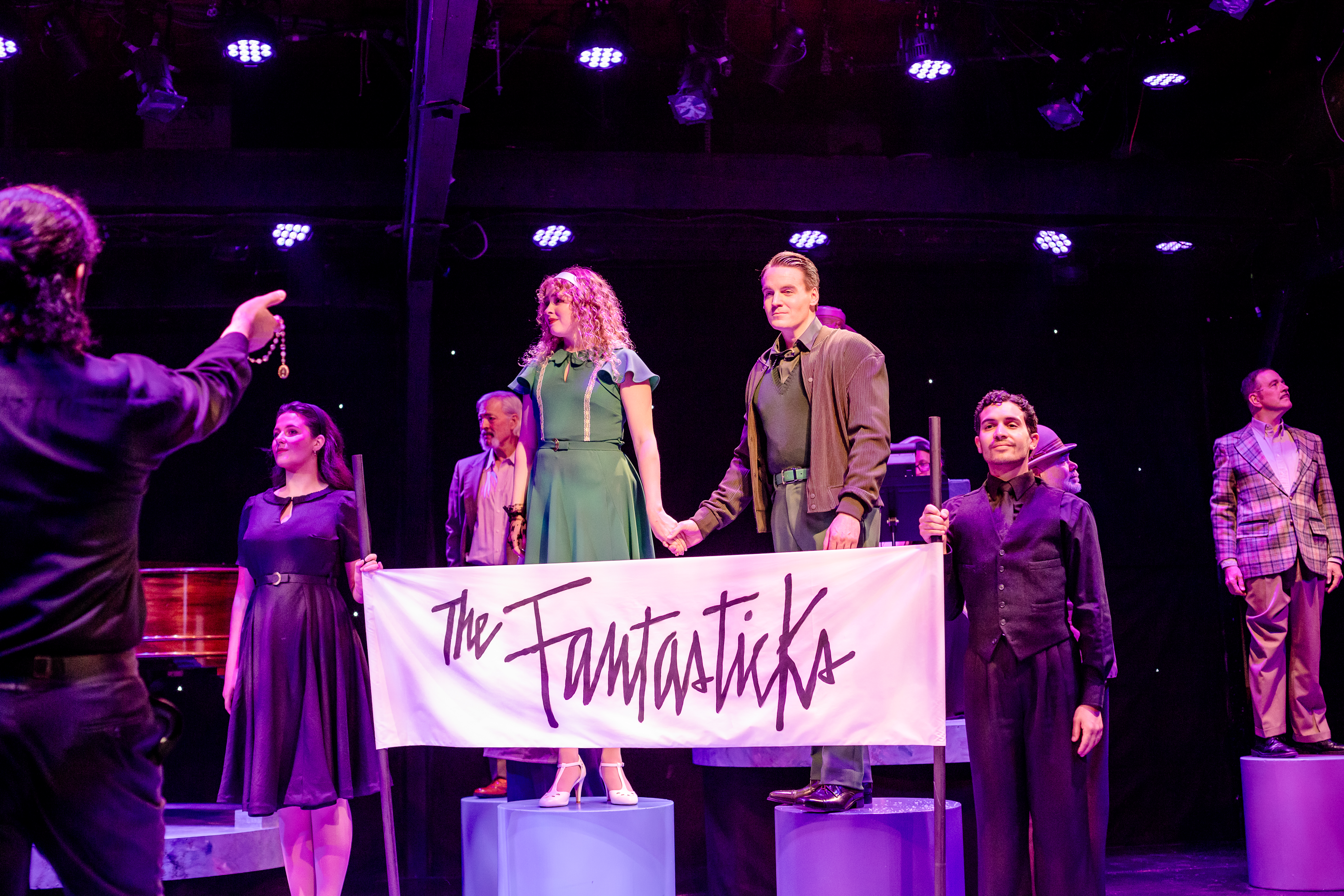
One challenge for Saunders and his cast was the loss of the upstage playing area to a piano (played by music director Eric Shorey) and a harp (played by Kathryn Sloat), both instruments called for in the script. The two musicians more than filled the theatre with their exquisite rendition of Schmidt’s score. Set and lighting designer Andrew Gmoser created a colorfully painted round platform in the center of the stage that looked like a revolve but didn’t move, matching platforms for the two instruments, and about six painted ottoman-like seats that two silent actor/stagehands in black spent nearly all of their time moving around for actors to sit or stand on. Although the different levels must have been helpful for the choreographer (Bella DePaola), all that time spent on rearranging a set that shouldn’t have been there did not seem to be in keeping with Jones’ concept. Without those ottomans, the original “mute” of the script could have been used instead, who basically served to extract props and costumes from the trunk containing them. Both choreography and lighting at the Mac have always been among their strong suits but here, though well done, they do not serve the playwright, with the exception of the simple but effective dances of the two fathers (the always dependable Gabe Belyeu, and Jeffrey Konowitch (new to this theatre).
The simple plot revolves around the fathers of adjoining properties who build a wall to keep their daughter (Belle Babcock) and son (Conor Fallon) apart, hoping that by not being allowed to socialize they would fall in love despite their fathers, which they do. Hiring a bandit, El Gallo (Tristan Caldwell), to stage an attempted abduction* of the Girl, the fathers pay dearly for him and his accomplices to allow the Boy to beat them back, thus making the Boy a hero and sealing their children’s marriage. However, when their scheme becomes known, everything falls apart and the Boy and Girl embark on their own adventures to see the world, finally returning, hurt and disillusioned, to realize how lucky they are to have each other. (*The Abduction song, written in 1990 for a Thirtieth Anniversary tour, replaces the original, which featured the word “Rape,” taken from a 1900 English translation of LES ROMANESQUES).
The performers are uniformly talented, engaging and sing well. But this is not an easy play to perform because it feels more like a fairy tale. The spoken lines are poetic, often rhyming, and are not what modern audiences, more used to realism in film and television, expect. In order for it to be effective, the actors must be able to reach out to the audience and make them believe in the truthfulness of the story. Some actors are more successful at this than others. Belyeu and Konowitch as the fathers don’t need to pretend—their motivations are clear, they are funny and believable in their camaraderie and their conflicts. The Boy and Girl have a more difficult job: Babcock looks and feels young, fresh, naïve, with her blond curls, twirling movements, soprano songs and sounds, while Fallon, the Boy, seems older and is dressed like a preppie. His best scenes are with Caldwell, the bandit, as their strong voices unite, when Fallon doesn’t have to create the illusion of a young boy in love. It is tough to follow in the footsteps of Jerry Orbach and other well-known El Gallos, and while Caldwell has the deep voice and smoldering looks, he does not have the panache to be the ringleader of this drama. He walks the walk, makes the gestures, but is not quite there. Finally, the Old Actor (Kevin Weldon) has a lovely way of confusing Shakespeare’s lines and references as he speaks with perfect diction, all the while searching for his light, while Mikel Hunter as Mortimer, who excels in death scenes, is perfectly dressed to suit his various characters (by Daniel Hewson) and if he tends to overdo the comedy, his look and accent are spot on.
For those who don’t know THE FANTASTICKS, this version can be a good contemporary introduction. For those who do, it may be too homogenized to fit the memory of the rough and tumble original.
THE FANTASTICKS runs from September 5-15 at the Mac-Haydn Theatre. Tickets may be purchased by calling 518-392-9292 or online at http://www.machaydntheatre.org. Two hours 20 minutes including intermission.
The Mac-Haydn Theatre presents THE FANTASTICKS by Tom Jones and Harvey Schmidt. Directed by John Saunders. Cast: The Narrator (El Gallo): Tristan Caldwell, The Girl (Luisa): Belle Babcock, The Boy (Matt): Conor Fallon, The Boy’s Father (Hucklebee): Gabe Belyeu, The Girl’s Father (Bellomy): Jeffrey Konowitch, The Old Actor (Henry): Kevin Weldon, The Man Who Dies (Mortimer): Mikel Huntee, Mutes: Emily Allen, Anthony Michael Velez. Choreographer: Bella DePaola; Music Director and Pianist: Eric Shorey; Costume Design: Daniel Hewson; Scenic and Lighting Design: Andrew Gmoser; Harp: Kathryn Sloat; Props Design: Paul Colarusso; Hair and Makeup Design: Emily Allen; Technical Director: Alan Highe; Sound Design: Sean McGinley; Production Supervisor: Eoghan Hartley; Production Stage Manager: Tori Moss.