

by Barbara Waldinger
WHERE WE STAND, the 2025 summer production of WAM Theatre, was written by Donnetta Lavinia Grays in order to create community. One performer, using storytelling and music, is tasked with removing the barriers between audience and actor, and in their stead, facilitating a communal response. Grays describes the play as “A Solo—Community Exploration,” especially needed “at this fragile moment in our nation when community feels so very vital to our survival and collective purpose.”
Vernice Miller, director of WHERE WE STAND, explains what drew her to this piece: In these times of king-making and deep division, as the ground beneath us keeps shifting, I return to a question that has followed me across borders, rehearsals, and communities: what does it truly mean to belong?” (WAM Press release, May 2025)
Indeed all three women—playwright, director and actor–have been deeply involved in community engagement. The performer, D. Colin, is a Haitian-American multidisciplinary artist who works with poetry, visual art and theatre. This award-winning play was originally commissioned by The Public Theater’s Brooklyn College Research Residency in 2018, and after further development it had its world premiere co-production in 2020 between WP Theater in NYC and Baltimore Center Stage, directed by Tamilla Woodard. It has since been produced by the Portland Stage in Maine and Greater Boston Stage Company in Massachusetts.
WAM is a women owned and operated theatre company at the intersection of arts and activism, concerned with gender equity, having donated more than $105,000 to organizations that act on behalf of women in areas such as girls’ education, reproductive justice, and sexual trafficking awareness. Now celebrating its 16th season in the Berkshires, WAM generally produces plays by and about women. In an unusual departure, the main character in WHERE WE STAND is called “MAN.” But in her script Grays points out that MAN should be an African-American “Everyman,” who has been portrayed both by the playwright herself as well as by male performers. She does not want MAN to be “a masculine gendered person if that is not who you are. The play requires yourself to be the self that embodies this story. “
WHERE WE STAND is written and sung in lyrical, rhythmic language, inspired by musical and theatrical traditions including: Jazz, Blues, Gospel, Spoken Word, Oral Storytelling, Call-and-Response, and American Musical Theater. Grays insists that songs and spoken language meld together “flawlessly.”
Its story is a fable or folktale, whose central character is an outsider, a “highway marker,” bent over and in terrible pain, ignored by the townspeople (voiced by Colin) who drive by, as she tries to tend the bit of land she inherited. One evening MAN meets the STRANGER (also Colin) dressed all in gold, who offers help to the downtrodden: a“hallelujah for the spirit,” a kind of magician who will take away her pain. He will give her the power to spread joy in this broken-down, “Used to Be” town by replacing it with one that “Still Could Be”—which will gain her the respect and admiration of the townspeople. There is only one caveat to the pact that he proposes: he demands that all these changes be made in his name and in his image. Either the town’s soul will be his or, if the pact is broken, everything reverts not only back to the way it was, but to something darker. Sound familiar?
MAN accepts the gift, the responsibility, and the adoration of the town where she is finally acknowledged, where at long last she belongs. But, when the townspeople refuse to go along with the STRANGER’s conditions, resulting in the destruction of the town, MAN is forced to pay the price, face their condemnation, and seek their forgiveness.

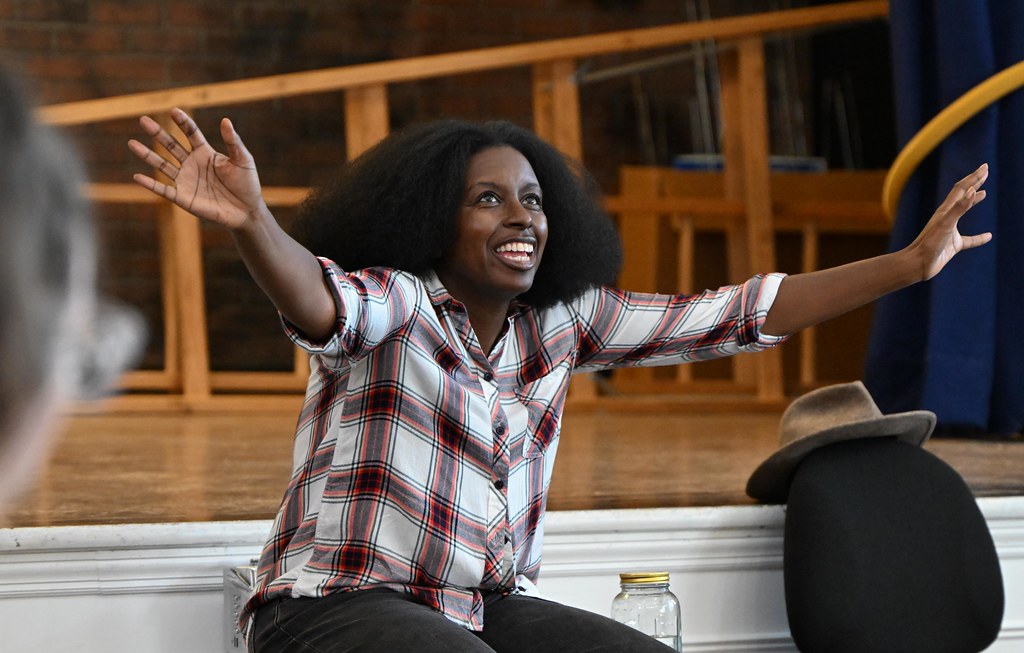
D. Colin as MAN in “Where We Stand” by Donnetta Lavinia Grays, directed by Vernice Miller, presented by WAM Theatre at the Lenox Town Hall. 
D. Colin as MAN in “Where We Stand” by Donnetta Lavinia Grays, directed by Vernice Miller, presented by WAM Theatre at the Lenox Town Hall. 
D. Colin as MAN in “Where We Stand” by Donnetta Lavinia Grays, directed by Vernice Miller, presented by WAM Theatre at the Lenox Town Hall. 
D. Colin as MAN in “Where We Stand” by Donnetta Lavinia Grays, directed by Vernice Miller, presented by WAM Theatre at the Lenox Town Hall. 
D. Colin as MAN in “Where We Stand” by Donnetta Lavinia Grays, directed by Vernice Miller, presented by WAM Theatre at the Lenox Town Hall. 
D. Colin as MAN in “Where We Stand” by Donnetta Lavinia Grays, directed by Vernice Miller, presented by WAM Theatre at the Lenox Town Hall. 
D. Colin as MAN in “Where We Stand” by Donnetta Lavinia Grays, directed by Vernice Miller, presented by WAM Theatre at the Lenox Town Hall. 
D. Colin as MAN in “Where We Stand” by Donnetta Lavinia Grays, directed by Vernice Miller, presented by WAM Theatre at the Lenox Town Hall. 
D. Colin as MAN in “Where We Stand” by Donnetta Lavinia Grays, directed by Vernice Miller, presented by WAM Theatre at the Lenox Town Hall. 
D. Colin as MAN in “Where We Stand” by Donnetta Lavinia Grays, directed by Vernice Miller, presented by WAM Theatre at the Lenox Town Hall. 
D. Colin as MAN in “Where We Stand” by Donnetta Lavinia Grays, directed by Vernice Miller, presented by WAM Theatre at the Lenox Town Hall. 
D. Colin as MAN in “Where We Stand” by Donnetta Lavinia Grays, directed by Vernice Miller, presented by WAM Theatre at the Lenox Town Hall. 
Cast and creative team of “Where We Stand” by Donnetta Lavinia Grays, directed by Vernice Miller, presented by WAM Theatre at the Lenox Town Hall. 
This is where we come to the raison d’etre of the fable–where the power of the collective—the audience as townspeople– will decide the fate of MAN. This is why Grays requires that the space in which the play enfolds be one of civic engagement, “a democracy of space” where we can all see one another and take action together. There is to be no distance between the audience, seated on two sides of the large room (which in this case is the Lenox Town Hall), and the performer. Thus the play begins with MAN sitting among the audience, humming, then singing as we are encouraged to accompany her on her journey, together creating its parameters.
There are no sets, no special lighting, no costumes. “We are where we are” says Grays, “at this town’s center.” In the course of their two and a half week exploration, Miller encouraged Colin to find a use for whatever was available in the room.
D. Colin is an enormously talented performer, creating multiple characters with the aid of only one prop: the gold hat of the STRANGER. Her physical and vocal prowess are impressive, as is her ability to turn a roomful of visitors into a community in ninety minutes. Adult audiences have been trained to sit quietly and listen, but a performer like Colin, who can gently free us from those constraints and fears of interrupting, is both brave and quite skillful.
Though the story can feel simplistic, the issues it tackles (discussed in an interesting talkback following the performance) are definitely not.
WHERE WE STAND takes place at the Lenox Town Hall, 6 Walker St. in Lenox, on June 26-29, with a special pop-up performance at Capital Repertory Theatre, 251 N. Pearl St., Albany, on Saturday June 28. For tickets call 413-274-8122 or online at wamtheatre.com/where-we-stand/
WAM Theatre presents WHERE WE STAND by Donnetta Lavinia Grays. Director: Vernice Miller. Cast: D. Colin. Vocal Coach: Wendy Welch. Production Stage Manager: Meg Lydon.
The production runs 90 minutes with no intermission. http://www.wamtheatre.com