
by Gail M. Burns
The Hubbard Hall Theater Company is not timid. This season they are presenting works by María Irene Fornés, Stephen Sondheim and James Lapine, and William Shakespeare. These are works not to be entered into unadvisedly or lightly. These are big, demanding shows and the guiding hands and directors are to be commended for their bravery and commitment to staging shows less seen.
Speaking of shows less seen, I had never seen “Sunday in the Park with George”, for which Sondheim and Lapine took home the Pulitzer Prize for Drama in 1984. And I haven’t seen it because I haven’t been presented with an opportunity to do so, meaning that the people who make the decisions about which shows to present are not selecting it despite its stellar pedigree. Why?
“…George” comes right after “Merrily We Roll Along” in the Sondheim canon, and that show was a monumental flop in its original production. The Broadway community was very divided on Sondheim in those days, in equal parts angry and jealous that he was getting all the attention and all the awards and basically changing the art of musical theatre. Sondheim and Lapine had just suffered the slings and arrows of outrageous fortune and their minds were on the very concepts of art and entertainment, and the creation thereof.
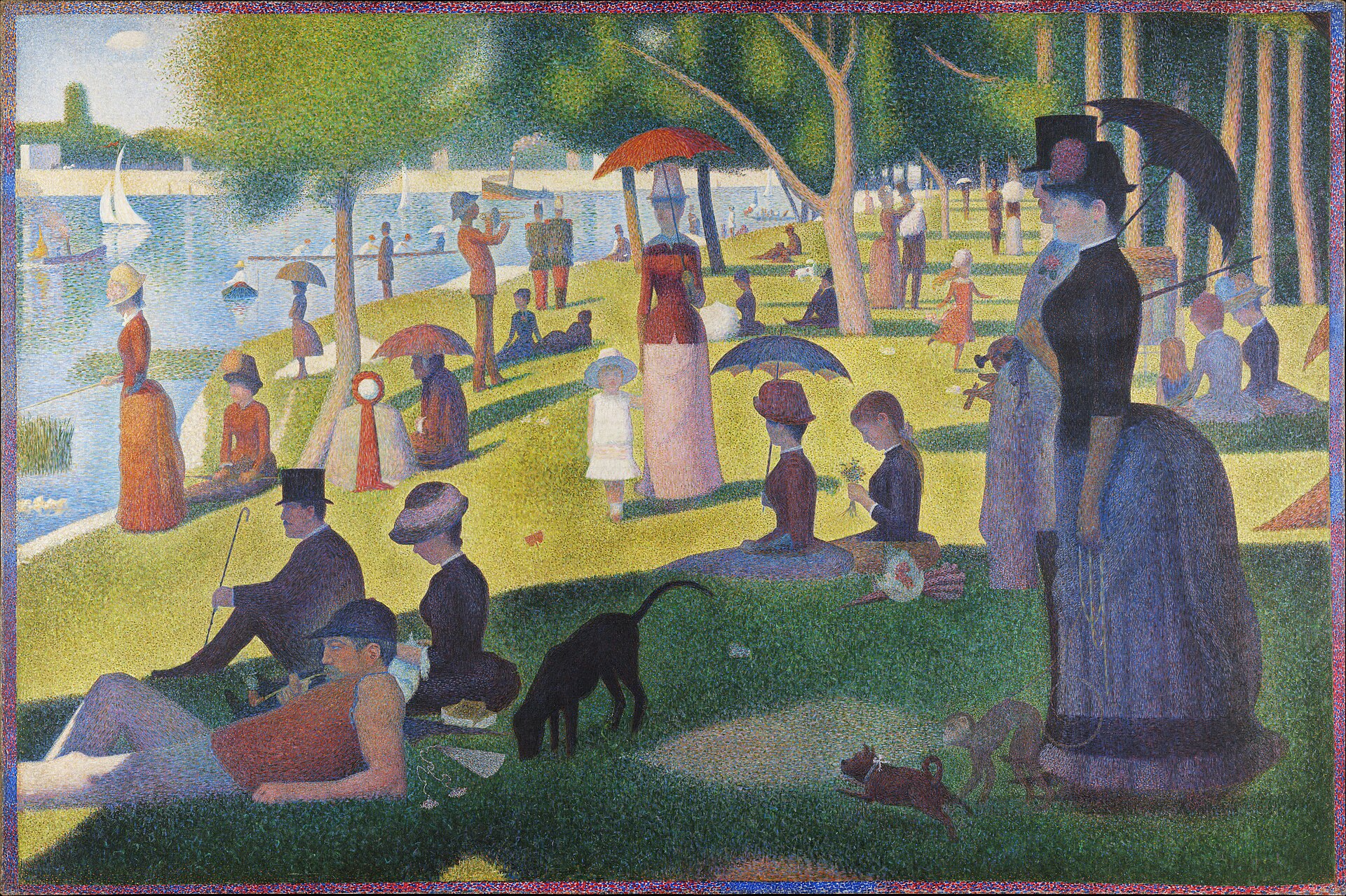
So its not surprising that that is what “…George” is all about. In Act I we see the French post-Impressionist artist Georges Seurat (1859-1891) struggling to paint “A Sunday Afternoon on the Island of La Grand Jatte” in 1884-1885. I include an image of that painting here, in case you aren’t familiar with it, because many of the people depicted therein become characters in the show.

Act II is set in “the present day” – meaning the 1980s – and focuses on an artist named George who is probably the great-grandson of Seurat, who is having his own struggles as a creator, although his medium is sculpture and light.
Alongside Georges is his model/mistress, Dot (yes, he’s a pointillist painter with a mistress named Dot). Alongside George is his grandmother, Dot’s daughter, Marie, who is probably Georges’ offspring. (In both cases George is pronounced in the contemporary, American way and the roles are played by a single actor.)
Everyone else on stage is a character from the painting. Seurat spent many hours on La Grand Jatte – an island in the Siene River at the gates of Paris, France – sketching random citizens as the strolled through or sat in the park. Sondeim and Lapine have imagined who these people are and what they are doing as Seurat sits drawing them. Faces are only vaguely alluded to in Seurat’s painting, so the authors could layer different personalities and occupations on each character.
A number in Act II is called “Art Is Hard” and that is pretty much the plot. There are minor subplots, but they are incidental. An effort is made in Act II to have the characters from the painting in Act I parallel the characters at a swanky gallery opening for George’s newest creation “Chromalume #7”*, but there are so many characters that each gets just a few lines, or, if they’re lucky, a song, to explain their raison d’être that they are never fully fleshed out.
Even Dot/Marie is given short shrift. Her storyline zips along – he loves her, he loves his art more, they hook up, they break up, she hooks up with a baker, she’s knocked up, she says it’s Georges’ baby, she gives birth and names her daughter Marie, she and the baker move to America – and that’s just Act I which she has to share with the endlessly moaning Georges and the entire gang from the painting! The only characters developed in any depth are Georges/George.
Originally Act I was the show. It was publicly performed as such. Sondheim and Lapine added Act II later, and it really, really shows. The two parts feel very tenuously related.
I hope that all of that explains to you why I was puzzled that this show won a Pulitzer. The book is the weakest part, and now 42 years later, Act II is sadly dated, but it cannot be transported out of the 1980’s because it needs to be plausible that Marie, who is born to Dot at the end of Act I, is still alive.
So this is an awkward musical to present. The music and lyrics are dense and complicated, the sets and costumes specific and intricate. How did a small theatre troupe do with it? Very well indeed!
Director Dianna Heldman is not only skilled and dedicated to this production, as is evident from her Director’s Note in the program, but also has staged many productions – many of grand opera – at Hubbard Hall and knows the quirks of the space. Act I fits well in a space designed in 1878, the more angular and “modern” Act II less well, but Heldman has made both work to good advantage.
The cast is large and the two lead roles – Georges/George and Dot/Marie – are double cast with the “off-duty” pair appearing in smaller roles at alternate performances. I saw Dan Costello and Abbey Hutchins, while the other lead pair -Collin Ellsbury and Heather Ferlo – played Mr. and Yvonne respectively.
With the exception of the two leads, the rest of the cast is very much an ensemble and they behave as such. Amy Griffin, Michael Stebbins, and David Sutton stood out, but not in ways that overshadowed their theatrical teammates.
Musical Director Richard Cherry – also the conductor of many excellent programs at the Hall – helms a seven-piece ensemble who are placed house left. I was seated in the front row just left of center and the instruments often overwhelmed the voices. When you go, I recommend sitting as far from the orchestra as possible to achieve the best sound balance. Many cast members have operatic or musical theatre training and experience, so the vocals are strong, and the use of body mics is minimally so to preserve the illusion of an acoustic house.
Hearing is important because of the intricacies of Sondheim’s lyrics, which do most of the storytelling. There are not a lot of scenes with spoken dialogue. If you are not deeply familiar with the score I recommend reading a plot synopsis, reading through the lyrics, and listening to the songs. Yes, this is show that requires a little homework to get the most out of your theatre experience.
Projections of Seurat and his artwork are central to the appearance of the show, to the extent that I don’t know whether to credit them to set designer Charles J. I. Krawczyk or lighting designer David Groupé. At the conclusion of Act I, the cast recreates Seurat’s painting on stage so that the projection of the painting and the actors blend into one. I was excited to see this effect and I wasn’t disappointed. Thanks to the heroic efforts of a large team of set builders and painters, and Neeley Dessaint’s excellent costumes, it all works and is most satisfying.
As I studied the individual costumes, knowing that the tableau was coming, I wasn’t at all sure they would properly represent the figures in the painting, but they did, which proves both Dessaint’s skill and Seurat’s genius at capturing the ordinary.
I have very mixed feeling about the material, but no qualms at all recommending this strong production. It is a testament to what a small theatre can do with the right people and a LOT of hard work. I am delighted that Hubbard Hall is once again forming their own theatre company and look forward to seeing more ambitious productions in the future.
The Hubbard Hall Theater Company presents “Sunday in the Park with George”, music and lyrics by Stephen Sondheim, book by James Lapine, directed by Dianna Heldman, musical director Richard Cherry. CAST: George/Georges is played by Dan Costello or Collin Ellbury, Dot/Marie is played by Abbey Hutchins or Heather Ferlo, Amy Griffin as the Old Lady/Blair Daniels, Grace Foulsham as the Nurse/Harriet Pawling, Kolby Kendrick as Jules/Bob Greenberg, Heather Ferlo or Abbey Hutchins as Yvonne/Naomi Eisen, Abigail Weeden as Louise, Gordon Horne-Otten as Franz/Dennis, Maureen “Moe” Cossey as Frieda/Betty, David Sutton as the Boatman/Charles Redmond, Michael Stebbins as a Soldier/Alex, Kathleen Green as Celeste #1/Server, Ocie Tucker as Celeste #2/Louise, Collin Ellsbury or Dan Costello as Mr./Lee Randolph, Simon Woods as Louis/Billy Webster. CREATIVE TEAM: Stage manager Heidi Lauren Duke, assistant director Maureen “Moe” Cossey, scenic designer Charles J. I. Krawczyk, assistant scenic designer Laurie Kenny, costume designer Neeley Dessaint, lighting designer David Groupé, sound designer Joan Eason. ORCHESTRA: Richard Cherry, piano; Patte Hadfield, synth; Elizabeth Huntley, harp; Patrice Malatestinic, French horn; Rich LaPlante, percussion; Jackson Paley, reeds; and Elizabeth Sterling, violin.
ADVISORY: This production includes lighting effects, including flashing and rapidly changing lights, that may affect individuals with photosensitivity or certain medical conditions, including epilepsy.
Performances at Hubbard Hall, 25 East Main Street in Cambridge, NY, from June 19-28, 2026. Fridays & Saturdays 7:30 pm, Sundays 2 pm. Tickets: $35 Adults, $20 Students 21 and Under. Run Time: Approximately 3 hours including an intermission. Call the box office 518-677-2495; https://hubbardhall.org/
* Seurat invented a painting technique called chromoluminarism which is defined by the separation of colors into the individual dots or patches of pointillism that interact optically. Chromolume means color and light, which is the title of a song in Act I.