
by Gail M. Burns
“When we did [The Understudy] in New York, I think I went to see it…three times a week because I found it so healing, and the audience really dug it —
Playwright & director Theresa Rebeck in the Rutland Herald
— and it was…a very sparkly event for me.”
I love this description by Theresa Rebeck, the author and director of this current production of “The Understudy” at the Dorset Theatre Festival, because it concurs exactly with my experience of this play. I saw it first in 2008 at the Williamstown Theatre Festival and it was indeed a “sparkly event” in my memory, so much so that I booked my tickets for this production not knowing that I would be called upon to write this review. There is nothing more exhilarating than watching a perfect production of a well-written play. Rebeck’s intellect and the intricate ways in which she weaves big ideas into small, human stories reminds me of Tom Stoppard, only funnier, warmer, and more human and less esoteric.
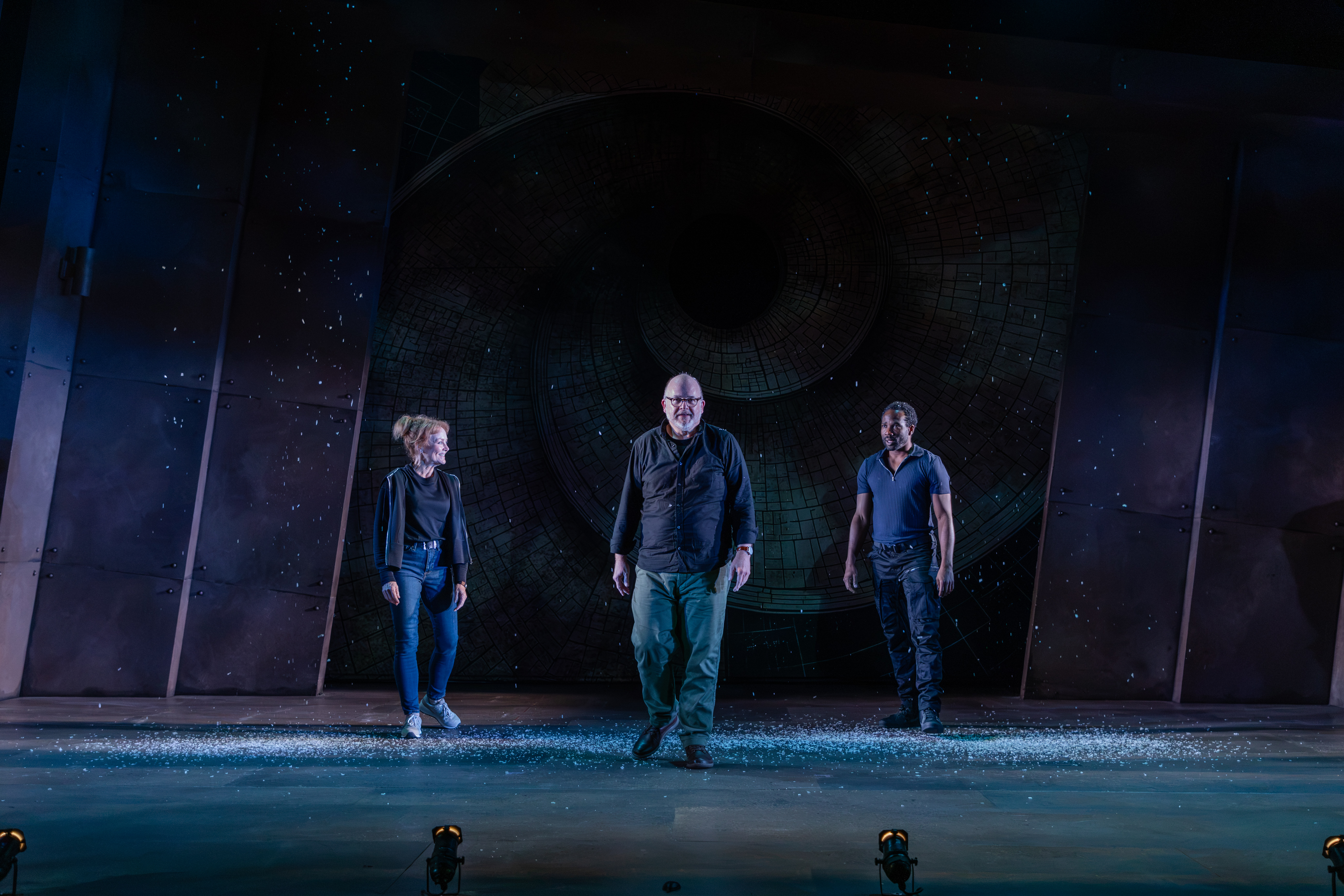
“The Understudy” takes place in a Broadway theatre during what’s called a “put in” rehearsal, in which an understudy or new cast member is given a chance to rehearse their bits of the production before they are “put in” at a performance. The full cast is not there, nor is the director since this is an understudy rehearsal. The characters in this play are Roxanne (Elizabeth Heflin), the stage manager in charge of the rehearsal, Jake (W Tré Davis) a movie star on the rise who has recently starred in a blockbuster action film, and Harry (Jeffrey Bean), the actor hired to understudy Jake.
Jake in turn is the understudy to the unseen star of the play, the unseen Brad, who is an even bigger Movie Star than Jake. If anything happens to Brad, Jake goes on for him and Harry goes on for Jake.
The play they are rehearsing is a long-lost work by Czech writer Franz Kafka (1883-1924) whose dark, nihilistic novels have coined the term Kafkaesque. There is much despair and frustration in his novels, which inspired Rebeck, even though the play is a comedy. There are many hidden references to Kafka’s works throughout, so if you are a Kafka expert keep an ear out for “Easter eggs”, but there is no need for any specialized knowledge to enjoy the play. The theatre has prepared a little handout with some helpful Kafka facts.
Kafka’s protagonists often find themselves meshed in struggles with unseen but demanding bureaucracies, Their very existence is in question.
If an actor performs a role and no one sees them, does the performance exist? Does the actor exist? What about the understudy, who is literally paid not to appear unless absolutely necessary? These and other Kafkaesque questions are raised.
Rebeck knows a whole lot about the business side of show business, but has survived it well enough to become this country’s most Broadway-produced female playwright. Here she uses Kafka’s to explain both the points of pain and the methods of survival theatre folks use.

Elizabeth Heflin as Roxanne and W Tré Davis as Jake in the Dorset Theatre Festival production of “The Understudy” written and directed by Theresa Rebeck. Photo: Joey Moro. 
Elizabeth Heflin as Roxanne and W Tré Davis as Jake in the Dorset Theatre Festival production of “The Understudy” written and directed by Theresa Rebeck. Photo: Joey Moro. 
Elizabeth Heflin as Roxanne, Jeffrey Bean as Harry, and W Tré Davis as Jake in the Dorset Theatre Festival production of “The Understudy” written and directed by Theresa Rebeck. Photo: Joey Moro. 
Elizabeth Heflin as Roxanne, Jeffrey Bean as Harry, and W Tré Davis as Jake in the Dorset Theatre Festival production of “The Understudy” written and directed by Theresa Rebeck. Photo: Joey Moro. 
Elizabeth Heflin as Roxanne, Jeffrey Bean as Harry, and W Tré Davis as Jake in the Dorset Theatre Festival production of “The Understudy” written and directed by Theresa Rebeck. Photo: Joey Moro. 
Elizabeth Heflin as Roxanne, Jeffrey Bean as Harry, and W Tré Davis as Jake in the Dorset Theatre Festival production of “The Understudy” written and directed by Theresa Rebeck. Photo: Joey Moro. 
Jeffrey Bean as Harry and W Tré Davis as Jake in the Dorset Theatre Festival production of “The Understudy” written and directed by Theresa Rebeck. Photo: Joey Moro. 
Elizabeth Heflin as Roxanne, Jeffrey Bean as Harry, and W Tré Davis as Jake in the Dorset Theatre Festival production of “The Understudy” written and directed by Theresa Rebeck. Photo: Joey Moro. 
Elizabeth Heflin as Roxanne and Jeffrey Bean as Harry in the Dorset Theatre Festival production of “The Understudy” written and directed by Theresa Rebeck. Photo: Joey Moro. 
Jeffrey Bean as Harry and W Tré Davis as Jake in the Dorset Theatre Festival production of “The Understudy” written and directed by Theresa Rebeck. Photo: Joey Moro. 
Jeffrey Bean as Harry and and W Tré Davis as Jake in the Dorset Theatre Festival production of “The Understudy” written and directed by Theresa Rebeck. Photo: Joey Moro. 
Jeffrey Bean as Harry and W Tré Davis as Jake in the Dorset Theatre Festival production of “The Understudy” written and directed by Theresa Rebeck. Photo: Joey Moro. 
Jeffrey Bean as Harry and W Tré Davis as Jake in the Dorset Theatre Festival production of “The Understudy” written and directed by Theresa Rebeck. Photo: Joey Moro. 
Jeffrey Bean as Harry in the Dorset Theatre Festival production of “The Understudy” written and directed by Theresa Rebeck. Photo: Joey Moro. 
Jeffrey Bean as Harry in the Dorset Theatre Festival production of “The Understudy” written and directed by Theresa Rebeck. Photo: Joey Moro. 
Jeffrey Bean as Harry in the Dorset Theatre Festival production of “The Understudy” written and directed by Theresa Rebeck. Photo: Joey Moro. 
Jeffrey Bean as Harry in the Dorset Theatre Festival production of “The Understudy” written and directed by Theresa Rebeck. Photo: Joey Moro. 
Jeffrey Bean as Harry in the Dorset Theatre Festival production of “The Understudy” written and directed by Theresa Rebeck. Photo: Joey Moro. 
Jeffrey Bean as Harry, Elizabeth Heflin as Roxanne, and W Tré Davis as Jake in the Dorset Theatre Festival production of “The Understudy” written and directed by Theresa Rebeck. Photo: Joey Moro. 
Jeffrey Bean as Harry, Elizabeth Heflin as Roxanne, and W Tré Davis as Jake in the Dorset Theatre Festival production of “The Understudy” written and directed by Theresa Rebeck. Photo: Joey Moro. 
Elizabeth Heflin as Roxanne and W Tré Davis as Jake in the Dorset Theatre Festival production of “The Understudy” written and directed by Theresa Rebeck. Photo: Joey Moro. 
Jeffrey Bean as Harry and W Tré Davis as Jake in the Dorset Theatre Festival production of “The Understudy” written and directed by Theresa Rebeck. Photo: Joey Moro. 
Jeffrey Bean as Harry in the Dorset Theatre Festival production of “The Understudy” written and directed by Theresa Rebeck. Photo: Joey Moro. 
Jeffrey Bean as Harry and W Tré Davis as Jake in the Dorset Theatre Festival production of “The Understudy” written and directed by Theresa Rebeck. Photo: Joey Moro. 
Jeffrey Bean as Harry and W Tré Davis as Jake in the Dorset Theatre Festival production of “The Understudy” written and directed by Theresa Rebeck. Photo: Joey Moro. 
W Tré Davis as Jake in the Dorset Theatre Festival production of “The Understudy” written and directed by Theresa Rebeck. Photo: Joey Moro. 
Jeffrey Bean as Harry, Elizabeth Heflin as Roxanne, and W Tré Davis as Jake in the Dorset Theatre Festival production of “The Understudy” written and directed by Theresa Rebeck. Photo: Joey Moro. 
Davis and Bean are ideal in their roles. One fabulous joke in this production is that Bean is white and Davis is Black. Davis is buff and Bean is of a more average build. If you bought a ticket to see Davis and someone sent Bean on in his place you would notice, and not in a good way. In 2008 the roles were both played by White actors, as they were in the handful of photos I’ve seen from other productions. The characters’ races are never mentioned, nor are they integral to the plot, but that moment when Brad is questioning the thinking behind hiring Harry as his understudy is priceless. No words are needed.
The two men are called upon to act as if they’re acting, and the audience needs to be able to quickly understand when they are “speaking” and when they are “acting”. They also need to assume a couple of different styles of acting – what you would use when declaiming Kafka on Broadway as opposed to how you would say “Get in the truck!” in an action movie are not the same. At first you completely buy Bean as a bumbling wannabe, and then layers are revealed and you see his talent. The men don’t start as artistic equals, but they end up that way.
Roxanne is a vulnerable and sad woman. She has endured a deep wound from Harry, who she hasn’t seen since until this rehearsal. She has given up acting because she cannot get cast – it isn’t mentioned but Heflin is a “woman of a certain age”, that age after which it is nearly impossible to get a break – and has taken up stage managing simply to be inside the theatre. Heflin makes Roxanne a sympathetic character who you are glad to root for.
There are two unseen characters in the play – Brad and Laura. Laura is the techie in the booth to whom Roxanne shouts instructions about the sets, lights, and sound effects she needs for each scene. Laura never gets it right. She either can’t or won’t get it right. Both characters, by their absence, have a profound influence on the course of the play and the lives of the characters.
This means that the sets, by brothers Christopher Swader and Justin Swader, the lights by Mary Ellen Stebbins, and the sound design, by Ian Scott, essentially play the role of the unseen Laura and are vital to the production. The play is set in a Broadway theatre with big, mega-budget sets. The Swaders are top-notch set designers who have worked with Rebeck before and they have done a terrific job of recreating the large, mechanical technical requirements of this play in the Dorset Playhouse.
You will notice that Rebeck has created a world in which the women are in charge but have absolutely no control.
The ending of the play, which I will not give away, is just delightful thanks to the work of Shannon Lewis and composer Obadiah Eaves. That moment has stuck in my mind all these years and I was truly tickled to see it performed again.
The Dorset Theatre Festival presents “The Understudy” written and directed by Theresa Rebeck, from July 10-19, 2026. CAST: Jeffrey Bean as Harry, W Tré Davis as Jake, Elizabeth Heflin as Roxanne. CREATIVE TEAM: Set deign by Christopher Swader and Justin Swader, lighting design by Mary Ellen Stebbins, sound design by Ian Scott, costume design by Fabian Fidel Aguilar, Choreographer Shannon Lewis, composer Obadiah Eaves, casting director Joe Gery, production stage manager Adam Taylor Foster.
RUNTIME: 100 minutes, no intermission
The Dorset Playhouse is located at 104 Cheney Road, Dorset, VT 05251. Box Office Hours: Wednesday-Saturday noon-6 pm, Sunday noon-4 pm, and an hour before each performance. Phone Number: (802) 867-2223 ext. 101 dorsettheatrefestival.org Email: boxoffice@dorsettheatrefestival.org