

by Paula Kaplan-Reiss
This seems to be the season for reviving Tony award-winning playwright Terrence McNally’s plays. Having just reviewed Frankie and Johnny at the Clair de Lune at Shakespeare & Company, I had the opportunity to see The Lisbon Traviata directed by John Sowle at Bridge Street Theatre.
Opera is McNally’s passion, as seen in this play, which opened Off-Broadway in 1989, and in Master Class which premiered on Broadway in 1995. In both plays the famed opera diva, Maria Callas, is highlighted. Callas is the object of obsession for both Mendy, an opera fanatic and flamboyant gay man and his close gay friend, Stephen who owns an enviable rare bootleg album of Callas singing La Traviata at an opera house in Portugal.
The first act takes place in Mendy’s (Timothy Dunn) apartment. Stephen (Michael Raver) comes to visit and is concerned that his lover of eight years is being unfaithful. Mendy, desperate to be loved, desperate to be in a relationship, and desperate to own a copy of the Lisbon Traviata, in equal measure, spars with Stephen as they listen to endless opera recordings, reenact opera death scenes, and discuss what their relationship has meant to each other. Mendy, the needier of the two, a father from a past failed straight relationship, and jealous of Stephen’s love life, holds on to hope that he and Stephen can be lovers. Stephen, believing their only shared interests are opera and Callas, cannot imagine a love affair would develop into anything but giggles and arguing over which opera to play on the stereo. Stephen is consumed with thoughts of his long-term partner, Mike, at their home with another lover. He is hoping their adulterous relationship does not grow more serious.
The first act is long with endless opera references. I admit that though I am a lover of many art forms, opera is not one of them and I am woefully ignorant. My guess is I am not alone in my ignorance, and many audience members may feel equally lost. Nevertheless, while we understand the themes of passion, need, jealousy and betrayal, the play makes little movement in any direction in the first hour, despite excellent performances by Raver and Dunn. They give me a distinct vibe of the banter between Will Truman and Jack McFarland in the sitcom Will & Grace, proving how few gay relationship role models are present on television.
Act II goes in a completely different direction, opening in the contemporary apartment of Stephen and Mike, scattered with clothing and pizza boxes and the stereo stuck on repeat. Stephen comes home unexpectedly, walking in on nude, well-built Paul (M. Daven Hawkins) leaving their bedroom, after an apparent night of sex with Mike. Rather than see the anxious Stephen we witnessed in Act 1, we watch him be far more extravagant in his style, trying to make Paul believe that he and Mike are much more committed and in love than they actually are. Mike (Jeff Brackett) is furious with Stephen’s visit, believing he, too, is supposed to be out with another man. While the action and repartee amongst the three performers liven up the play, the relationship between Stephen and Mike continues to deteriorate, with Mike struggling to break up with Stephen as Stephen desperately tries to keep Mike from leaving. We are very much aware that this play takes place during the height of the AIDS crisis where fear of dating and loss are heavily impacting the gay community. As a physician, Mike sees deaths first-hand. All of the characters make note of those who did not make it.
The brief time we see Mendy in the second act is when he shows up at the apartment, still seeking the Lisbon Traviata record, after Stephen and Mike have come to blows. We miss the humor he brings to this drama.
While McNally re-worked the ending to his play due to concerns about violence, the original opera-like conclusion is used. While this heightens the drama and, admittedly, brings me relief that this relationship finally ends, it takes too long to do so.

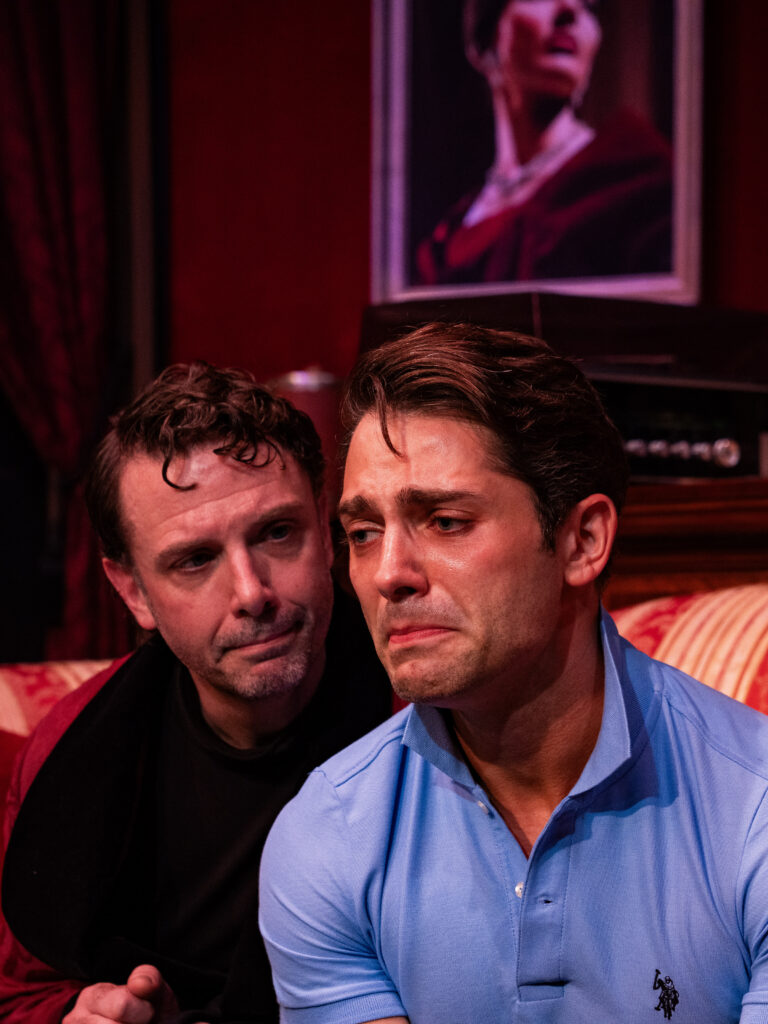
Michael Raver as Stephen, Timothy Dunn as Mendy in the Bridge Street Theatre production of Terrence McNally’s “The Lisbon Traviata”, directed and designed by John Sowle. Photo by Ned’s Event Photography. 
Michael Raver as Stephen, Timothy Dunn as Mendy in the Bridge Street Theatre production of Terrence McNally’s “The Lisbon Traviata”, directed and designed by John Sowle. Photo by Ned’s Event Photography. 
Michael Raver as Stephen, M. Damon Hawkins as Paul in the Bridge Street Theatre production of Terrence McNally’s “The Lisbon Traviata”, directed and designed by John Sowle. Photo by Ned’s Event Photography. 
Michael Raver as Stephen, Timothy Dunn as Mendy in the Bridge Street Theatre production of Terrence McNally’s “The Lisbon Traviata”, directed and designed by John Sowle. Photo by Ned’s Event Photography. 
Michael Raver as Stephen, Timothy Dunn as Mendy in the Bridge Street Theatre production of Terrence McNally’s “The Lisbon Traviata”, directed and designed by John Sowle. Photo by Ned’s Event Photography. 
Michael Raver as Stephen, Jeff Brackett as Mike in the Bridge Street Theatre production of Terrence McNally’s “The Lisbon Traviata”, directed and designed by John Sowle. Photo by Ned’s Event Photography. 
Jeff Brackett as Mike, Michael Raver as Stephen in the Bridge Street Theatre production of Terrence McNally’s “The Lisbon Traviata”, directed and designed by John Sowle. Photo by Ned’s Event Photography. 
M. Damon Hawkins as Paul, Michael Raver as Stephen in the Bridge Street Theatre production of Terrence McNally’s “The Lisbon Traviata”, directed and designed by John Sowle. Photo by Ned’s Event Photography. 
Timothy Dunn as Mendy, Michael Raver as Stephen in the Bridge Street Theatre production of Terrence McNally’s “The Lisbon Traviata”, directed and designed by John Sowle. Photo by Ned’s Event Photography. 
Jeff Brackett as Mike, Michael Raver as Stephen in the Bridge Street Theatre production of Terrence McNally’s “The Lisbon Traviata”, directed and designed by John Sowle. Photo by Ned’s Event Photography. 
Michael Raver as Stephen, Jeff Brackett as Mike in the Bridge Street Theatre production of Terrence McNally’s “The Lisbon Traviata”, directed and designed by John Sowle. Photo by Ned’s Event Photography. 
Set for Act I of the Bridge Street Theatre production of Terrence McNally’s “The Lisbon Traviata”, directed and designed by John Sowle. Photo by Steven Patterson. 
Set for Act II of the Bridge Street Theatre production of Terrence McNally’s “The Lisbon Traviata”, directed and designed by John Sowle. Photo by Steven Patterson. 
Director Sowle works with a fine cast, virtually directing two different plays in the two acts. Notable is Dunn as Mendy, inhabiting a role that Nathan Lane originated. We feel his needs, obsessions and frustrations, and easily laugh with him. While his flamboyant role is somewhat stereotypic, Dunn makes it work.
Raver, as Stephen, shows the most range as he goes from confident, yet anxious, to increasingly loud, aggressive and desperate. He develops believably and we feel for him as we try to understand his choices. His final choice, however (without giving away any spoilers), is reminiscent of La Traviata and far less easy to justify.
Brackett gives a less convincing portrayal of Mike, the doctor Stephen fears losing. During an emotional scene describing why their relationship no longer brings him pleasure, I struggle to feel Stephen’s pain and loss.
Hawkins’ striking physical presence, yet quiet demeanor, easily makes him an attractive and appealing character. One wonders why he does not run for the hills in the midst of the insane drama between Stephen and Mike. He does, however, leave the scene.
Sowle in his dual role as set designer creates two impressive dichotomous sets. Mendy’s home in deep reds, with a prominent portrait of Maria Callas and classic, traditional furniture easily matches Mendy’s taste and style. Multiple albums are in piles around the room. Stephen and Mike’s apartment in neutral greys with modern chairs, a sofa, and contemporary built-ins to hold records and cds reflect the comfortable financial status of a physician and Stephen’s position as a successful editor.
Costume Designer, Michelle Rogers, outfits each character to highlight their strong physiques, while dressing Mendy in a somewhat predictable smoking jacket, also in red which matches his apartment.
Despite the impressive performances, sitting through The Lisbon Traviata is a challenge. Friends who accompanied me felt sure the play was over after the first act. While the second act renews my interest, the interminable pleading and fighting finds me hoping for the play’s conclusion. Having seen and appreciated many other McNally plays, I did not expect this feeling. Maybe I need to see an opera.
Bridge Street Theatre presents Terrence McNally’s “The Lisbon Traviata”, directed and designed by John Sowle, from August 6-16, 2026, at 44 West Bridge Street
Catskill, NY. CAST: Timothy Dunn as Mendy, Michael Raver as Stephen, Jeff Brackett as Mike, M. Damon Hawkins as Paul. CREATIVE TEAM: Costumes by Michelle Rogers; Assistant Director Steven Patterson; Fight Director Carson Borst; Stage Manager Stacey Dobos.
Performances are Thursdays, Fridays, and Saturdays at 7:00pm and Sundays at 2:00pm. Tickets are $30 for adults and $25 for students. For information and reservations, visit bridgest.org/.