

by Macey Levin
At the first moment of Samuel Beckett‘s Happy Days at Bridge Street Theatre in Catskill, New York, the curtain opens accompanied by the sound of clanking metal bars suggesting, perhaps, we are entering a jail of some sort. Indeed, we are.
The play is an example of the “Theatre of the Absurd” made popular in the late nineteen 50’s, whose proponents also include Eugene Ionesco, (Rhinoceros) Jean Genet (The Maids), Harold Pinter (The Homecoming) and others. They shared the philosophy that mankind’s collective illusion, that existence can be controlled, eventually leads to a discovery of life as bleak and ridiculous.
Winnie (Roxanne Fay) is waist deep in the top of a towering mound. Much of her talk is bright and reminiscent of the past. Next to her is a black bag full of various items – a toothbrush with very little remaining, toothpaste, a bottle of medicine which she consumes, a music box and, amongst yet others, a revolver. She often refers to happier days and also repeatedly uses the phrase “…in the old style” treasuring what existed before. As she prattles, using trite and garbled bowdlerized quotes from classical litertature, she sometimes directs a question or comment to her husband Willie (Steven Patterson) who is in a hole near the base of the mound. While reading a newspaper, he responds to her with taciturn grunts or single words and is seldom seen. A bell is occasionally heard, perhaps tolling the hours of the day, yet its meaning defies context.
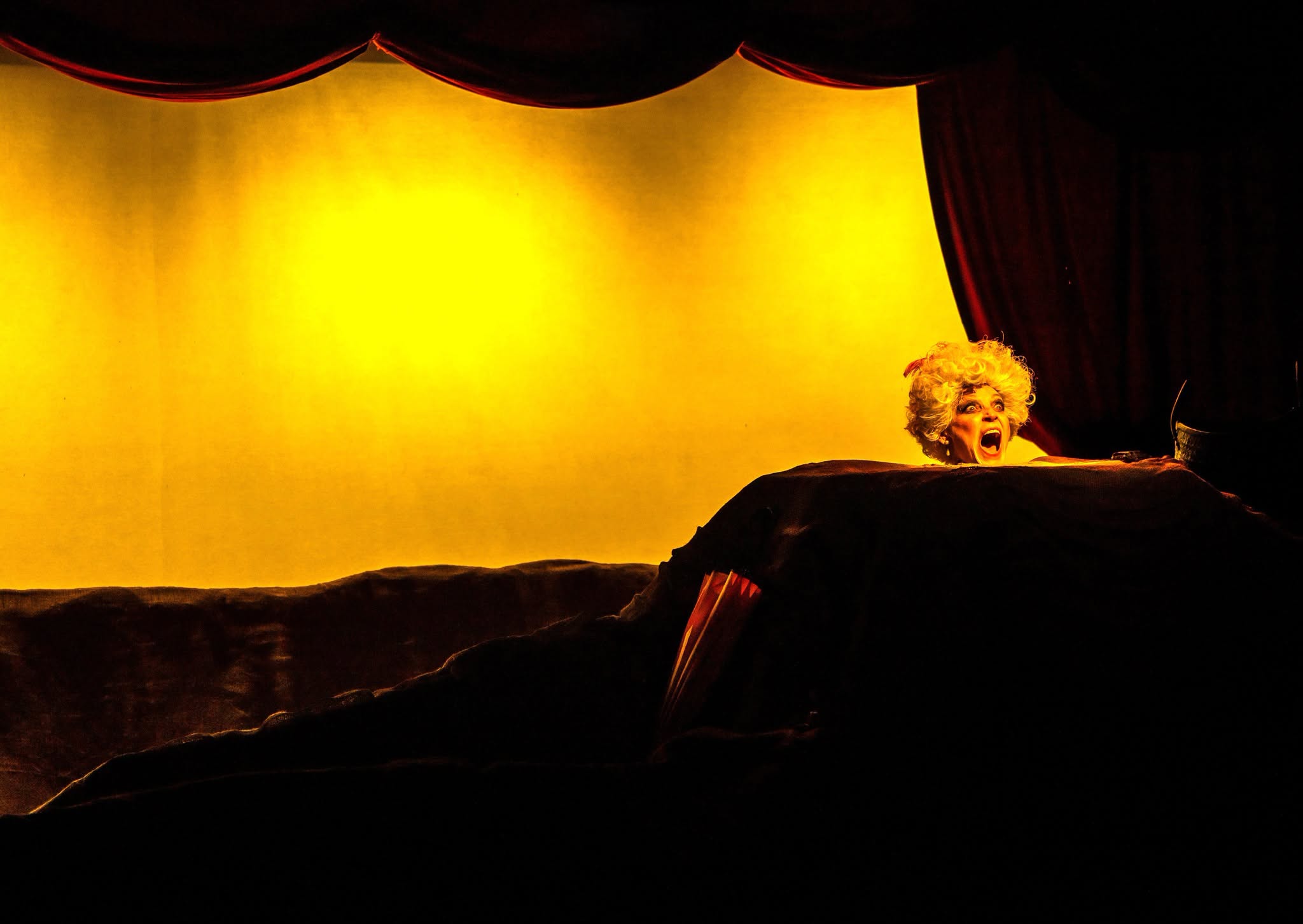
In the second act all that is seen is Winnie’s head. She no longer has the vivacity of the first act. The tone of this act is much darker. We see all of Willie for a brief moment. He is incapable of intelligent conversation and, though nicely dressed, appears to be beaten-down. Time seems to have slowed for them and the conclusion hovers outside of their reality.

Roxanne Fay as Winnie in the Bridge Street Theatre production of Samuel Beckett’s “Happy Days”, directed by Matthew Earnest. Photo: Ned Averill-Snell of Ned’s Event Photography. 
Roxanne Fay as Winnie in the Bridge Street Theatre production of Samuel Beckett’s “Happy Days”, directed by Matthew Earnest. 
Roxanne Fay as Winnie in the Bridge Street Theatre production of Samuel Beckett’s “Happy Days”, directed by Matthew Earnest. Photo: Ned Averill-Snell of Ned’s Event Photography. 
Steven Patterson as Willie and Roxanne Fay as Winnie in the Bridge Street Theatre production of Samuel Beckett’s “Happy Days”, directed by Matthew Earnest. Photo: Ned Averill-Snell of Ned’s Event Photography. 
Steven Patterson as Willie and Roxanne Fay as Winnie in the Bridge Street Theatre production of Samuel Beckett’s “Happy Days”, directed by Matthew Earnest. Photo: Ned Averill-Snell of Ned’s Event Photography. 
Roxanne Fay as Winnie in the Bridge Street Theatre production of Samuel Beckett’s “Happy Days”, directed by Matthew Earnest. 
Roxanne Fay as Winnie in the Bridge Street Theatre production of Samuel Beckett’s “Happy Days”, directed by Matthew Earnest. Photo: William Bezek. 
Rehearsal shot of Roxanne Fay as Winnie in the Bridge Street Theatre production of Samuel Beckett’s “Happy Days”, directed by Matthew Earnest. 
Rehearsal shot of Steven Patterson as Willie and Roxanne Fay as Winnie in the Bridge Street Theatre production of Samuel Beckett’s “Happy Days”, directed by Matthew Earnest. 
Set by for William Bezek the Bridge Street Theatre production of Samuel Beckett’s “Happy Days”, directed by Matthew Earnest. 
Scenic rendering by for William Bezek the Bridge Street Theatre production of Samuel Beckett’s “Happy Days”, directed by Matthew Earnest. 
Beckett’s observations seem to be about the end of life or its futility in the actual living of it. Winnie and Willie are in a place that does not allow joy. She is literally shrinking away but is not gone. There is little that either one of them can do to alleviate their situation as they flounder in the midst of nothingness. They are victimized by time and their own humanity.
Fay is onstage throughout the entire play. She paints word-pictures that offer insight into Winnie’s world, times and character. Her delivery and vocal dexterity bring Winnie to a full life. In the darker moments of the second act she elicits more than sympathy; we empathize with her anxiety as her grasp of the situation slips away. Fay’s performance is a tour de force.
Though Patterson is hardly seen, his mostly monosyllabic lines ring true. In the first act only his hands and the back of his head appear. Act two we see the whole man. In just a few minutes he shows us what kind of person he is as Winnie’s counterpart in this existential commentary on the tragic/comedic observation of life.
Matthew Earnest has directed the play with a sure hand, delicately bringing Winnie and Willie to life. Though physically limited by the set, they sound and look like real people caught in the dark time of life. He also designed the sound, selecting music which adds to the ambiguity of the characters’ dilemma. Will Bezek’s set of the huge colorless mound surrounded by some large rocks depicts the hopelessness of the characters and the detritus of the human situation. As the costume designer, he has dressed Winnie and Willie in clothes that would seem to reflect their past lives or at least the personas they imagine. John Sowle’s lighting complements the tone of each act adding to the effectiveness of the production.
Bridge Street theater never shies away from presenting challenging plays to their loyal audience. If you have never ventured into this art form, their production of Happy Days is an outstanding visit to the surreal concept of our lives as illogical and hopeless. However it will make you laugh, discuss the symbolism and argue about the meaning of the gun. The acting is divine, and the production celebrates the mystery of an often incomprensible world.
Happy Days by Samuel Beckett: Director and Sound Designer: Mathew Earnest; Cast: Roxanne Fay (Winnie) Steven Patterson (Willie); Set and Costume Designer: Will Bezek; Lighting Designer: John Sowle; Production Stage Manager: Timothy Dunn; Running Time: one hour, thirty minutes, one intermission; September 3 – 13, 2026; Bridge Street Theatre, 45 Bridge Street, Catskill, NY.; For tickets: 518-943-3894; email Contact@BridgeSt.org