

by Barbara Waldinger
“I started inventing my version of Willy Loman, who has a daughter, a wife and his own philosophies and missed opportunities”—playwright Emily Feldman interviewed by Garrett Anderson in May, 2024. Miller’s play, Death of a Salesman, and the MeToo movement are the sparks that ignited Feldman’s play, The Best We Could (a family tragedy), a Harbinger Theatre production now playing at the Sand Lake Center for the Arts in Averill Park, NY, skillfully directed by Chris Foster.
This is Harbinger Theatre’s twenty-third production in five seasons and sixth collaboration with the Sand Lake Center for the Arts. The positive reviews of Feldman’s play, which premiered off-Broadway at the Manhattan Theatre Club in March, 2023, caught the attention of Patrick White, co-founder of Harbinger Theatre, and The Best We Could (a family tragedy) was selected as the final play of their 2026 season.
The script received the Edgerton Foundation New Play Award and the Tow Foundation Playwrights Residency. Feldman’s career has been filled with honors: the Kennedy Center’s Paula Vogel Playwriting Award for her play The Oracle; a MacDowell Fellowship; she was a Lila Acheson Wallace American Playwriting Fellow at The Juilliard School, and has been offered commissions from Manhattan Theatre Club, Playwrights Horizons and Arena Stage.
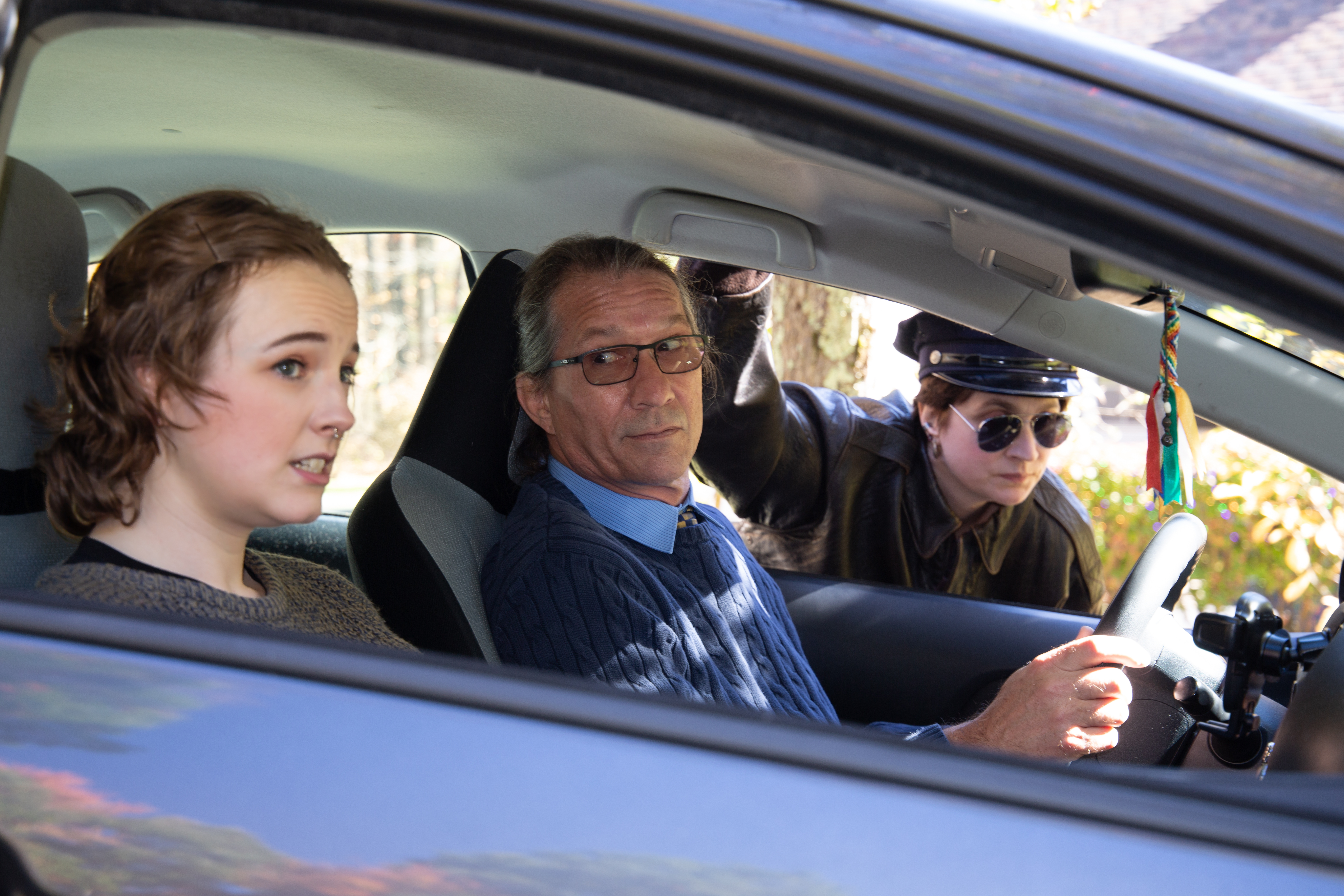
The Best We Could (a family tragedy) has an unusual structure. It is about a thirty-six-year-old daughter who accompanies her father on a road trip to adopt a rescue dog. But every scene is directed by a character called Maps, who seems to map their journey and the events that happen along the way. In Anderson’s interview with the playwright, Feldman explains: “I completely stole this idea from Thornton Wilder. I always wanted to write a play with a stage manager character like Wilder created in Our Town and The Happy Journey to Trenton and Camden.” Maps, played expertly (and forcefully) by Tanya Gorlow, runs the show as a sort of Acting class, letting the actors know what has to happen in each scene—except instead of improvising the lines they are scripted. One major difference from Wilder’s stage manager is that Maps also excels in playing several characters, adding costume pieces from an upstage coatrack to cover her all black attire. Thanks to Lisa Morgan for those clever and amusing costumes.

Harbinger Theatre’s production of Emily Feldman’s “The Best We Could (a family tragedy” directed by Chris Foster. Photo: Andrew Elder for Best Frame Forward. 
Harbinger Theatre’s production of Emily Feldman’s “The Best We Could (a family tragedy” directed by Chris Foster. Photo: Andrew Elder for Best Frame Forward. 
Harbinger Theatre’s production of Emily Feldman’s “The Best We Could (a family tragedy” directed by Chris Foster. Photo: Andrew Elder for Best Frame Forward. 
Harbinger Theatre’s production of Emily Feldman’s “The Best We Could (a family tragedy” directed by Chris Foster. Photo: Andrew Elder for Best Frame Forward. 
Harbinger Theatre’s production of Emily Feldman’s “The Best We Could (a family tragedy” directed by Chris Foster. Photo: Andrew Elder for Best Frame Forward. 
Harbinger Theatre’s production of Emily Feldman’s “The Best We Could (a family tragedy” directed by Chris Foster. Photo: Andrew Elder for Best Frame Forward. 
Harbinger Theatre’s production of Emily Feldman’s “The Best We Could (a family tragedy” directed by Chris Foster. Photo: Andrew Elder for Best Frame Forward. 
Harbinger Theatre’s production of Emily Feldman’s “The Best We Could (a family tragedy” directed by Chris Foster. Photo: Andrew Elder for Best Frame Forward. 
Harbinger Theatre’s production of Emily Feldman’s “The Best We Could (a family tragedy” directed by Chris Foster. Photo: Andrew Elder for Best Frame Forward. 
Harbinger Theatre’s production of Emily Feldman’s “The Best We Could (a family tragedy” directed by Chris Foster. Photo: Andrew Elder for Best Frame Forward. 
Harbinger Theatre’s production of Emily Feldman’s “The Best We Could (a family tragedy” directed by Chris Foster. Photo: Andrew Elder for Best Frame Forward. 
Harbinger Theatre’s production of Emily Feldman’s “The Best We Could (a family tragedy” directed by Chris Foster. Photo: Andrew Elder for Best Frame Forward. 
Harbinger Theatre’s production of Emily Feldman’s “The Best We Could (a family tragedy” directed by Chris Foster. Photo: Andrew Elder for Best Frame Forward. 
Harbinger Theatre’s production of Emily Feldman’s “The Best We Could (a family tragedy” directed by Chris Foster. Photo: Andrew Elder for Best Frame Forward. 
There is no actual set besides the coatrack, a few round rugs, and a chair for each actor. Feldman: “I like to play with the simplest tools of the theatre, like language, bodies and empty space. . . a bare stage is all you need.” She leaves it to the creativity of the production teams to fill in the blanks. The use of lighting (David Caso and Cheryl Hussey) and sound (Stephen Wilson) go a long way towards creating the locations and mood of the play.
The movement of the actors and their chairs throughout this production is astonishing. Seeing no choreographer listed in the program, we must assume that director Chris Foster is the movement specialist. And what a job he has done! With the fluidity of a dance, the actors move to different positions with or without their chairs within and between scenes, sometimes facing each other across the width of the wide stage, sometimes facing the audience and at other times facing upstage with their backs to the audience.
Although the play is subtitled “a family tragedy” most of the play is filled with humor. Feldman: “I wanted to see what would happen if I wrote a tragedy that made me laugh.” The engaged audience can be heard laughing throughout, yet they must be wondering about that title. Before the ninety-three intermissionless minutes are over, they will understand and react audibly.
The actors create distinct, identifiable characters. There are struggles between the parents, Peg (the always surprising Kathleen Carey) and Lou (Robert Francis Forgett) and their estranged daughter Ella (Tiffany McWilliams). Rounding out the cast is Marc (Don Smirlock), Lou’s friend and former co-worker at a biomedical research laboratory.
Carey, playing the self-centered, wedding planner Peg, is often cruel and heartless. The actress, a multiple Berkie award winner who has been performing for over thirty years, does not minimize the terrible things she says but delivers her insults with equanimity and no regrets. Her Peg is a complex woman: comic, mean, and yet able to elicit our sympathy when she is suffering.
It is Forgett’s central performance as Lou that is the most puzzling. His line delivery doesn’t feel human; he plays a scientist who hasn’t worked in years, nagging his successful friend Marc to find him a job, claiming that every paper he writes is his best, childlike in his admiration of all the sights he visits with his daughter, unable to accept his or her failures and all delivered in the same tone of voice, with multiple repetitions. Speaking with the actor and director revealed that he is mirroring Loman, a man from a different time who cannot face reality, who substitutes a fantasy life because he simply is not equipped to live in the world around him.
McWilliams’ Ella lives on her own, cannot deal with her family, is a college educated philosophy and art major who quit every job she ever had, loves ballet but quit dancing and now teaches yoga in a rehab center. Her lesbian relationship ended, she’s alone and miserable. Yet she would do anything for her Dad, even leaving her current job for two weeks to drive him cross country to find him a dog to love. She captures the many levels of this unhappy, difficult woman.
Don Smirlock’s Marc is caught between his friendship with Peg and Lou and Lou’s constant entreaties to help him find a job.
Harbinger Theatre’s production of The Best We Could (a family tragedy) runs the gamut of emotions, involving us deeply in the lives of these characters and their attempts to cope with the vicissitudes of life. It is an unusual play, well worth seeing.
THE BEST WE COULD (a family tragedy) runs from November 13-22 on Fridays and Saturdays at 7:30 and Sundays at 2:00 at Sand Lake Center for the Arts at 2880 NY-43, Averill Park, New York. For tickets go to Harbinger Theatre’s website. The cost is $15.
Harbinger Theatre presents THE BEST WE COULD (a family tragedy) by Emily Feldman. Director: Chris Foster. Cast: Tiffany McWilliams (Ella); Kathleen Carey (Peg); Robert Francis Forgett (Lou); Daniel Smirlock (Marc); Tanya Gorlow (Maps). Sound Design: Stephen Wilson; Light Design: David Caso and Cheryl Hussey; Costume Design: Lisa Morgan. House Manager: Marjorie Geiger. Production Stage Manager: Kal Muste.
The production runs 93 minutes with no intermission.